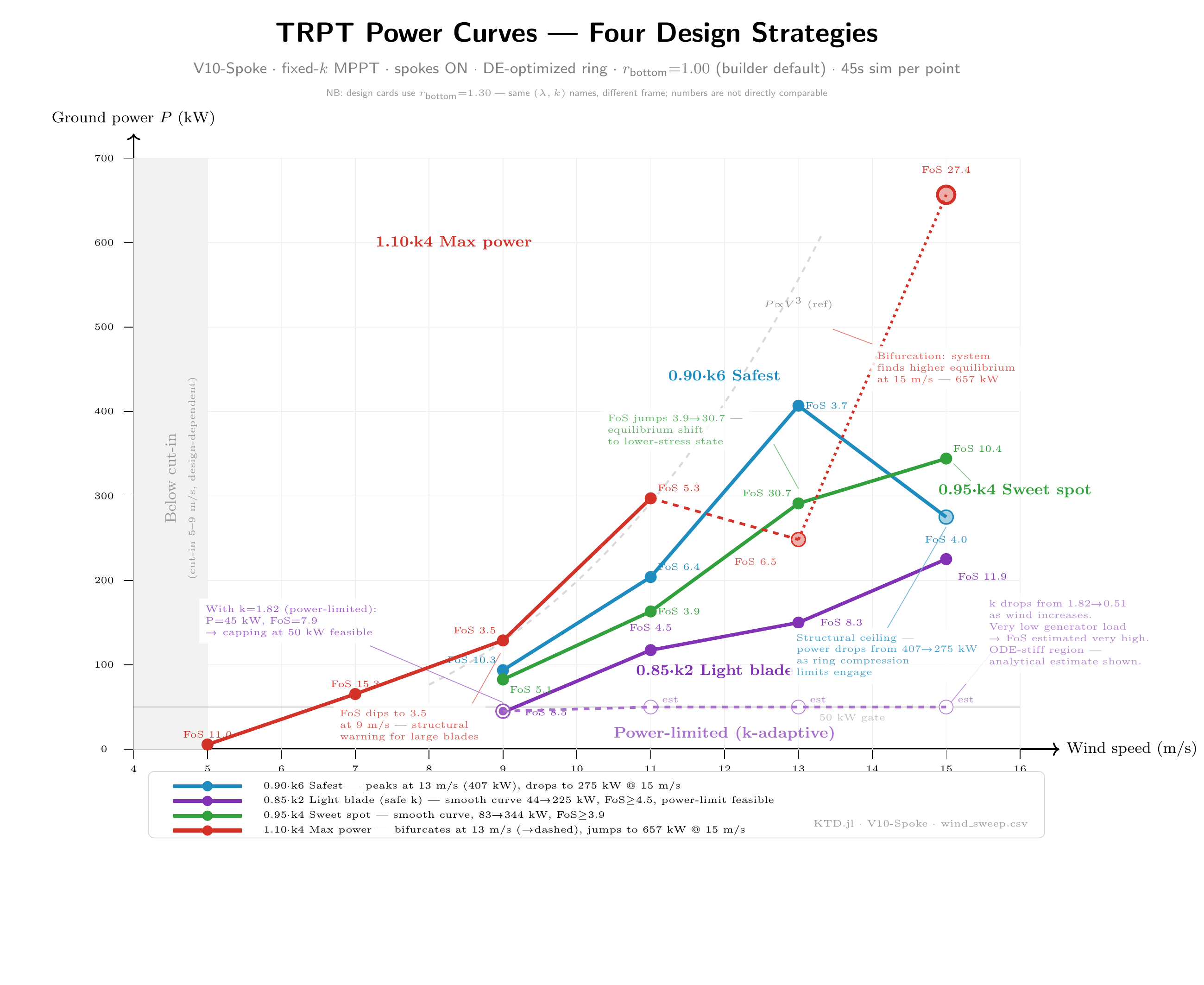
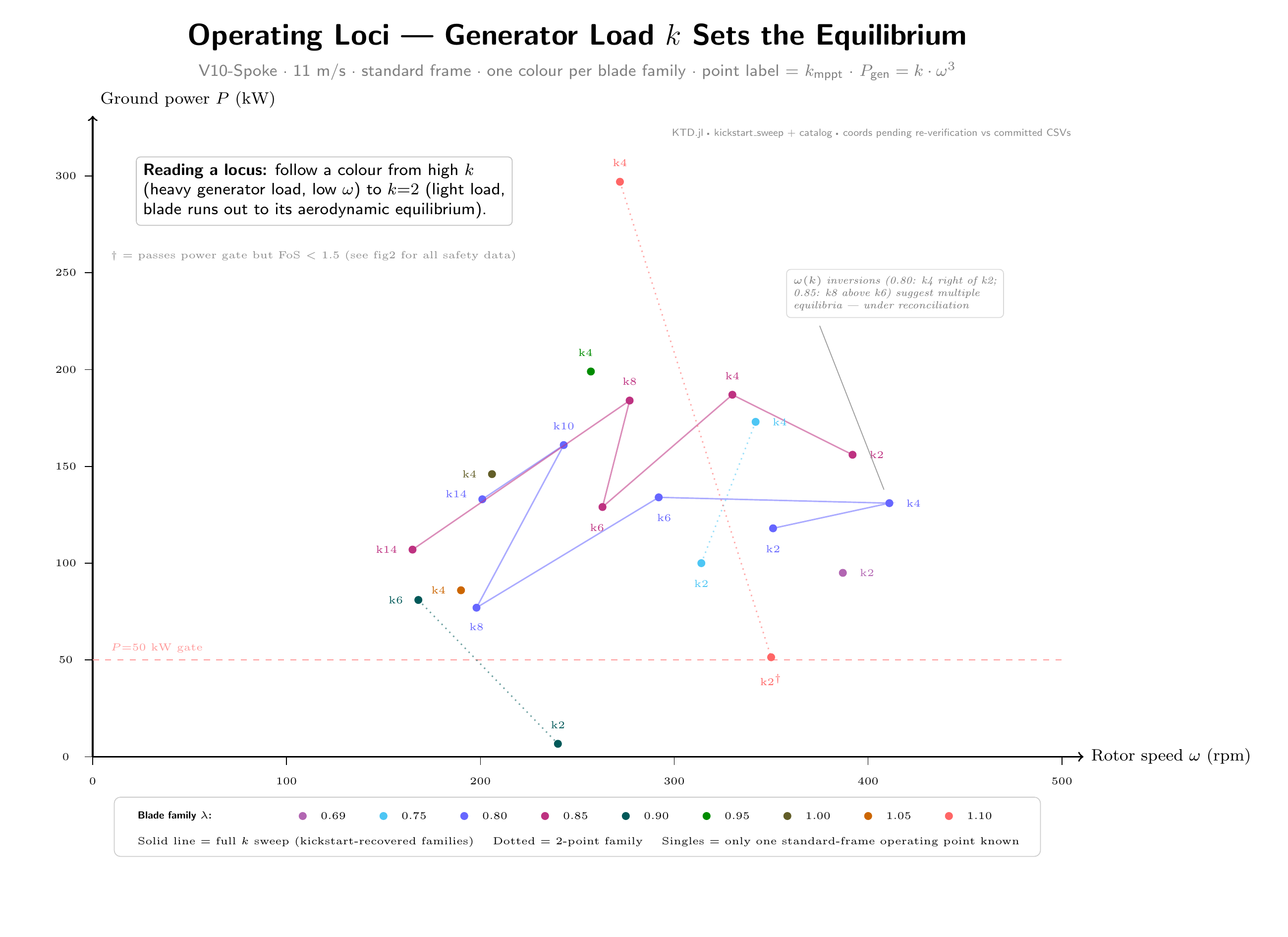
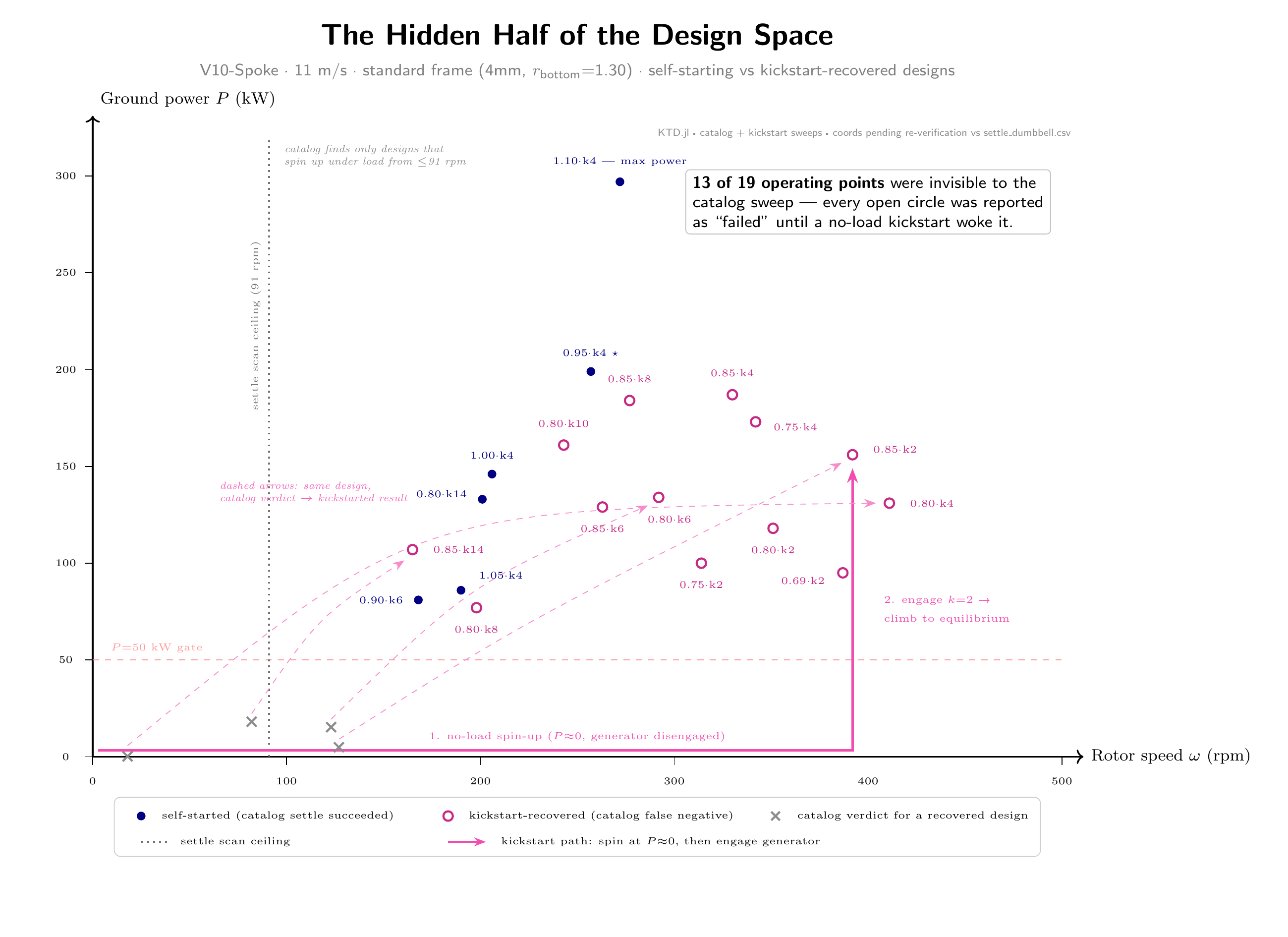
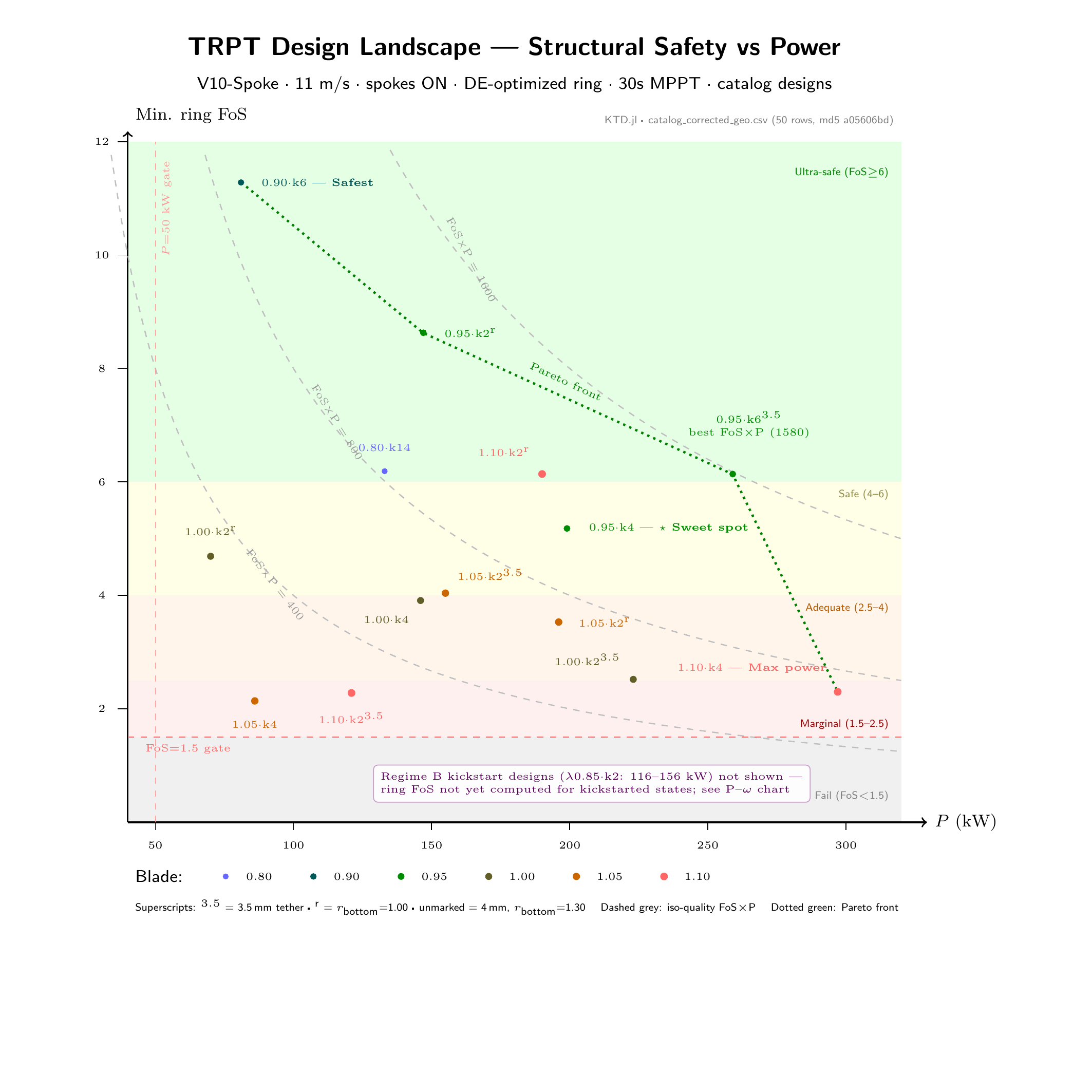
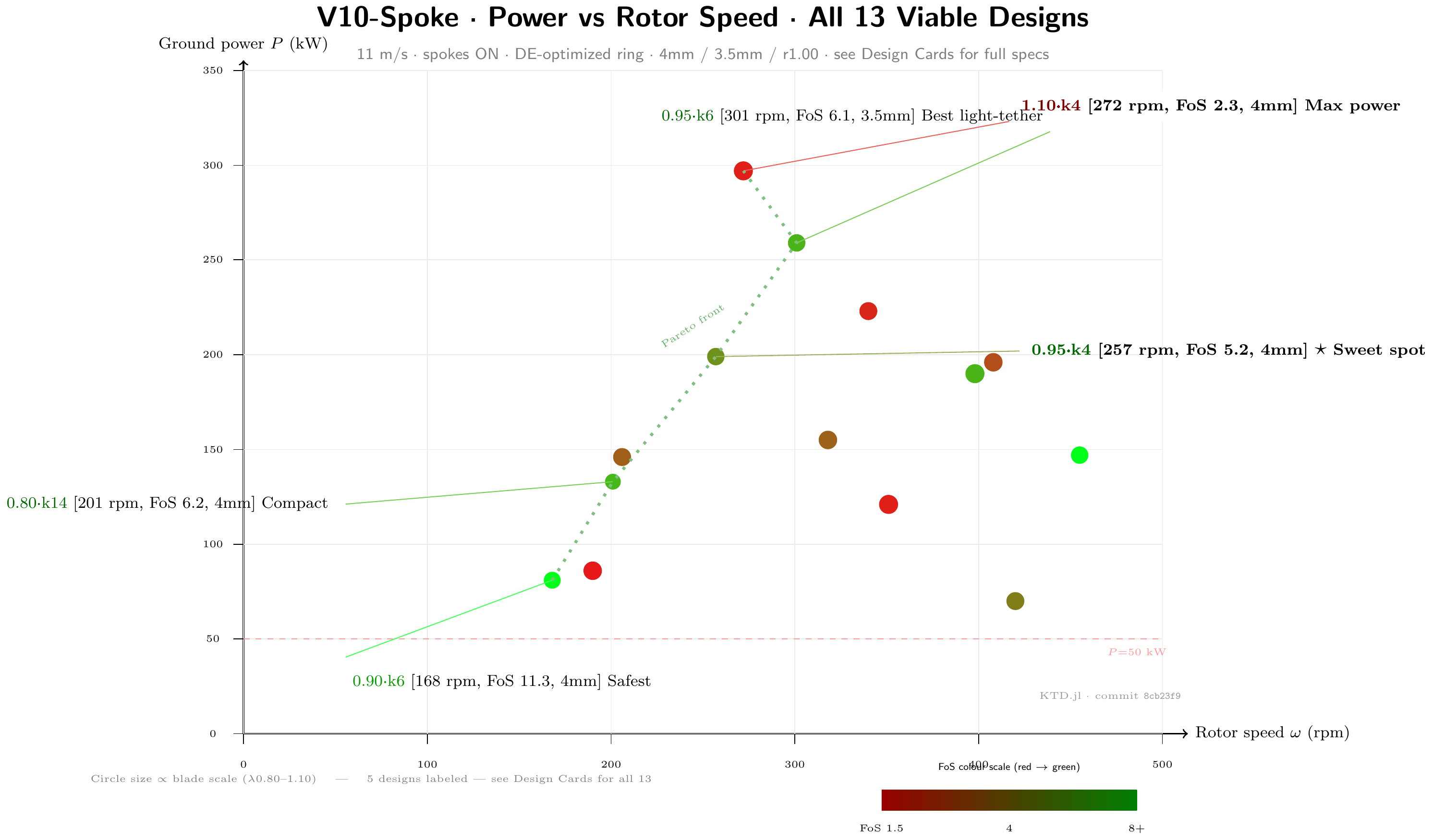
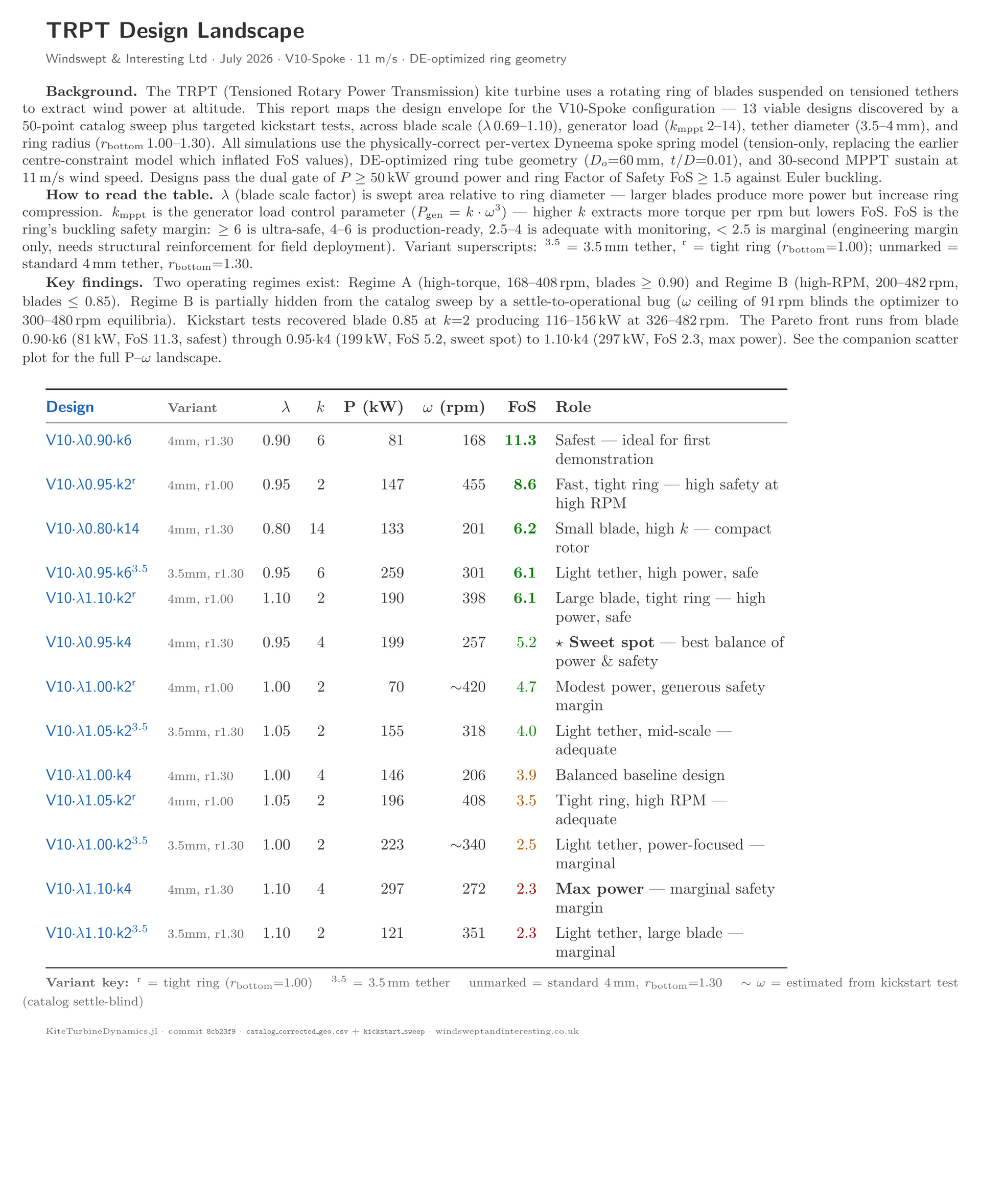
Note : These are all reliant on an as yet unproven coaxial autogyro stacking method replacing the old lift kite
Now also spotted a flaw in the codebase where stale documentation lead to a poor analysis of FoS.
Also these are totally upper bounds numbers. There’s a red flag been raised on the momentum calculations for the expansion rings.
Edited overnight. The model now respects momentum theory throughout. Much more reasonable power outputs
In the section of the video on mass scaling in accordance with square-cube law, the exponent 3/2 is applied and works for SkySails’ flexible kites. The exponent 3 can be applied when the size is considered instead of the surface area.
About Makani, I calculated an exponent of 1.582 (based on surface area), or 3.164 (based on size).
About Ampyx, the exponent becomes 1.88 (based on surface area), or 3.76 (based on size).
In other words, flexible wings scale cubically (about the mass), and rigid wings beyond that.
Traditional wind turbines scale much less, and on top of that, they don’t need to fly.
I couldn’t find the mass (8 kg) of the 30 m² SkySails prototype, nor that (120 kg) of the 180 m² PN-14.
Besides, I weighed two of my old 4-line Buster power kites: the 4 m² kite alone weighed 0.795 kg, and the 9 m² kite alone weighed 1.72 kg, which is a mass scaling slightly less than the surface area, so slightly less than squared.
There are references everywhere, and they are all different. It’s a ‘reasonable’ estimate (in video), since there’s no Skysails published data.
Some sources →
30m² kite → AWE Book, U Ahrens et al (2013) : page 431 plus Deformation and Aerodynamic Performance of a Ram Air Kite, A de Wachter (2008) page 26
PN-14 kite → AWE Book, U Ahrens et al (2013) : page 554 & 561 plus
Analysis of the Maximum Efficiency of Kite-Power Systems, S Costello et al (2015) Table I
Thanks for these references. Unfortunately, I only have access to two publications.
In page 26, Aart de Wachter does not mention (for what I saw) the 30 m² kite with a mass of 8 kg, but Flysurfer Pulse2 6.0, 6 m², with a mass of 1.6 kg, for a normal wind range of 6.5 – 21 m/s.
“Analysis of the maximum efficiency of kite-power systems” (S. Costello), table 1, mentions SkySails’ kite of 400 m² with a mass of 320 kg.
400/6 = 66.66…
320/1.6 = 200.
The exponent is 1.262 (or 2.524 if the size is the basis).