Perhaps some Makani’s videos could provide some clues.
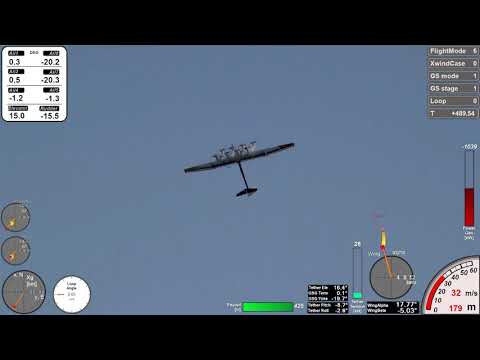
At 14:34: wind speed (in the left) aloft: 12.7 m/s. M600’s speed: 40 to 60 m/s. Tension on the tether: 45 to 125 kN. Power: -250 kW (negative power) to 750 kW (positive power).
I don’t remember exactly M600’ surface area, but with its span of 28 m, an area of 35 m² seems to be plausible. Its lift coefficient (Cl) seems to be only about 0.65. Average M600’ speed: 50 m/s.
Average tether tension force: about 80 kN. Lift-to-drag ratio (glide number) is noted as: (L/D). Rough calculation:
35 x 1.2 (air density) / 2 x 12.7² x 0.75 (cosine² for an average elevation angle of 30 degrees) x (2/3)² (M600’ velocity² with turbines in relation to M600’ velocity² without turbines) = 1.129 kN: so, 80 (kN) / 1.129 (kN) would provide 0.65 (L/D)² (without turbines) = 70.86, leading to (L/D)² = 109, so (L/D) being about 10.44 (without turbines).
For a rigid wing, it is a slightly lower value than expected 12 (without turbines) by taking account of tether drag. And if the area and the Cl are higher, the (L/D) would be still lower for a same tether tension of about 80 kN. We can note that 50 m/s (M600’ average speed) / 12.7 m/s (wind speed aloft) lead to a (L/D) value of about 4, which is a far lower value, but requiring correction due to the circular trajectory in relation to a supposed straight trajectory.
We can therefore think (without yet having formal proof because of unknows) that in connection with the losses due to the variable cosine according to the position in the flight window, we have the losses by speed variations that result from the consequences of variations in the cosine, exacerbated by the mass aggravating the force of gravity, so kinetic energy issues towards the ground.