Interesting link thks
There a step before that @Windy_Skies. We need to deliver the product to first early adopter in August. It s a real challenges as development process is still on and we have a 4 month delay on electronics cards.
Then we will have the feedback of those users and there will probably some updates to be made. Kitewinder will assist those customers in this process. Then the product will be mature enough to be tested more largely, for example as you propose.
But as you can see there is steps before that. At the moment we are on fb and really active, we have a cumulative 1M views approx which is not bad, around 50K per videos for example. We also have Btoc sales on its way, this you will eard of in our newsletters, LinkedIn, fb. We also have the active website and get customers trough it, first one 3 days ago, it works! Here is our marketing strategy at the moment
Kiwee beta testing at no cost to the tester was presumed under this 2017 offer-
“Be one of the 20 beta testers worldwide ! Kitewinder will release 20 units of the Kiwee One in September for beta testing. You’d like to be the first to try the Kiwee One and would like to share your experience ?”
KiteLab’s circle applied to do in-depth comparative Kiwee testing against its similar predecessor, KiteMotor1, but was denied.
Free Kiwee trials funded by one of the high-capital venture players could have occurred if the AWE community was more sharing.
Impressive numbers! And that looks like a good strategy. My comment was mostly a reaction to the bit I quoted.
@kitefreak we didn’t delivered because product was not mature enough. Too risky.
So it was not denied, just canceled
As you can imagine, Kitemill is not abundant with funding, I expect the other actors arent either. What value would it be using time and money testing Kiwee? Sorry if were all being selfish here, but though we support Kitewinder fully, we must focus our resources on our own path.
What you describe could perhaps be valid for a university or a utility company
“Canceled” effectively means “denied”. When the Kiwee becomes “mature enough” for the beta testing intended, that will contribute both to the design’s fitness and public AWE knowledge. No beta tester has a deeper knowledge of Kitewinder’s general AWES architecture and operation than KiteLab’s circle.
Tallak, the idea would be for poor KiteMill to also receive a free Kiwee (if it saw any value in testing it). GoogleX, having spent ~300M USD in AWE, could have funded free conferences, 100 evaluation Kiwees, and much more; without strain. kPower finds value testing everything it can, as its R&D ethos. We intend to productively test the Kiwee when circumstances allow.
This old discussion, which could continue 5 years later, does not allow us to decide between the difficulty of finding a market and the relevance of Kiwee as it is presented.
Now we know the story of Kiwee: a quality product with a very good power coefficient for an AWES, in the 100-200 Watt range, and which has been somewhat commercialized.
What we don’t know is what a similar system in the 1000-5000 W range would have produced, and possibly beyond, for a use other than that initially intended, namely something like powering one’s home. Perhaps things would have been still worse.
I have always been a strong proponent of the Kiwee system. See my comments in the “KiweeTwo” listing. The problem with the system is that we have not developed a reliable, autonomous method of launch and land, which in this case applies to the lifter kite only because if the lifter kite is satisfactory launched, the turbine system will automatically be launched with it.
A reliable, autonomous method of launch and land is something useful for fixed AWES, and therefore based on a significant power range.
Kiwee was designed as an object that one takes along when hiking or camping. So an autonomous land and use method was not useful while being too expensive.
I believe that the next phase for Keewee will be an industrial system or a system suitable for small farms in the order of 5-10 KW. This system must have autonomous launch and land capabilities.
See also on
Semi-automatic launch mode described in 6.3 section, page 15.
And, in 6.4 section, page 17:
The KiweeOne can be brought back automatically, semi-automatically or manually. Auto and semi auto modes are only possible in moderate wind. The automatic mode allows KiweeOne to detect a decrease in wind force and rewind the rope belt without any user action. The wind turbine and the kite will then land close to the generator.
@Kitewinder had also intended to develop a 2.5 m in diameter Kiwee version:
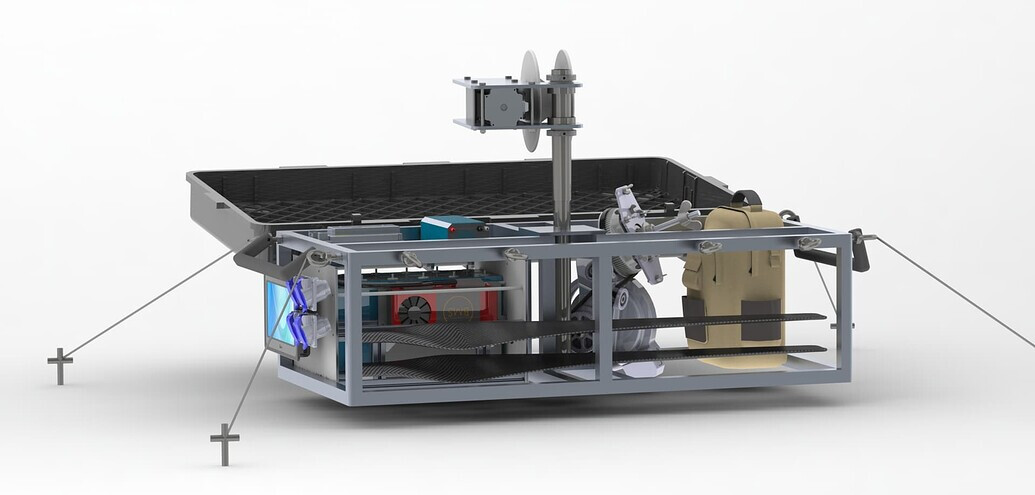
The swept area would have been almost 5 times that of Kiwee, or almost 5 m², leading to a power of 1 kW instead of 200 W with a wind speed of 10 m/s. It can be deduced that the lifter kite would have increased from about 4 m² to 20 m² without taking account of mass penalty of turbine scaling.
For a 5-10 kW version, the lifter kite would be 100-200 m², assuming the same very good elevation angle. But the wind turbine aloft scales cubic, so a still higher kite area would be required.
I don’t know what could be a reliable method for autonomous takeoff and land. Perhaps using the propeller and the generator as motor to inflate the kite? Not easy, due to the rope-drive transmission.
It can be noted that a kite alone of same area, like a parasail, could produce about as much, certainly in the unfavorable yo-yo (here tether-aligned, not crosswind) mode.
In my scheme proposed in KiweeTwo, I would use two counter-rotating turbines, 2.5 m in diameter. This would give us a power of 2 kW. with a wind speed of 10 m/s. If we can increase the altitude of the turbine system to a location where we obtain 12 m/s wind speed, we would develop 2X1.2X1.2=2.88kW. The size of the lifter kite would be approximately 40 m² and this kite would be aided by an aerodynamic frame around the turbine system, which would increase the lift.
Clearly, the above method does not adequately enable autonomous, launching and or landing. I have developed a complete alternative method which I feel is much more amenable to autonomous operation. In my method shown in KiweeTwo, there is no requirement for a rewind and the cable Drive and Tether are both fully extended laying on the ground in the landing position. The kite is spread over a frame and secured in place by auxiliary lines. During launch, the frame is lifted to a suitable height where the lifter kite catches the wind and continues to lift the turbine system to the required height controlled by the auxiliary lines. For landing, the kite is dragged down by the auxiliary lines and is forced to remain spread open resting on the frame ready for the next launch.
Plan a launch area with no obstacles and with a radius equal to the length of the rope-drive cable + the tether? It’s better to forget it.
It’s an unnecessarily complex and heavy setup that needs to be moved every time the wind direction changes, with the rope-drive cable and the tether. As for automating all that, it’s better not to think about it.
Kiwee works very well with simple turbines.
Counter-rotating turbines seem not to be useful and add cost and weight.
I think that Kiwee in its original state is significantly more appropriate, even though it lacks a comprehensive strategy (not only for the cable but also for the flying equipment) for autonomous takeoff and landing, when industrial AWES are envisaged.
Two turbines means double the power. We need smaller turbines to rotate faster which improves the cable drive performance. Counter rotating turbines neutralize the torque and prevents the whole system from rotating about the tether axis.
This vould mean that the power coefficient (Cp) is doubled for a wind turbine because it would use two counter-rotating rotors instead of a single rotor of same swept area. So the measured power coefficient Cp of 0.35 would be 0.7, so above Betz limit (0.593). It is not possible. At the best, counter-rotating rotors for a turbine could marginally improve the Cp, and at the price of higher weight, cost and complexity.
One more detail: since each of the two rotors turns in the opposite direction, a rope-drive transmission would need to be installed for each of the two rotors.
Kitewinder uses a simple turbine (with only one rotor), and the system does not rotate around the tether axis.
Perhaps the reason is that the (essential) right angle between the hub and the pulley (and the belt connecting them) allows to neutralize the torque (among other useful advantages including simply a correct transmission) by the traction force, a little in the manner of a helicopter tail rotor. Moreover, a sort of weather vane is used, allowing the turbine to be settled in the wind direction.
Conclusion: Kitewinder made a great job on Kiwee, that it is difficult to improve, but easier to make worse.
No, Pierre. I would use two rotors the size that Kitewinder proposed rotating at the same speed, since they are joined by a serpentine cable drive connected to the generator on the ground. See my diagram that I show in KiweeTwo. There is no need for a paddle since the counter-rotating rotors neutralize the torque. There is also no need for a right angle belt drive.
There is no relevant sketches in KiweeTwo - next Kitewinder product.
There are two sketches here:
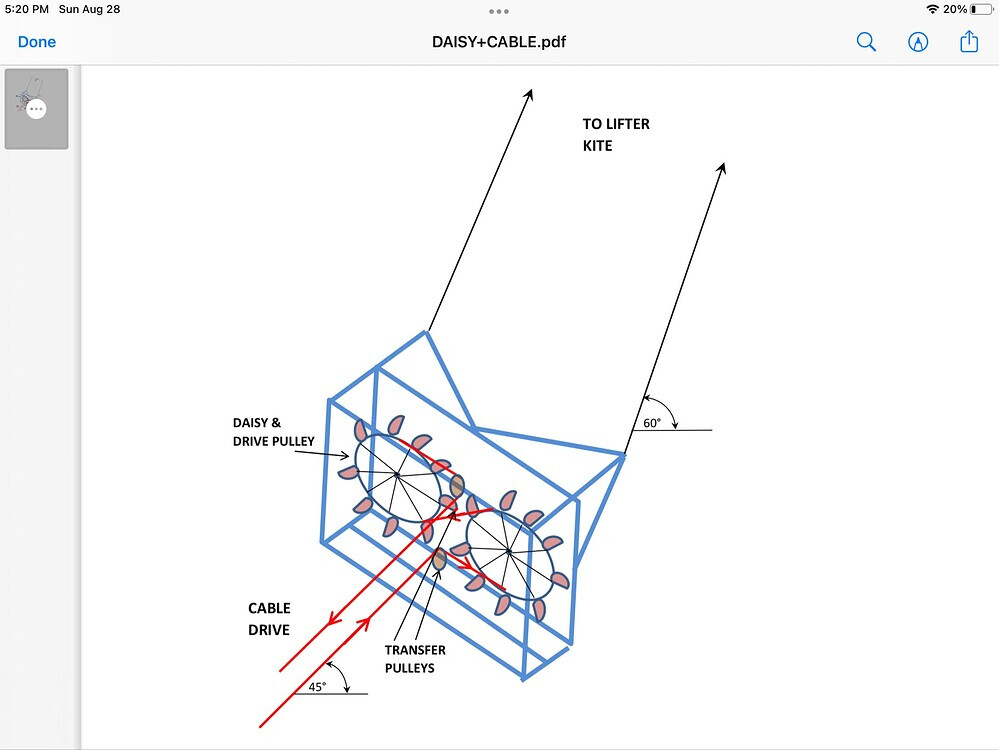
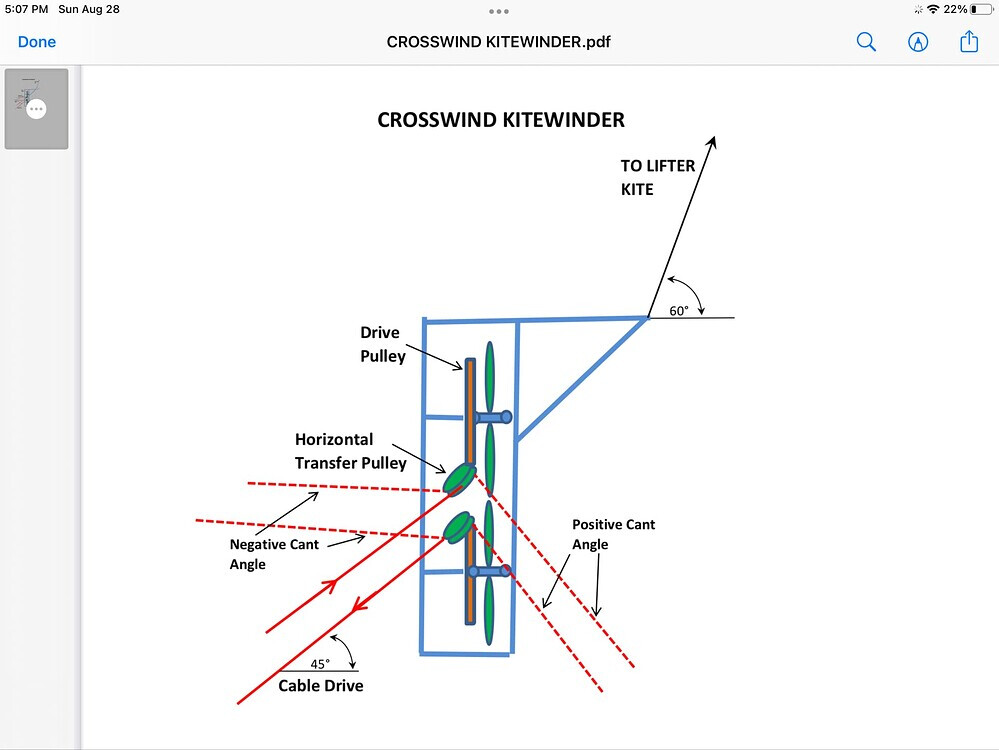
Maybe you are referring to one of the two sketches. My opinion: a large frame is required to hold the two rotors, which adds weight, cost, and complexity. And all this is on the paper. Kiwee is in the real world.
For Kiwee’s rope-drive transmission, the right angle is essential, otherwise the transmission does not work.
Another issue is the tension of the small belt connecting the propeller hub to the right angle pulley: said tension is ensured by the large fixed piece connecting said propeller hub to said right angle pulley, and not directly by the tension of the main rope-drive transmission which would prevent the small belt to rotate, in my opinion.
As another consequence, as Kiwee scales up, the aforementioned fixed part would also become larger and heavier, scaling cubic like a hub of a regular wind turbine. And I don’t know what would be the limit.