Paragraph 12:
The corresponding cumulative annual wind energy from LiDAR measurements, shows that the energy available at 10m of altitude, 104m of altitude and 199m of altitude is respectively 0.5 2.5 and 4.7 MWh per m2 per year.
This leads to a complete change in the way wind speed is measured depending on whether it’s near the ground (with AWES performance then overestimated) or at the ABM balloon altitude.
- Proof-of-concept and on-field results - analysis results of a representative cycle
Some cycles were performed between the 23rd and the 24th of January 2014 and, cycle number 4 is the cycle which will be analyzed in detail:
-The duration of the cycle was of 70 seconds;
- the average cycle height was of 191m;
- the wind at average ABM altitude was of 6,23m/s;
In this case the mechanical power produced at the winch is around 1kW, despite a 0,35kW power consumption to rotate the ABM.
About the same “cycle number 4”, a little further:
The magnitudes of the different powers which influence the HAWE prototype during the analyzed cycle are:
• Average power generation, during the power production phase is 2,4kW;
• Average power spent during the recovery phase is 1,4kW;
• The average power needed to rotate the ABM was of 0,35kW, leading to an actual “net” cycle power of 1,05kW (excluding transition period).
(Note: Transition period is always constant and has a high influence on average power depending on the length of the cycle)
These test values were obtained at 5,4 m/s of average wind speed (this average wind is the true average wind throughout the whole cycle), which is clearly below the “nominal design wind conditions” of 8m/s (while standard wind turbines are designed for nominal operation of 10 to 12m/s of wind speed).
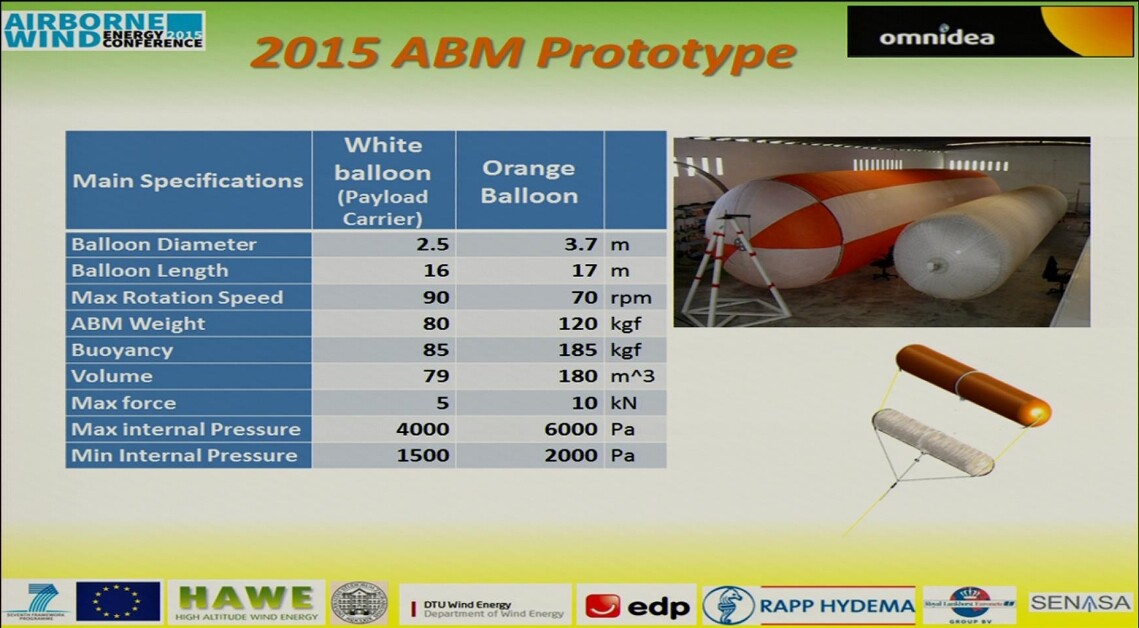
(from the video).
It turns out that the wind speed was measured at the average cycle height of the ABM balloon (191 m) of 16 m wingspan x 2.5 m in diameter (covering 40 m²), and not at 6 m height (table 8 page 44, wind speed of 8 m/s, Mutiny projected area 18 m², 5.19 kW average power Development and validation of a real time pumping kite model | TU Delft Repository) or at mast height (SKS PN-14, average 92 kW, wind speed of 12 m/s, figure 15 Autonomous Airborne Wind Energy Systems: Accomplishments and Challenges | Annual Reviews).
See also Real efficiency of “Crosswind Kite Power” measured at the kite height? and Comparison of the traction force of a static parachute kite and a crosswind kite, both with the same projected surface
As a result, Omnidea’s balloon could be almost as efficient as a flexible crosswind kite at equal wind speed measured at kite height. And we are not even talking about vertical trajectory yet.