It is possible to transmit power with a rope drive. It is more correct to say you can use the capstan equation to design the difference in tension between the slack and taut sides of the rope drive.
You could try to minimize the tension on the slack side, and with that the needed tension on the taut side, with a higher wrap angle. A higher wrap angle would also give you more tether wear however.
The rope drive going at 50 m/s and a tension difference of 2000N, gives a power of 100kW for example. You can decide on an elevation angle, likely around or below 30 degrees. Again, you’d likely want to limit the tension difference to reduce tether wear. I’d be interested to read more on that.
Power transmitted was typically 50 bhp per rope, for ropes working at 5,000 feet / minute.[i][5] Groups of ropes could drive different floors and they also allowed individual ropes to be replaced separately, and without losing all power to a mill floor after a rope breakage.
This gravity-powered chairlift for moving crushed rock material is an old topic in these forums. Maybe it could be made into an uneconomical “energy storage system”, like the cranes lifting concrete blocks, as favored by Dave Santos, who was advocating abandoning electricity, going back to factories powered by leather belts hanging from ceilings, and on the other hand, somehow using chairlifts to generate electricity. More food for untargeted brainstorming, but does it lead anywhere?
Industrial wind turbines are larger than those found in schoolyards or behind someone’s house, with the GE 1. 5-megawatt model being the most common. It consists of 116-ft blades atop a 212-ft tower, a total height of 328 feet, and a vertical airspace of just under an acre. The nacelle alone weighs more than 56 tons, the blade assembly more than 36 tons, and the tower itself weighs roughly 71 tons.
Other features of this (or similar) wind turbine, sweeping 3904 m² (instead of 1963 m²), on
The nacelle weighs only 56 tons, and the rotor weighs 36 tons (instead of 91 tons for the nacelle of ELKRAFT 1 MW (year of construction 1993) and 23.6 tons for the rotor), while the swept area is doubled. The GE model is probably more recent. A rope-drive wind turbine of equal dimensions would certainly be lighter, but not enough (in my opinion) for it to be the obvious choice, especially since the performance and features are not known for such dimensions.
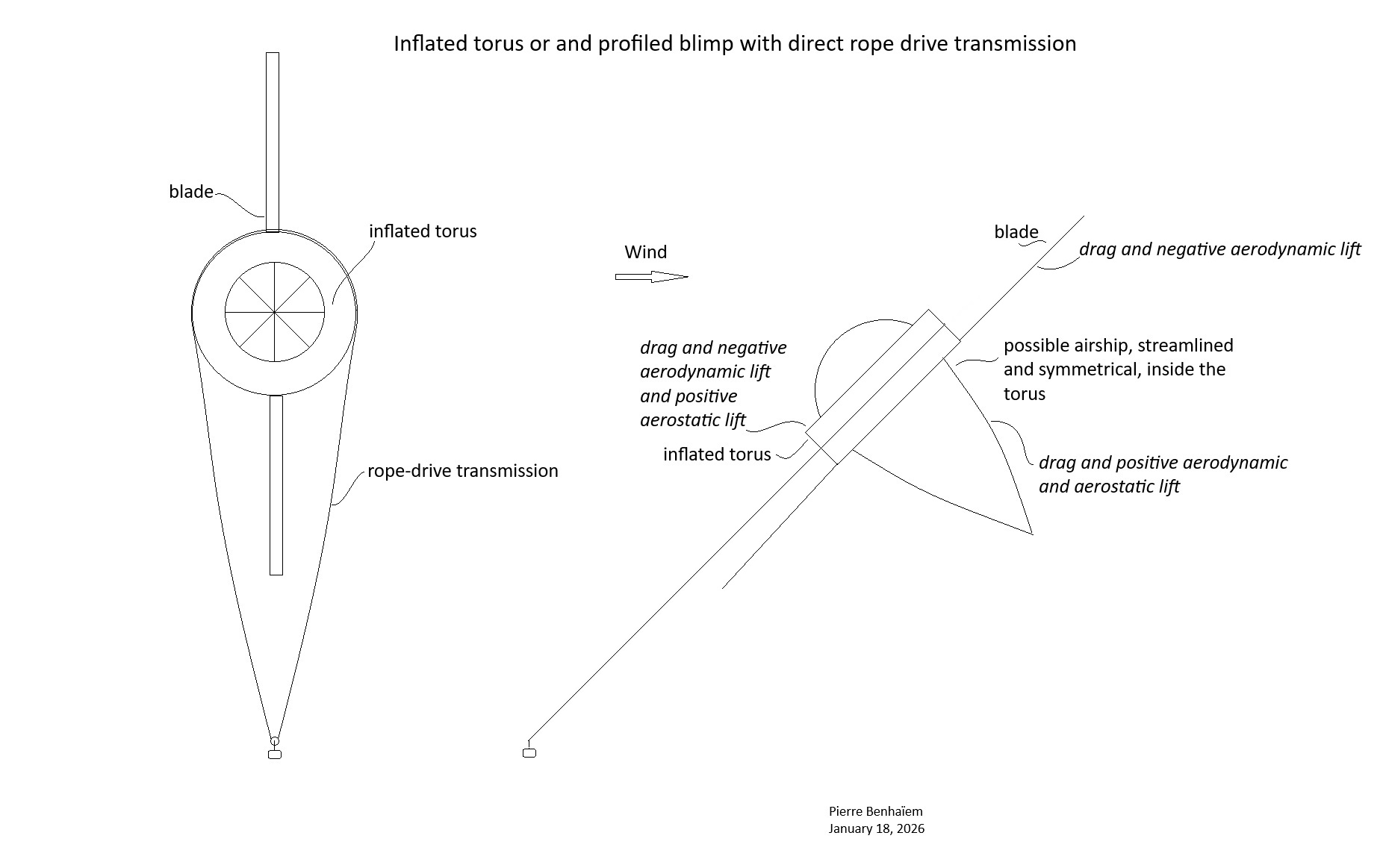
A simpler mean to implement the rope-drive transmission, by using the perimeter of the blimp and a direct rope-drive transmission, a little like on Keuka, is sketched below.
The problem is that, for both designs, direct cable transmission requires the rotor to tilt in an inverted position under the effect of the wind, resulting in negative lift in addition to drag.
This disadvantage could be compensated by an aerostatic thrust, in this case from helium (initially) or hydrogen (later) inflating the torus and/or the streamlined airship which also adds aerodynamic lift. The profiled blimp can be inserted within the torus or installed alone. The blades are designed to generate as little lift as possible to mitigate the negative lift problem.
After a more in-depth analysis of the various AWES using a rope drive transmission, including some inflatable versions intended to reduce weight, it seems to me that the Kiwee in its original form is by far the most workable. All that remains is to scale it up, which has already been started.