Hi Tallak and thanks for taking a look at some of my patents. I’ve built and run probably over 100 different SuperTurbine variants, some as products manufactured in my “factory” (which actually exists yet we never issued a press-release over it) and sold to happy customers, a few shipped to Europe. Again, no big “press-releases” of “We sold a single turbine two years ago! Someday it may even be allowed to operate!” What a way to keep your shit in “new condition” - just never run it. One has been operating here continuously for over ten years, surviving through many severe storms, including this one that ended yesterday giving us 50 MPH winds and 5 feet of snow just up the road at a higher elevation, and about a foot here… All the turbines here ran the whole time without damage. I see a large branch out there hanging off a tree, and I’ll probably find more, and it will be one more project to clean up the mess.
Meanwhile the armchair inventors always have the same answer to high winds: We’ll just shut down the turbine whenever winds get really strong! Problem with that is you give up your most productive times when your machine can be running at a 100% capacity factor for days on end.
One thing you’ve got to remember is, there’s a huge difference between producing a few sketches, and having a successfully operating device. Everything looks great on paper as long as all you have to do is assume it will work perfectly as envisioned in a windfarm-class wind environment, or when wind speeds get even more serious, storms and turbulence enter the picture, etc.
I said was I’ve got plenty of on-paper designs that include airplanes on lines pulling in a circle. With plenty of features and aspects I haven’t exactly seen anyone else even approaching in their on-paper proposals… Yes you are right, I never looked very closely at all the exact features in what you were recently promoting.
It just kind of blows my mind how people think just putting some sketches on a chat group, and bringing up certain points like “center of gravity” mean you have the equivalent of a working system to then have arguments about, when nobody can see it run. What about “center of lift”? What about a million other details?
Every armchair inventor thinks they have everything figured out, as long as all they have to do is talk about it. When asked what they will do when winds get severe, the answer is always the same: “We’ll just shut it down!” Yeah, yeah, yeah.
Look, these chat groups can be fun, but they are only a chat group. I have an endless parade of real stuff to work on around here, like addressing storm damage as just the latest “emergency”, and trying to sit around dissecting every detail of whatever concept happens to come up every day is just not something I feel is the best use of my time and energy. I hope for the best for you everyone else. 
Well though I didn’t come up with Kitemill’s design, I was part of solving many issues to make it work as well as it does now. I think there are not many (ie less than a thousand people) who has my amount of experience with actually flying an AWE system. So I think it does not serve me justice to put me in the armchair inventor bag.
You could divert from my original point and rather talk about some doomed concept like Altaeiros or whatever. But that is really just avoiding my posts.
I said the cartwheel was there to handle zero wind, not high winds. But anyhow I disagree with you that it makes sense to produce in «infinite» wind. I would plan for bringing the windmill down in higher winds rather than making it strong enough to handle anything you throw at it.
I dont have the means to build «The Pyramid» right now. Somehow you managed to build your designs. Good for you, probably with a mix of dedication, hard work and some cache of money to pay for all the expenses. We are not all in a position where we could actually build prototypes. But it still makes sense to discuss ideas because if you can improve an idea at that stage, the change is very cheap. Mind you if the idea is ever actually built.
Perhaps Daisy can provide a first picture: the cartwheel of the Pyramid could be the last torque ring before the rotor.
Though I admire @Rodread’s designs and was inspired by them, they are distinctly different from «The Pyramid». So I am not sure how much learning would be transferrable between the designs. Some of course, but maybe less than half of that stuff would be relevant.
Fair enough Tallak, that is a good point. It’s also true that there are not really that many people in the world who know how to make a really good wind turbine, even though if you can read the recipe/ instructions on a bag of chocolate chips and successfully make a batch of cookies, you ought to be able to make a well-functioning wind turbine too, but alas, most people just never get to that point.
I can see how my often dismissive attitude could put people off sometimes.
But just take a step back and look at the “Skysails powering Mauritius” debacle:
First we have this big, celebratory press-release frenzy over “a new factory!” Impressive photos, I’ll admit, but then again we have to remember this is AWE, where you can’t believe everything you read.
“But Doug, haven’t you heard? They have a FACTORY!!!” Sales are now commencing!!!" Don;t you read the press-release news?
“Uhh, OK, if you say so.”
So, for the last two years, we’ve seen maybe a hundred articles about this supposed AWE system feeding the grid in Mauritius, long after they should have worn out more than one kite.
Just as with Altaeros, there was one (1) person expressing skepticism that any of it was true. I said several times I did not believe such a grid-feeding AWE system was even running in Mauritius.
Two years later we get a press-release saying they finally actually got approval to feed the grid. (huh???)
I don’t even know what to say at that point. “I told you so?” That again? This shit really gets old after a while.
I’ll give you another example:
The James Webb Space Telescope.
I sure wish I would have gone through with my idea to do a video, giving a preview of what the results would be. Because I already knew.
Rather than finding some small galaxies just beginning to form, because they thought they would be looking at the brand new baby universe right after “the big bang”, I knew they were going to see “more of the same” - more galaxies just like the previous galaxies, as always, which would call their entire previous narrative into question, including even the “big bang” theme itself.
How did I know? All you have to do is be aware of the previous track record of “seeing further into the universe”. When I was a kid, we were still coming out of the era where everyone had thought the Milky Way itself WAS the whole universe. Previous to that, very learned people, who could predict eclipses years in advance and everything, had still thought the solar system was the whole universe, and the stars were just “little lights” floating around for our amusement.
The point is, every time we learned to see a little further, the thought immediately becomes “That must be the entire extent of the universe”, based on “that’s how far we can see, so since we are so learned, that must be as far as things go.” which makes no logical sense, but in science, the true fact of “that’s at least how big we can factually say it is, so far” somehow makes a subtle change to “That’s how big it factually is.”.
This has happened so many times now that rather than studying “the science” as presented by scientists, it pays to take a look at “studying THE SCIENTISTS” and their typical repeated folly of thinking that the universe just happens to be exactly as big as how far their latest telescope can see. So I wish I would have made a video on that. Now it’s too late obviously, but the “scientists” are now saying “We might have to rewrite everything we thought we knew about cosmology”.
Now these are some pretty darn smart people as a whole, or they would never have been able to get the Webb Space Telescope built and deployed. And it is a truly amazing piece of art.
So how can someone like me who just reads a few articles in the popular press, predict ahead of time what the result will be? Well, many years of seeing the same stuff happen over and over makes me less gullible than the average bear, I guess.
The fact that I was trained in science helps, because rather than just “believe the science”, we were actually taught that “science” is actually quite often wrong, a work in progress, and yesterday’s firm theory is tomorrow’s “Nice try, that was a good guess or approximation for its time, still useful today, but we now know it was only what we knew until we learned more.”
Well it just seems to be the way life is. Some of just have a knack for such observations of the whole scientific process. Some of us have enough natural skepticism to recogize the same old repeating dynamic when we see it, like when an AWE company declares they “will be” powering X number of homes, in remote location Y, by date Z. Once you realize it has never been true yet, a bit of skepticism is warranted when you hear it yet again, don’t you think?
You’ve probably read articles in Scientific American etc,. explaining how despite the robust aviation industry we all rely on for travel, there is still, as yet, no satisfactory explanation for the lift generated by a wing.
Well, I have the explanation. I never believed the standard Bernoulli explanation offered for maybe a century, and these days the experts admit it is not sufficient to explain the huge amount of lift generated by a wing. Well, as I spent several years making wind turbine blades, and discussing the details with aerodynamicist friends, I had a lot of time to think about how exactly the blades I was building would actually work. (Oh look, the computer (spellcheck) says there is no such word as “aerodynamicist”. It’s suggesting maybe I mean “thermodynamics” So much for artificial intelligence - no substitute for the real thing.)
And there’s something about building things with your own two hands that leads to a greater understanding than you would be likely to attain sitting at a desk or computer.
And maybe feeling when a wing was going to pick you up off the ground, or drop you back down to the ground when hang-gliding helped.
So, there’s another video I need to make. The solution is “slap-yourself-in-the-forehead” simple. The only mystery to me is why nobody else has come up with it.
Have a McDay! :)))
After additional experiments about tilted rotors,I added some notes and a sketch of the Experiment Findings: Flexible kite carrying a turbine within a torus-shaped balloon (DOI: 10.13140/RG.2.2.29622.00320):
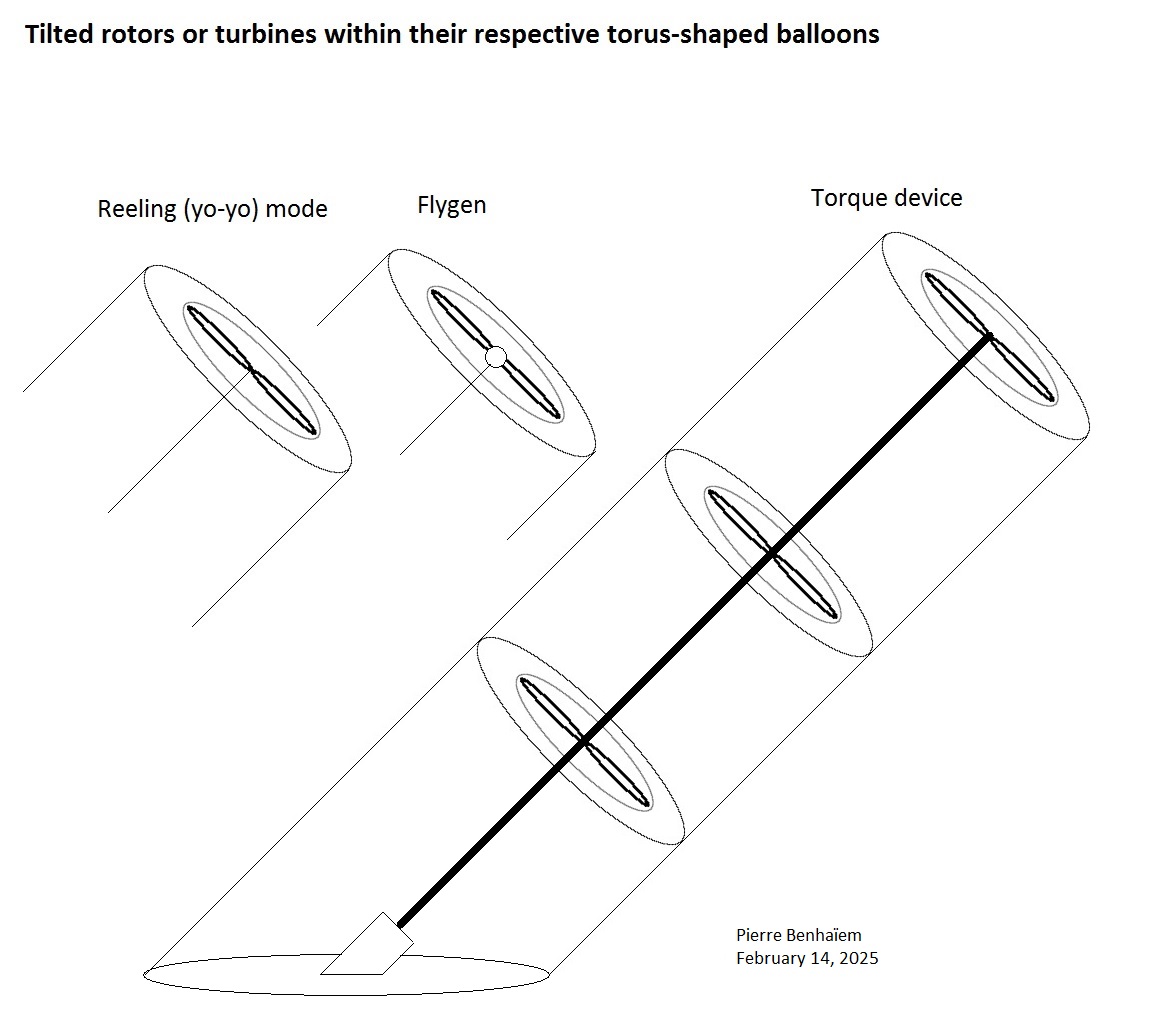
Tilted rotors or turbines within their respective torus-shaped balloons
Additional experiments with the same tire (inner tube) of 42 cm outer diameter and 24 cm inner diameter and the same 20 cm diameter propeller were performed, at low angle of attack of approximately 15 degrees, and high angle of attack of approximately 45 degrees. The propeller spun faster. But some other experiments with various wind speeds (see the § Anemometer inside the 42 cm diameter tire) showed a significant drop of the wind speed even for angles of attack above 45 degrees. Paradoxically at least in appearance, the propeller ended up rotating faster than alone, while receiving less wind power: this may be due to mechanical questions of stability of the axis.
This leads to thinking about other AWES, considering a very high angle of attack of about 50 or 60 degrees if possible, and a thinner torus the objective of which is not to increase efficiency but to mitigate the loss of efficiency. A thick torus is probably blocking the air.
Pull devices in reeling (yo-yo) mode with gyroplane-shaped blades providing both lift and power during the reel-out phase (the device moving away from the ground station by unwinding a winch operating the generator). These devices can be arranged in train of multiple units, some torus being inflated with helium in such a way that the global buoyancy is neutral.
Flying generators [7], or flygen: here a torus inflated with helium, blades and a generator per unit.
Torque devices including superimposed rotors and tensile rotary power transfer to the ground, as described on the Fig.89 and other figures [8] and tested [9]. But as these embodiments include peripheral tethers, they cannot be implemented because of the diametrical ropes of the torus which would prevent their rotation. This is why in the sketch following, Fig. 1 [8] with a single shaft is taken as a reference. Each rotor or the majority of rotors are surrounded by a torus, providing both an additional power and positive buoyancy allowing the train of rotors to achieve a theoretically unlimited length, mitigating or cancelling the catenary sag effect which is due to both length and weight, allowing scaling. Both torus and rotors are concentric, and tied by their common center.
The torus are fixed in all tilted or not tilted configurations. Only the rotors are rotating.
In all variants, the torus are also protections for turbines or rotors, and allow an arrangement in farms of unities in bumper car mode, where collisions are of minor effect.
Multiple units can also be easily achieved by implementing a rope-like links between the multiple torus, torus by torus. A similar arrangement with not tilted rotors was mentioned above.
Lifter kites can perhaps be added.
A sketch of the three main arrangements
I don’t know if kite lifters would really be necessary.
Concerning the torque devices (references to SuperTurbine ™ Serpentine, and Daisy), it is possible that the positive buoyancy with helium in the torus tends to position the rotors, stabilizing them in their inclination, according to the level of the buoyancy, and without requiring any additional lifter kite. But I am not sure of it.
Temporary conclusion
Torus-shaped balloons act like simple and efficient shrouds. They also work as supports and protections for the turbine inside, allowing higher density in a farm in bumper car mode where collisions are not important. They can be carried by static or crosswind flexible kites. In the configurations where the torus is tilted, the efficiency drops, so thinner torus should be implemented.
Hi Doug @dougselsam,
Following a discussion on chiral metamaterials with high elastic torsional energy storage capacity:
It looks that Fig. 1, particularly f and g, show configurations that might perhaps be appropriate as a shaft, if we assume that they could extend in length and make a very long shaft. If it is possible scaling mass penalty would be partially solved.
Maybe there would be possibilities for Daisy as well.
If you have very long shafts, you would still have to lift the whole thing by kite lifters or aerostats every 10 or 20 m, if you want to have an almost unlimited range. And it’s not easy to attach something fixed to a rotating shaft. Perhaps this would be possible with the help of the intermediate toruses.
Publication already discussed:
Large recoverable elastic energy in chiral metamaterials via twist buckling | Nature
Samples
The rubber chiral metacell in Fig. 4a features N = 8 rods with r = 1.5 mm, whereas the titanium version has N = 20 and r = 0.6 mm.
In Fig. 4c, chiral-20° has R = 5.5, 2r = 1.8, α 0 = 20°, h 0 = 20 mm. Chiral-50° has R = 6, 2r = 1.7, α 0 = 50°, h 0 = 20 mm. E s ≈ 5.5 MPa for rubber samples in Fig. 4e, whereas other rubber samples have E s ≈ 15 MPa.
Experiments
Cyclic compression experiments were performed. The rods in newly fabricated metal samples are initially straight. However, after the first compressive cycle, the all-metal samples exhibit some residual plastic deformation. In this case, α 0 increases, and the rod becomes slightly bent.
These objects therefore appear to be made of metal.
Maybe other materials could be used? Tethers with a metallic core as chiral metamaterial?
Think the study on chiral metamaterials is cool
But
With regards to TRPT application
Models e and f as you mentioned in fig 1
Those are being studied for use in axially compressive loads
Like the look of the analysis though
Maybe a big boingy tilting ground station works well
Fig. 1: Deformation of chiral and non-chiral metamaterials. | Nature
f , Compression-twist buckling of chiral metacells.
Fig. 3: Metamaterial performances. | Nature
For chiral metamaterials, h 0 = 30 mm and radius (R ) is variable.
They are small objects. Could the length be increased to make it a SuperTurbine ™ shaft? Could the diameter be largely increased to make it suitable for Daisy? And use carbon or fiberglass rods, or even bamboo, instead of metal?
Train of lifter kites inserted into train of rotors
The inflatable versions not being satisfactory (too much drag from the rotating ballute), this is another attempt to distribute the lift of a Daisy-type rotor train by inserting a train of lifter kites.
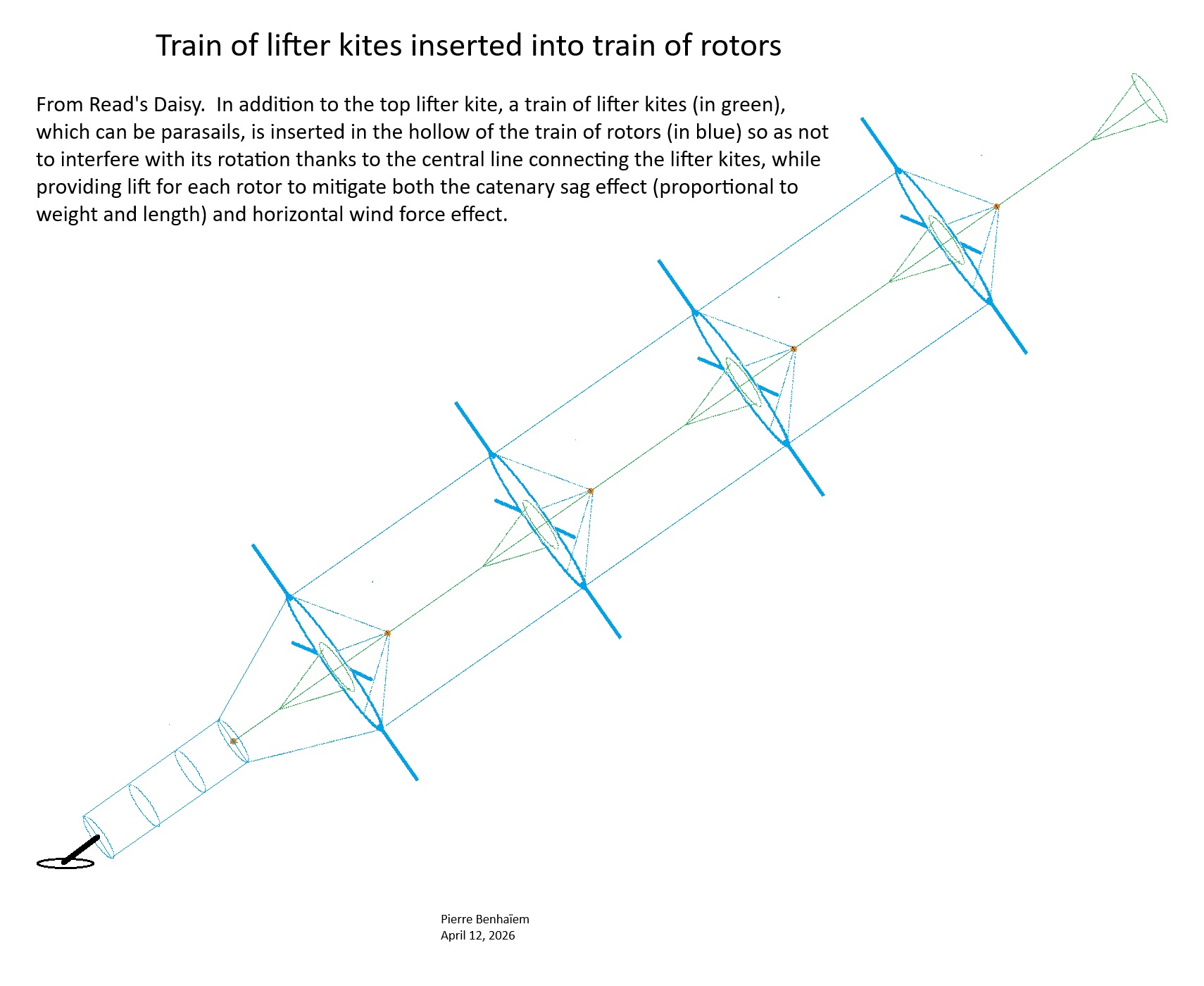
Approximate calculations, based on views from a video showing a rigid 3-bladed rotor and photos, and which may be incorrect. The surface values as well as the lift and drag coefficients are assumed to allow reaching an elevation angle of 30 degrees (30°) and may be different.
Daisy rigid rotor disc sweeping supposed 10 m² (power about 1 to 1.5 kW with a wind of 10 m/s or more) + lifter kite of 3 m², elevation angle 30° just below the rotor, and even less below, and of course far more for the lifter kite.
L/D is 0.5774 for an elevation angle of 30°.
If the drag coefficient is 0.85 for the 10 m² rotor disc, and the lift coefficient is 1 for the lifter kite (its drag coefficient being 0.5, leading to an elevation angle of 63° for the kite alone), that leads to L/D ratio of 0.5774 with (3 (kite) + 2.774 (rotor disc)) / (1.5 (kite) + 8.5 (rotor disc)).
So the rotor brings some lift, being 2.774, leading to a lift coefficient of 0.2774.
With no rotor lift, L/D ratio would be 3/10, leading to an elevation angle of 17°, which is below the elevation angle we see on the video and photos.
But if we want a longer (and wider) Daisy with an equal elevation angle (of 30-35°) in all places, a lifter kite (also about 3 m² or slightly less) for each rotor would be welcome if it works. For that the rotors should be spaced enough.
All of these tests had a back line
E.g. An extra line split from the lifter kite line running from just above the top bearing of the kite turbine down to the ground downwind of the kite turbine
So this back line effectively sets the maximum elevation angle
This changes everything: my calculations therefore need to be revised.
That said, the back rope is not tight in the video most of the time. However, this rope reduces the oscillations.
The back line was semi elasticated. . . e.g. it had sections of bungee tied in so that there was usually a bit of tension on it but limited range of stretch… This was to prevent the possibility that it might wrap over the lifting line … the tension helped to add a bit of torque to / remove twist from the lifting line