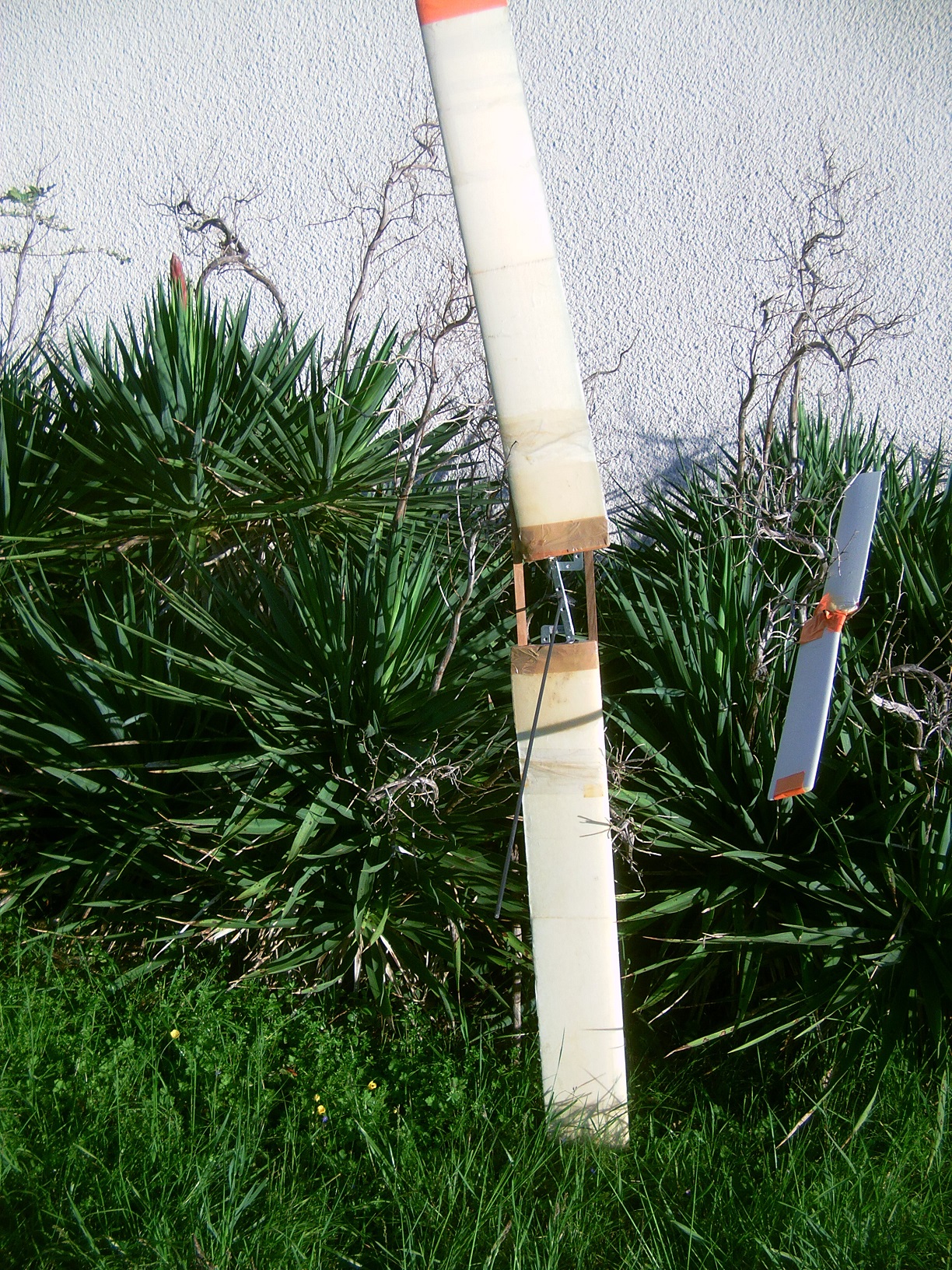
I measured the TSR of the two rotors on the picture below. Both are made with Naca12 blades.
The big (two blades 1 m/0.16 m, complete diameter 2.2 m, 0.7 kg) and old rotor was laminated with epoxy. Its TSR was only about 1, with 3 m/s wind speed.
The small rotor (two blades 0.5 m/0.08 m, complete diameter 1 m, 0.05 kg) was not laminated. Both blades were glued against each other with an offset of a few centimeters. The TSR was about 3-5, so much more. I don’t still know why there is such a difference.
I don’t think both could provide lift like an autogyro rotor as on the picture below, where the used rotor comes from a gyrokite.

With 6-8 m/s wind speed I tested the small parafoil lifter kite (0.2 m²) alone, elevation angle of 45°, then with the 55 cm diameter rotor rotating at full speed around the tether via a tubular axis, and after launching by hand: elevation angle of 35° until the rotor (as for the complete gyrokite whose the fuselage adds very little drag compared to the rotor). I have no video because I have only two hands.
I think there is a possibiity to stack rotors around ropes and produce a lot lift with numerous rigid (more lifetime) small elements. But I don’t know if this is really manageable. Particularly autogyro rotors should be launched to start-up in each cycle for reel-out phase. Even with 8 m/s wind speed the autogyro rotor did not start alone, while the two rotors above started alone with 2-3 m/s wind speed.