Barber Wind Turbines
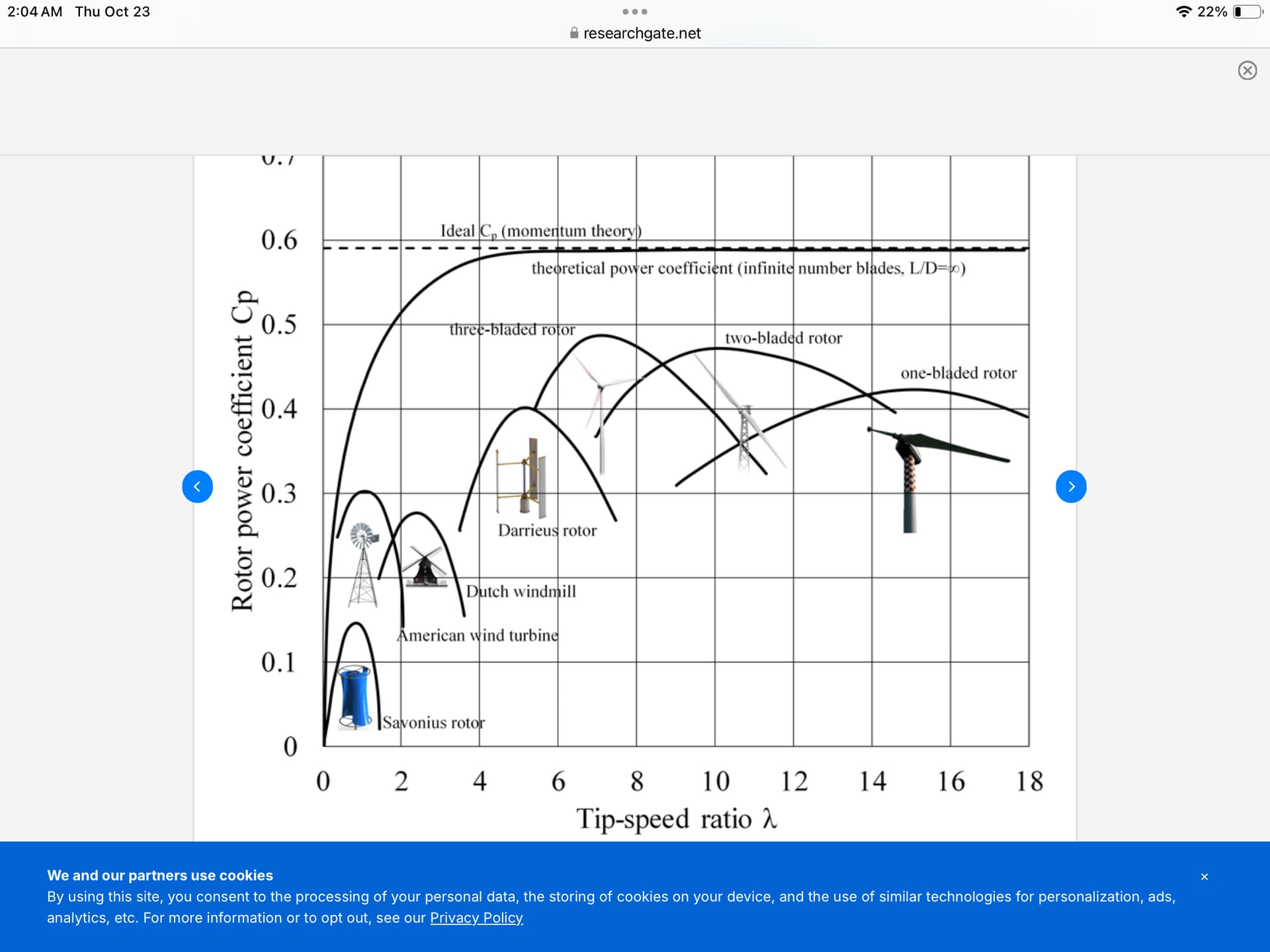
I did an analysis of this turbine based on the data they supplied. They claim 50% efficiency at a tip speed ratio (TSR) of 4.5. Operation of this turbine should be similar to a multi bladed water windmill which operates at a TSR of 1.0. According to the chart attached, the efficiency drops off rapidly on either side of the maximum TSR so I don’t understand how they can claim such a high efficiency. Is it possible that the narrow and longer airfoils (8” X 5’) are more efficient than the wider and shorter blades of the windmill?
That’s cool at least they try to invent a new wheel.
The efficiency at rated power of 800kwatt at 10.7m/s is a rather conservative 36.5%
Structurally a bicycle wheel has a very high stiffness to weight ratio, with no bending stresses.
Each blade is a set of 20 segments of 8” x 5’ each, strung along each “spoke”. And there are a lot - 64 - spokes.
In theory at least, the higher the aspect ratio the fewer losses, also the rim further diminishes tip losses. Another reason for improving efficiency is that each 5’ segment is freely rotating around its supporting spoke, such that it dynamically self aligns its “pitch” for optimum L/D ratio. And that also means that regardless of TSR, each airfoil segment seeks its own optimum angle towards apparent wind.
The small chord however has an impact in reducing efficiency due to lower Reynolds values.
Another advantage is light(er) weight. Despite the high overall solidity (of ~17%), blades themselves total a very low volume, and they don’t need to provide significant bending stiffness, so they can be quite lightweight. They also don’t need special geometry (taper or twist) like normal blades, they can be straight extruded segments so both manufacturing and transport are much simpler.
There is a reason they are not showing us a working model. oh no, it must be huge, and we need money for that, so just enjoy our renderings, God forbid we disprove our theory by building a working model at any size.
In al the years of electric motors, designers never considered the best diameter until these people came along, right? Professor Crackpot never sleeps!
They built a model of quite decent size, unfortunately there-s very little info about it. The rotor however isn’t as advertised - it seems to use only 5 rather “normal” blades with twist and taper.
Here-s a time lapse of its construction - and that’s it there-s no footage of it spinning at all.
Thanks for making my point. They could have built one at a small size and publicize a power curve. Instead, as you say, they build a different idea, at a too-large size, with no evidence it ever even rotated. This is “Professor Crackpot” at work… He never sleeps, and never wakes up!
Keuka Launches First Offshore Floating Wind Farm Prototype
January 18, 2011
Given the date of the last news item, it seems there has been no follow-up. We can assume the same is true for BarberWind, as the last year for their news was 2020:
The book “Wind Machines” from the late 1970’s shows a “Bicycle Multi Blade” rotor, and probably describes it too. Most concepts discussed in these groups were known by myself and others, almost 50 years ago