While I share the enthusiasm for exploring different concepts in wind energy, I think it is worth noting that advocates of vertical-axis turbines are almost always people with no real experience in wind energy. We have heard this 2x claim for low aspect ratio V-A since Peter Sharp was posting. There could be some truth to that. Might require a higher solidity rotor. Maybe someone should build a scale model and check it out. Wouldn’t have to be a mile across. But the vertical advocates usually just talk, rather than build. There is always an excuse not to build. If built, always an excuse not to use a tower of decent height. If run, always an excuse to shut it down. But still, I’d love to see what you’re talking about built. It’s been discussed a lot on these forums. I can imagine the advantages. But we always get to that resistance to build unless it is giant scale, which of course would cost so much and take up so much space it would be difficult to get funded, approved, etc.
Sketch please? ……………
The 2x issue:
The Betz limit applies to energy extraction from a plane across an airflow,
Energy = 0.5 x density x velocity^3
Any energy extraction on the windward side reduces the velocity of the air-stream.
The air-stream velocity after the windward blades becomes the upstream velocity for the lee- ward side.
Air is a compressible medium and turbulence is generated, hence the requirement for large diameters to get valid calculations of forces from flow conditions.
Sketches on the site!
Hi @GuyM ,
Is it not possible by using a (not too) small physical model and keeping the same proportions between blade height and turbine diameter, so by using small blades to allow the lee-ward side benefit from fresh wind as for a theoretically large installation, then measure the data by different rather low wind speeds, maybe in a wind tunnel, then rework on the theory to move from small models to large ones, taking the Reynolds number into account among other parameters?
In wind energy and I think even aviation, the air is usually treated (approximated) as an incompressible flow, because the amount of compression is so small. One more example of promoting vertical axis turbines without real experience in wind energy. I’m not saying these super-jumbo-sized vertical-axis machines could not work out. I’m also attracted to the idea. But it is kind of an old story. Maybe not taking into account all the pesky details that might render it uneconomical. I would think if someone could make a good enough case for it, with all the pesky details filled in rather than the typical “all-ya-gotta-do-is” hand-waving and happy-talk, such a system could be built.
For fixed (non pitching) systems small and medium size units can be made. Active Pitch controlled models have also demonstrated substantial increase in performance compared to fixed systems, with good coefficients of performance.
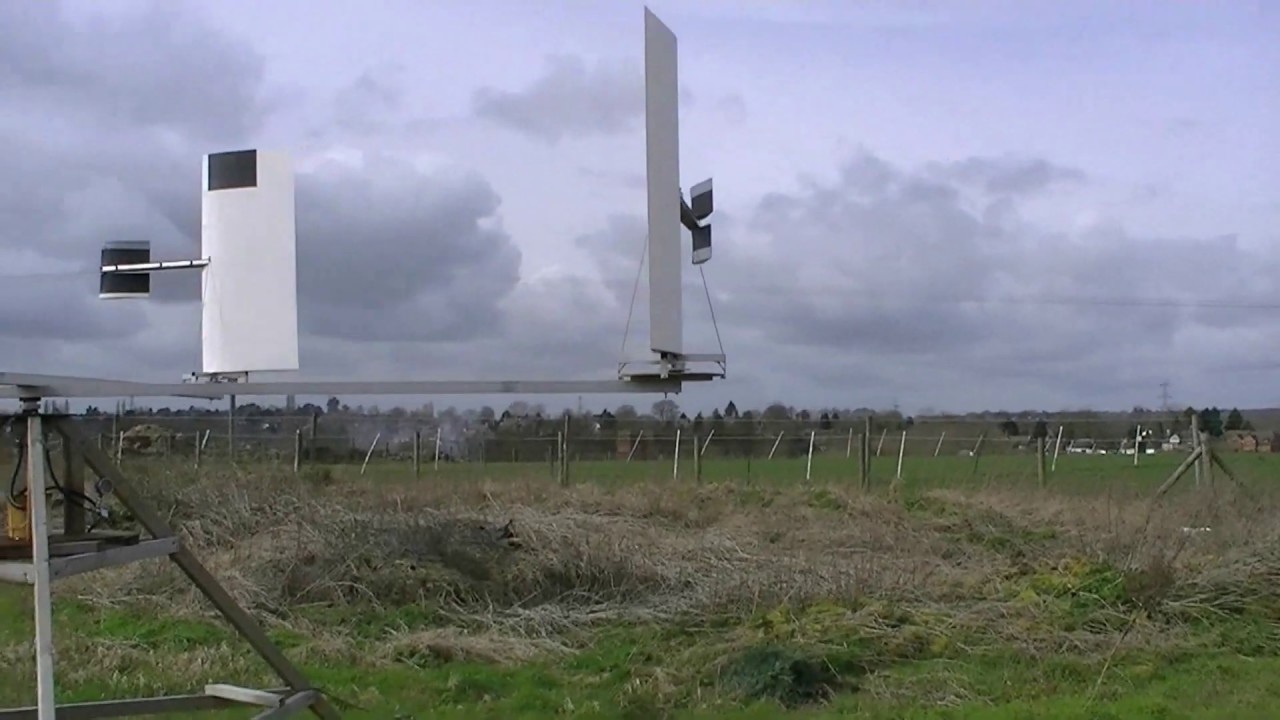
It would be extremely difficult to make a small unit based on aerodynamic balance for the optimum control of the angle of attack: The advantage of using aerodynamic balance is that it does not rely on any sensors or powered control devises, which makes it ideal for surviving really adverse conditions, reduced maintenance costs and long life. The disadvantage being that time is required to achieve balance so the more time available to get a balanced position the greater the accuracy. On a VAWT the the direction of the apparent wind is constantly changing but the rate of change is inversely proportional to the diameter. A video demonstrating the general concept of aerodynamic balance has been made.
Stage 1 is get the fundamentals, based on known aerodynamic theory.
For example :
The speed of the air stream at the blade is not the upstream air velocity, but rather the average of the upstream and down stream velocities. The velocity and angle of the air relative to the blade is then a vector, taking into account the movement of the blade.
None of this is easy all you gotta do.
If a small prototype is made with the same proportions, we will know a little more about the amount of energy captured by the lee-ward side.
Indeed (video below), but it looks like the blade height is proportionately far higher than that of the proposed giant installation. Testing the same with shorter blades?
Exactly, which starts as treating it as an incompressible flow (not a compressible flow), then realizing your blades are traveling faster than the wind, thereby creating their own operating environment. Next the vertical-axis advocate predictably notices the possibility to slightly improve performance by adjusting the pitch of each blade in response to the wind direction, while discarding the former main talking point which is no need to aim or consider the wind direction in any way. At that point you have a turbine that must sweep 3.14 times it’s intercepted area, with each blade requiring more strength, but now also predictably adding a complication of regular turbines: active blade pitching. That’s when it gets called a “cycloturbine”. Adding details like canards to help pitch the blades on-the-fly is another typical imagined detail. This typically leaves you with a more expensive machine that uses more material, is more complicated, and less reliable.
The detail I like is supporting the ring on an air cushion contained between two concentric vertical circular walls. That is very interesting. Using the water as a liquid flotation bearing for a wind turbine rotor is a concept I introduced in the 12th embodiment (Fig. 17) of my first wind energy patent U.S. 6616402.
In this embodiment the water supports a turbine from a central point, thereby allowing the water bearing to spin at a tiny fraction of the surface speed of the blades, giving lass drag. In the Windmax concept, the increased surface area of a double ring wall must expose 4 wall surfaces to water skin friction instead of one wall, traveling through the water at the same speed of the blades, which could approach 100 MPH at a tip speed ratio of 4 in a 25 MPH wind, which would be common, or even faster in higher winds. Has anyone calculated the skin-friction and other drag of four (4) supporting surfaces dragging through the water at that speed? Has anyone explored whether there might be other unknown effects on this spinning air/water tunnel at that speed? No, with all these new, untested features, it is still in a fantasy-land (graveyard? junkyard??) of “all-ya-gotta-do-is” at this point. Mostly all going down a well-worn “all-ya-gotta-do-is” path, leading to the well-populated final destination (final resting place) of “It will only work if we can make it HUGE!!!”
May it rest in peace. 
The object is not to drag it through the water, rather that the water is deep so that there is a small shear rate to create a liquid flywheel and reduce drag. Hence the Couette flow analysis.
The small unit built was to test the general concept of dynamic aerodynamic balance and supporting of the aerofoil from the bottom only by using stays.
Finding the power from the windward & leeward sides ( or at least a good estimate ) can be done by calculation ( but it is not simple.)
OK so you are going to create a 100 MPH whirlpool? How much power would that sap from the system? How much would you expect to get back? The more details cited, the crazier it sounds!