A sketch:
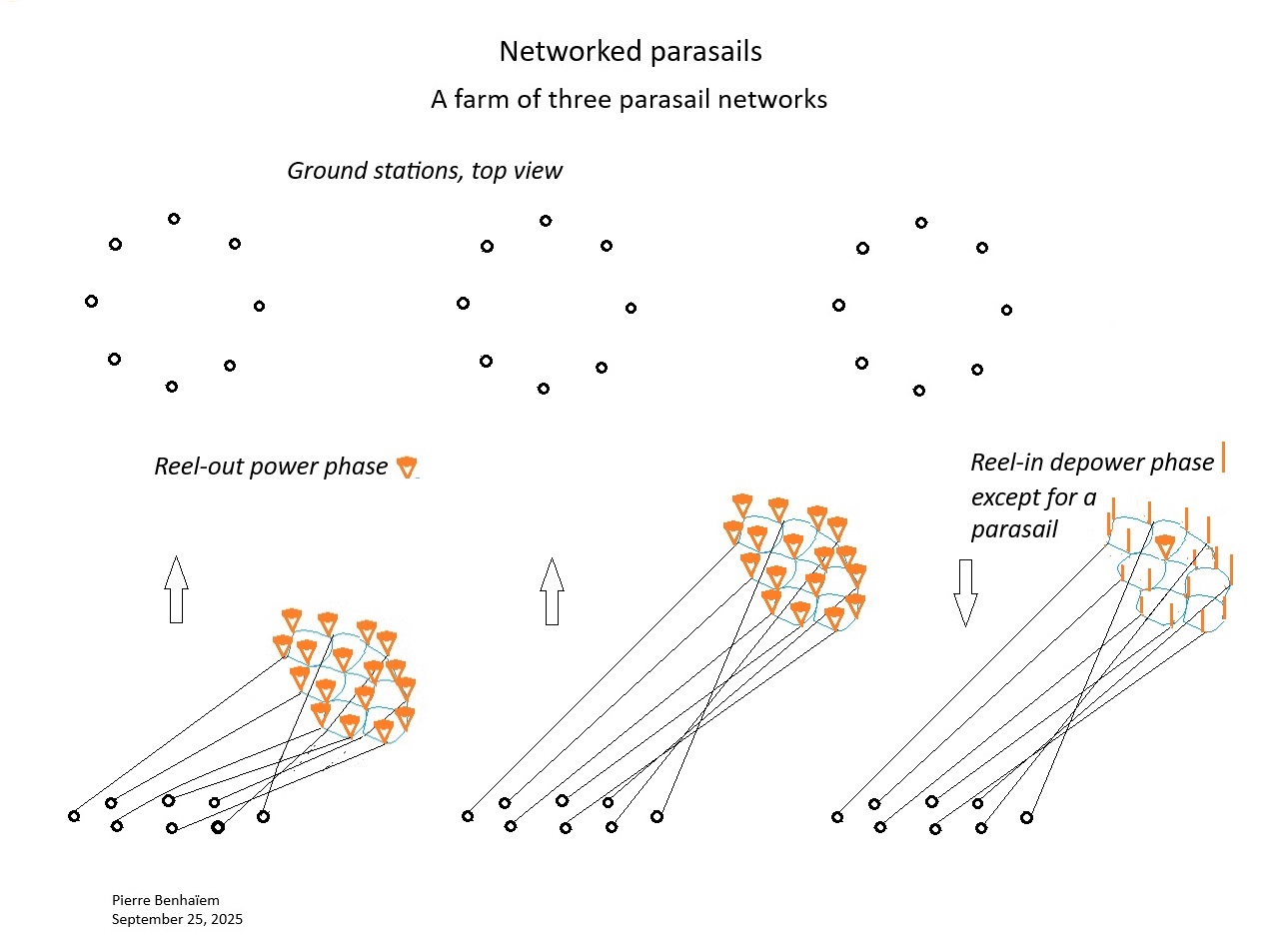
Networked parasails
An alternative is to bring the units together in networks, to avoid duplicating certain elements such as the main tethers, and to save space. This technique is developed by Dave Santos [27] and Roderick Read [28]. To supply continuous power, several (2 or 3 at a minimum and not much more at a maximum) networks of parasails with offsets may be suited to provide the reel-out and reel-in phases at the same time, leading to a continuous global power. But in that case, a least one parasail for each network, will be always in action to ensure a minimum of lift during the depower reel-in phases. Ground stations can pivot to face the wind direction in a similar way as for other arrangements. Note that during changes in wind direction, the same configuration is achieved by lengthening or shortening the respective pivoting ground station tethers. If necessary, the parasails can be equipped with respective swivels, possibly motorized, to facilitate their positioning face to the wind.
Trains of parasails can be seen as networked parasails but are not used in this configuration: simple parasail units are preferred, being arranged to cover the swept wind space.(2) (PDF) Parasail-based Airborne Wind Energy System. Available from: https://www.researchgate.net/publication/378970090_Parasail-based_Airborne_Wind_Energy_System [accessed Sep 25 2025].