Can they be corroborated by other tests than mine, whether for flexible or rigid wings in crosswind flight?
Regarding flexible wings, some hints are exposed again on Annual Reviews: Autonomous Airborne Wind Energy Systems - Engineering / System Design - AWESystems Forum.
Regarding rigid wings, flying in circular path:
1: 47: “wing area of 1 m² generates 40 kW (at 13 m/s wind speed and L/D of 15).”
3: 08: “10 kW for 4 m² plane [Vander Lind 2013] at 8 m/s wind speed,i.e. 25% of potential.”
I wouldn’t even consider the example on the left side of the image, which is still far less favorable.
The 4 m² plane can have a L/D ratio of 15. If that’s the case, what leads to only 25% efficiency, apart from the irregularity of power (and perhaps tether drag in a lesser level), hence the losses of the power generated by the accelerations and decelerations during the path, assuming that the L/D ratio of 15 partially or fully includes the tether drag?
See the curve of a Makani wing on:
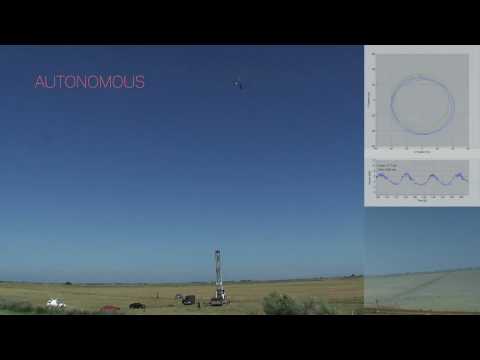
It is possible that large-radius circular trajectories, such as those of the Makani wing, result in fewer losses due to irregularities compared to figure-eights which likely produce more accelerations and decelerations.