In its basic form a solar balloon works like a greenhouse:

A simple black envelope is efficient because it is a “black body” with a high absorption percentage of the solar radiation, leading to a high emissivity, which is an advantage for heating. But it re-emits outside as well as inside, leading to loss.
The buoyancy has been measured, being about 90 grams/m³ for small balloons, and 80 grams/m³ for larger ones, in free flight, far less in tethered flight due to higher loss of heat by convection.
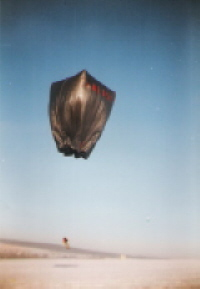
A double envelope has an external transparent envelope with properties sometimes close to those of glass, keeping almost all infrared from the re-emissions of the black envelope.I measured its buoyancy as about 1.3 times that of a simple black envelope. The thin air layer between the two envelopes is a little like an insulation.

For a Magnus balloon, buoyancy can be high, even too high the day, and low or zero the night. That said, the larger the volume, the longer the heat is retained.
In reeling mode, the buoyancy must be able to be compensated by the negative aerodynamic thrust to allow the balloon to descend during the reel-in phase.
An observation: while rotating the Magnus balloon keeps the feature of buoyancy because it would be symmetrical as for these solar balloons.
Another observation: the centrifugal force leads to the effect of propelling colder air against the walls, isolating the warmer air inside, but also strongly cooling the same wall by convection if the balloon is a single envelope, and to a lesser extent for a double envelope.
Now another mean of buoyancy is described on
and on
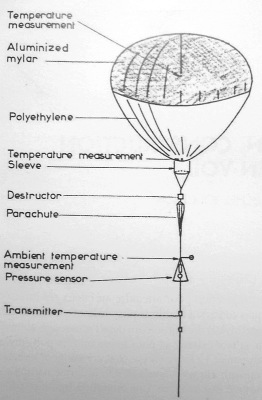
The so called Infrared Montgolfier (MIR) is a balloon developed by the Service d’Aéronomie of the CNRS and CNES in 1977 in an attempt to meet the needs of long-duration flights. The MIR is a hot air balloon “open at the bottom” made of 2 different materials: a top part of aluminized Mylar 12 µm thick making a cavity for absorbing ascendants infrared and block any re-emission toward the sky and the bottom part made of linear polyethylene 15µm thick, an infrared transparent material and tough at cold (-80°C). It only uses helium to gain altitude at takeoff. Their reflective cover provides lift heating the air inside the envelope by the sun during the day or by the infrared radiation coming from the earth during the night. During the day, the MIR flies at an altitude of about 28 km to 32 km while at night it floats between 18 and 22 km depending on the infrared flux radiating from the overflown area and the temperature of the air parcel. It could carry a scientific payload of about 50 kg.
An advantage for our balloon would be a permanent (but not quite equal) buoyancy, likely not too high (300 W/m² as noted on the pdf in the first page) because the direct radiation of the sun is not or only slightly absorbed: only the infrared rising from the earth are absorbed. That said it is better than nothing BUT this is not suitable for our Magnus balloon because its rotation leads to a cyclical reversal of the polyethylene part and the aluminized polyester part.
Another point: if we read (has anyone done it?) the preprint we see that the belts run around respective drop stitched double disks which are tracks for said belts. Generally drop stitched technology make it possible to build structures with relatively high pressure like kayaks or paddles. I wonder if a sewn crown is enough or if a complete disc is necessary as for the valves at the ends.
Stil another point: at equal expected power, the amount of waterproof ripstop (in m²) would be comparable to that of flexible crosswind kites at equal power range, but multiplied by 3.14 (the area of reference of a cylinder being its length multiplied by its diameter; so still multiplying by 3.14 is needed). That said the strength of a Magnus balloon (above all if it is harmoniously shared between disks-belts-tethers) flying vertically slowly can perhaps be lesser. Lifetime remains to experiment. For both recyclable materials would be welcome.