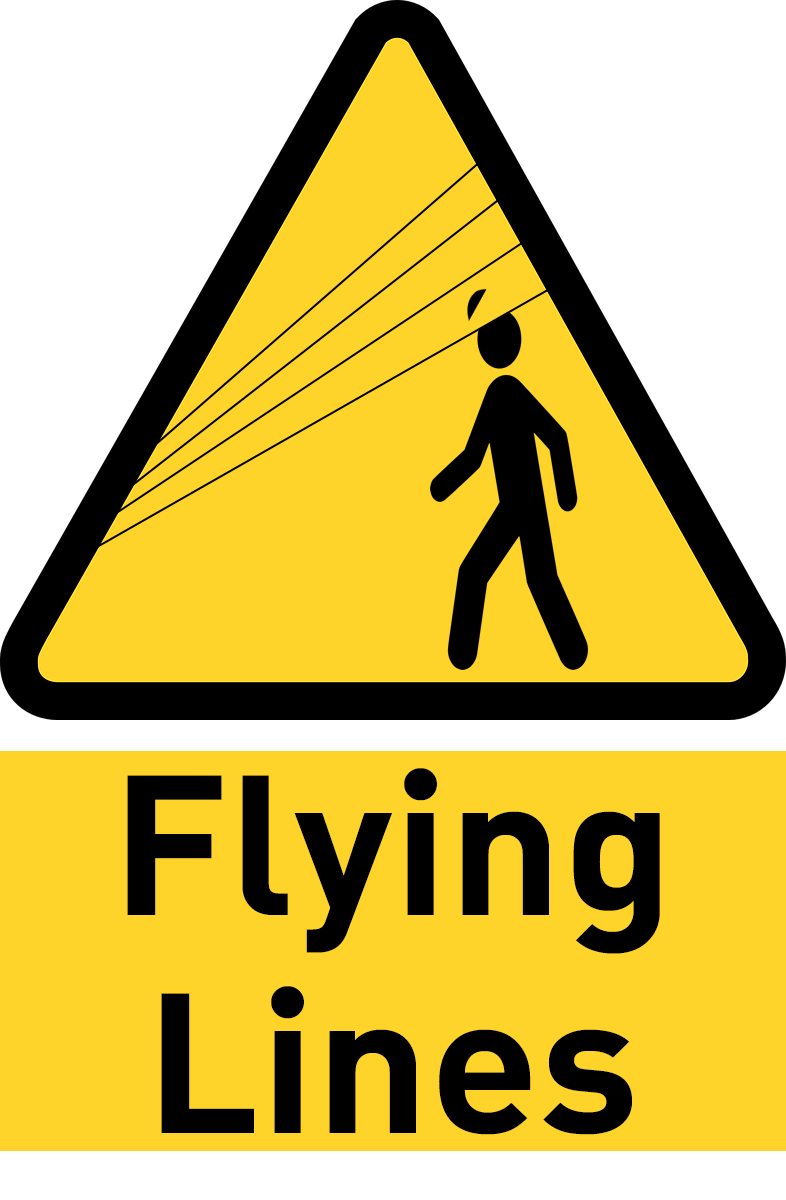
I’ve put this in Ground Station section… maybe we need a Kite Field section
Question: Is there a common standard warning sign for Flying kite Line Danger Awareness?
I’ve knocked this one together…
I think more text so bystanders understand the dangers, eg
Kite operations in progress. Lines are highly tensioned, risk of injury to cuts. Do not walk under the kite power plant, risk of injury from crashing wings.
Do you have insomnia? It’s 3 a.m. in California. Beware, this is a serious matter that deserves special attention.
Having once attended a kite festival, I saw no sign of it. It’s true that it’s hard to miss static, low-flying monsters.
Now, for AWE power kites flying in crosswinds, the no-go zone should cover the entire area of operation.
There are “No Kites Allowed” signs, but here it would be the opposite: “No entering, flying, crawling, walking, crashing except for kites in operation”.
Hi Pierre: yes I went to bed early and woke up early. Not feeling so good since the blizzard. Improving slowly. Computer down, saying the hard drive is in danger, stuck on my phone or an outdated computer I only keep around for its old version of a CAD program. Bored out of my mind. If I sound delirious, it’s only because I am. I am reminded of a couple of things with this: one is a traditional kite festival I recently read about, in some third world country, where they coat kite lines with broken glass.
A few people get their throats slit and die every year, but it is not considered a big enough problem to cease and desist the festivals. Seems like one more example that kite flying may result in a departure from reality, or you could just literally lose your mind. The other is I have a place with high winds at ground level I would like to place a wind turbine. Rather than a fence, maybe I should just put up a warning sign with a graphic of someone’s head exploding, and hope it is visible at night! If someone loses their head I can just say: “Didn’t you see the sign with the exploding head?”
By the way, I also remember a true story of a guy with a pretty good size wind turbine on a yacht. I think it was in Australia or New Zealand or something. Anyway at some point the guy accidentally walks into the turbine and was killed instantly. Don’t remember if he was some turbine developer or what. Maybe the incident could be googled to find the details.
Red signs are for prohibition, danger or for alarm. They are round shaped with a black pictogram on a white background and the red edging should be at least 35% of the surface area of the sign.
And you should also have blue signs.
Blue signs are for instruction or for information, for example, wear Personal Protective Equipment (PPE). They are a round shape with a white pictogram on a blue background. The blue part of the sign should be at least 50% of the area of the sign.
What should be on the sign, is it an exclamation mark, a skull, or your own design? And there should be an explanation of the sign under it. The “Flying Lines” doesn’t explain the danger. And you should restrict access to the field.
Then there’s the question of what PPE and safety measures you use. A helmet doesn’t protect you. I would use proximity sensors to shut down the turbine when something enters the field and when someone opens the gate.
I think the order to do this in was something like this: eliminate the risk (stop the turbine when anything approaches), restrict access, provide safety gear that protects against the risks, add signs. If you enter the field it is because you have something to work on in the field or on the turbine. Both should be done when the turbine is stopped.
There are no universal rules for these. Sure you can opt for a standard which is probably a good idea, but that standard will not be right for every location.
I chose a Scottish website for the quote, which a Scottish entity would need to comply with. To me this also looks identical or very close to how signage in the EU should be done.
What other safety precautions should humans take around AWES
Whether in the workshop (Thinking dust, glues) , or in kite simulation (Splinters and boredom) and kite test fields (plenty danger and even drowning in a bog in KitePower test field case) ?
We have exclusion zones and airspace clearance
But what about when humans have to be in the loop?
Technicians are still required to bring kit out to the AWES robot
As such they have to handle risks.
At Wind Energy Hamburg loads of technician PPE / rope access safety gear was on display
Harnesses / helmets / fall arrestors could all have their uses in AWES (Tempted to use a tweaked fall arrestor upside down as a low tension kite recovery device)
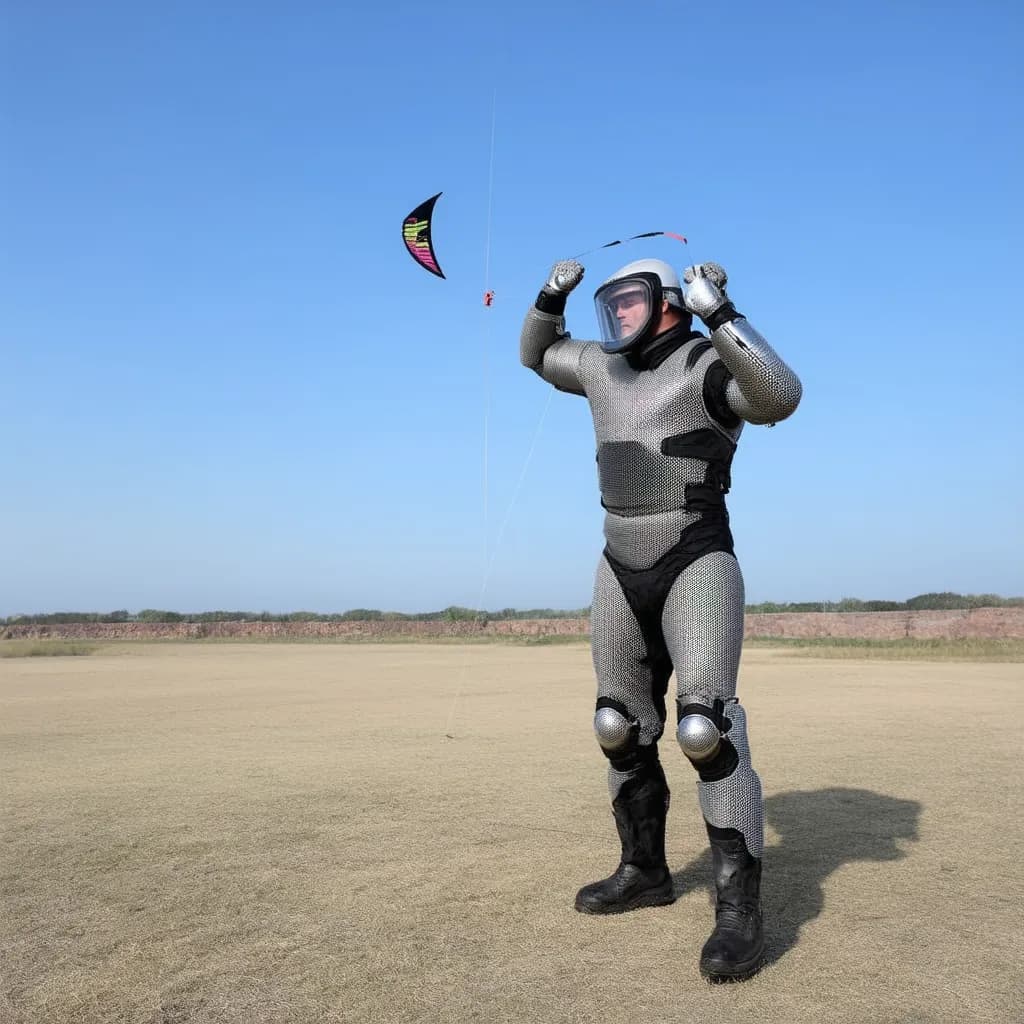
One product I discussed in Hamburg may help addressing rope abrasion - In my regard one of the higher risks in kite handling. Tight line running over skin will cut through in seconds. - The product is simple cut protection sleeves like
Would these help much?
They won’t prevent constriction / ligature injury
They only cover wrist & forearm to elbow.
I’ve seen my boilersuits get burnt from lines and grinding/welding in kite work.
I’ve burnt through gloves with kite lines before
and yes - stupidly, my hands too
Glasses and a stainless steel codpiece are essential to avoid lashback of course
but what else should we be using in AWES development for personal protective equipment
I think tether should not be handled by hand, at least not when a certain scale is achieved.
Separating people from spinning props and moving tether is an obvious concern. But this should maybe be solved other than PPE, maybe fencing ans em-stop buttons. I think many industries have solved this in a generic reusable manner.
There is also the issue of stuff being reeled in too far, in which case parts could start flying through the air at high speeds.
The issue of the kite[s] landing on people or equipment at high speed is an obvious no-no.
For the grazing animals using the area [or people for normal crops], any crash debris that is not recovered and removed could pose serious damage.
…so… signs, I guess yes please. But not a big concern at the end of the day