This last video, above, is typical idiot talk, by and for know-nothing idiots. It;s all based on lies that only know-nothing idiots will believe. Almost every statement by the science guy is in error. He is merely regurgitating the lies of the promoters of the blimp turbine, desperate for acceptance, lying to achieve it.
Since the entire script consists of mostly lies, they are too numerous to list, but here are a few:
That Altaeros was an MIT project. no, the promoters were said to have once attended MIT, but that does not make it an MIT project,
That the Altaeros project ever successfully operated at all. There is no evidence of anything but brief, momentary operation in light winds.
That the reason for its ultimate demise was helium leakage. No it was just built too frail to even operate in anything but the lightest winds and sure, as it fell apart it undoubtefly could no longer hold helium.
That Altaeros is now using its BATs to provide telecommunications services. There is no evidence that such ever happened. They were going to use standard blimps. Any idiot would knw that if blimps were better than towers for teleccumnucations they wooudl have already been in use 0 blimps are a well-known very old technology, not some new idea requiring MIT to comprehend. it was all lies to begin with.
That 1.2 MegaWatts of turbines could weigh “less than one ton” because of carbon fiber. no, the generators alone would weigh orders of magnitude more than 1 ton.
That a capacity factor of 25% means a turbine is making its rated power 25% of the time. no, it’s making a fraction of its rated power most of the time, adding up to 25% capacity factor. My turbine here on a 120-foot tower runs almost continuously, making its full output only when storms or very strong winds hit us. Its designed to spill excess power in high winds, like all turbines.
So this german Science person is just one more wind energy know-nothing, and not even a newbie, but just an uneducated bystander posturing as someone who knows anything at all about the subject matter. Almost every single thing he says is wrong.
I don’t want to waste any more if my time discussing such idiotic nonsense as this. if you do, have fun analyzing lies.
A further mistake is thinking a slightly-higher elevation will solve the intermittency issue, which mr german science calls something different (wrong terminology)
Wind and Solar have hit a wall.
I watched a video by people who run grids explaining how wind and solar are considered “parasite” generatiion, because they require duplicate capacity of conventional power plants. Let’s say 1 MW of wind power plant costs the same is 1 MW of conventional generation. The wind plant has a 30% capacity factor. it can very seldom produce its nameplate power. it is not reliable. It often produces nothing at all for days on end. Same with solar, which produces the most power when demand is lowest - mid-day!
So you need to build 3 or 4 times as many power plants of the same output as gas-fired or nuclear plants, quadrupling the cost. but it gets worse, because in calm periods, all that wind energy capacity is worthless.
So now, “All Ya Gotta DO” is build battery storage plants! Wheee, problem solved! Except most battery plants, again, cost as much as conventional power plants, but can only hold 4 hours of power. So you’d need to build many many such battery plants to achieve a reliable grid. At this point, maybe even mathematically-challenged morons can see that you’d end up building maybe 20 times as much grid capacity, and STILL not have a 100% reliable system. no matter how much battery you add, it wont be enough. There will always be prolonged periods of no wind or little sun. This is why all the tech-bros including bill gates, are abandoning wind and solar for nukes. Here;s a pic of me and bill, for your viewing pleasure:
Indeed, there is a lack of critical analysis of the information being disseminated, as is often the case with this subject.
However, I disagree with your point 3. On 13:09, it is stated that helium leaks led to the need to inflate the balloon again and again, without specifying whether it was ultimately destroyed or not. A little further on, the commentator indicates, conditionally, that the S1500 has new materials allowing the balloon (and the helium inside?) to be maintained for 25 years, which seems implausible.
I used this video because it refers to the 365m high wind turbine and AWES, which helps to solidify the topic. After, a critical work can be applied to both tall wind turbines and AWES.
Anything can sound great as long as it’s restricted to a positive-sounding limited statement on the internet. It’s when the real issues must be addressed that most of these partial stories fall apart.
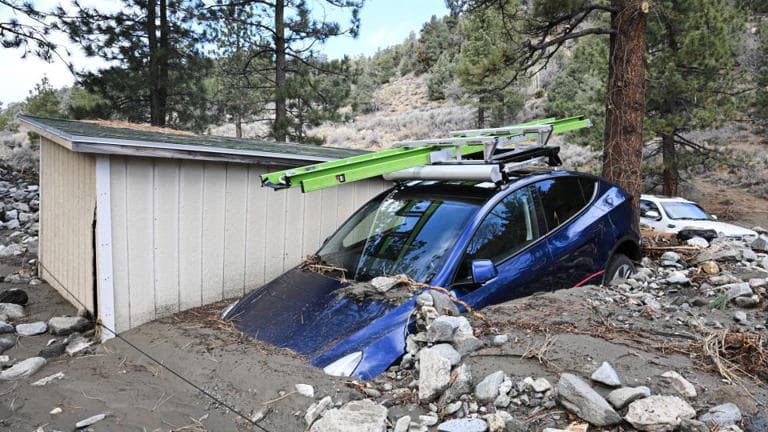
Thank You Pierre! I second the motion! Meanwhile we’ve been fighting mother nature here in Southern California, with high winds and lots of flooding. I had a couple feet of water on parts of this ranch. My 10-kW turbine is manually furled to protect it. Here is a pic from our local mountains.
Dave Santos, talking about TerraWatts, using a dome of triangular fabric sheets, to pull trains up the sides of a crater, then allowing the trains to coast downhill, generating electricty, with no explanation as to how that electricity would reach the grid.
The machine for which I posted the link seems to be a serious matter, despite the mention “200% More Power”, which would mean that the power is tripled. Indeed, since there are two turbines, one might think that the power should be doubled, i.e., “100% More Power”.
Note one point: for some time now, China has been making exponential industrial progress and has surpassed European countries in almost all areas (including the larger and more powerful wind turbines they export, and also AWE which they consider something potentially promising, including also coal plants…).
So, in spite the approximate presentation, I take this as a serious progress.
Hello Pierre: There’s a difference between just making larger versions of other’s bad ideas, and actual innovation. Great info you’ve dug up regarding the larger versions of the failed Altaeros project, etc. I do not believe you will ever see any of the AWE devices you’ve recently found in regular operation, let alone mass-production. The lifetime would be short, the operating expenses high, and the monetary return a negative number.
Never forget the reality new wind energy devices always fall under: “There are a million ways to generate SOME amount of electricity from the wind at SOME cost”, always has been, always will, but is it a better way? is it an economical way? Is the electricity cheaper? Otherwise, such projects are just STUNTS, not serious progress in wind energy. There’s a difference between putting on a show, and providing economical electricity.
Just go back to that guy with his wife, with the Savonius aluminum bucket contraption permanently relegated to brief demo’s in a no-wind parking lot behind a rented industrial building, where the cited advantage is that it visually spins in light winds, “so your mother won’t ask why it isn’t working”… : (Crap so stupid that “You can’t make this stuff up!”)
For most people, who do not know the relevant parameters in wind energy, it all sounds amazing, like they’ve “solved the energy crisis”. Meanwhile anyone with any actual knowledge of the subject matter can immediately explain why the concept is a complete dead-end that will never go anywhere. So far with AWE, most every effort has been in that latter category. Most can be easily disproven, on paper, by simple arithmetic, without wasting the money to build one at all, let alone large versions.
Success in the AWE field is limited to success during tests, which last only a few hours at best (with the notable exception of Kiwee), and are far from allowing any conclusions to be drawn about lifespan or viability. All the AWES tested produced something for very short periods, including Altaeros, SAWES, Makani, SkySails, KitePower, etc. One might even think that behavior in regular operation isn’t even studied (for example, what would be the lifespan of the ultralight wind turbines on the S1500, using very strong winds allowing to achieve the rated power, not to mention the lifespan of the complete machine?): it’s enough for the device to be testable for a few moments.
That said, there is one innovation in SAWES (S1500) compared to Altaeros: it has several wind turbines instead of just one, arranged between the balloon and the outer ring, on a lightweight frame.
Few people would understand that the stated power and weight figures are not realistic at all. The lifetime of the turbines would be measured in mere minutes, or even seconds, as the generators of the stated weight would quickly burn out at the stated power levels. These conversations are about wind energy. They cannot be meaningful without basic knowledge of the subject matter, As it is, they are nonsense, to be disregarded. What you are analyzing are just lies. A fraud. Typical wind energy newbie talk, discussing mere lies as though they have any meaning whatsoever. From beginning to end, it makes no sense and has no real meaning.
I had just said something similar, relying on your previously expressed opinion:
Now, I have a question that I have already asked. Crosswind fly-gen generators (like Makani) could have the same problem of short lifespan, due to producing large amounts of energy (in fits and starts), while being very lightweight. Why had no one raised this issue before Makani’s failure?
Hi Pierre: I know you have been examining this question recently at least. I think it was part of the discussion in the distant past too - I know I always wondered about it. Making tons of power is easy. It’s how to handle that power that is hard. The first thing anyone actually IN wind energy, or who had ever worked on turbines that make a lot of power would wonder is “How much power can those relatively small motors produce, for how long, before overheating???”
The typical learning progression in wind energy is you first learn how to make gobs of power, at which point you start routinely burning out generators, until you get sick of repairing/replacing generators. That’s step 1 in learning wind energy, but nobody in the supposed field of AWE has gone through such a “preschool” experience. Only after getting your rotor under control can you have a machine that can run for hours unattended in strong winds. But even that doesn’t mean it can run for days on end in unrelenting strong winds. So there is quite a long learning curve. “Real wind people” know this. Personally, like any experienced windsmith, I saw it as the obvious issue it was, but assumed that hopefully their engineers had enough training to know what they were up against, and had a handle on the situation. For one thing, the high relative windspeed offered a lot of airflow for cooling fins. The generators got to “rest” during uphill periods, (or maybe had to be run as motors, using power rather than generating power?). And who knew what tricks such “really smart people” might have up their sleeve, right? I mean, this was supposedly “cutting edge” technology. Anyway, I think we can assume if it really made good, reliable power, they wouldn’t have given up so easily, and also would have worked further on their early, smaller models, since that is easier. Not sure if the legacy they left for posterity included an account of what the biggest problems were, but I thought maybe they had something useful til I saw a video of it struggling to complete the uphill sections of a figure-8 path.
The same can be said for the generators of the Chinese S1500 balloon, which would need to capture winds of around 25 m/s to achieve their nominal power (1.2 MW).
Overheating would be a risk for Makani and S1500 turbines, despite the wind speed (relative or actual) cooling the mechanism, as the generators are undersized relative to the power output.
The fact that there are no conventional wind turbines (to my knowledge) operating at full capacity with small generators in very strong winds in extremely windy locations seems to confirm this problem. Otherwise, high-powered small generators would be a possibility for some AWES.
Another big issue. Possible solution: lighter fly-gen AWES.
“It is extremely important that turbines installed in those regions can not only resist typhoons, but also harness the strong gusts in the lead up to their arrival,” Zhu says.
The means to achieve this are not described. Perhaps survival wind speed would be much higher than cut-off wind speed, just like for KiteX (see below), although the article mentions the possibility of “harness the strong gusts…”.
Nominal Wind Speed
7.0 m/s
Cut-in Wind Speed
3 m/s
Cut-off Wind Speed
18 m/s
Survival Wind Speed
42 m/s
Could this lead to AWE wind turbines with the strong winds at high altitude?
While I admire several aspects of the KiteX concept and demo’s, you have to realize what it actually represents.
First, let’s look at the good points:
They started with an automatic pitch-control mechanism, for the blades. This is a good indication - they know that high winds destroy turbines. They paid attention to what wind people already know, and have known for 1000 years and counting, unlike most AWE people.
Their design goes far into the “high capacity factor” realm, or what I call “generator worship”, where everything is about how much energy you can generate, over time, from a small generator. The advantage is, you can cite your small generator capacity as your “nameplate power” denominator, so your numerator is higher, relative to your denominator, thereby claiming a “high capacity factor” since your swept area by far outweighs your generator size. The idea behind this “high capacity factor” approach is that most winds will be in the intermediate range, so a larger rotor with a small generator can capture a lot of total energy during those medium windspeeds, and then throw away (spill) the extra power available in high winds, while still achieving a good overall energy capture, especially tailored for bragging rights over the long-term energy capture versus generator size.
They decided that AWE was a dead end, for them anyway, and gave that as a reason to transition to a tower-mounted device. This at least shows they are actually interested in producing wind power, as opposed to putting on an endless show that leads nowhere, to impress investors and get more free money for doing next to nothing.
For this push toward a high capacity factor, an experienced wind turbine designer has applauded their approach.
So that is all well and good, but I also note some typical not-so-promising symptoms:
Many small wind turbines have taken the automatic pitch control approach, but the mechanisms have always required maintenance, and suffer from wear over time. I’m not sure if there are any such automatic pitch control turbines still in production or operation. They have tended to appear with great fanfare, then silently disappear, which is why this new one seems so revolutionary to all the newbies. For many years, a successful automatic pitch control for small turbines has been seen as a highly-desirable, “wish list”, “holy grail” for small turbines, but so far, other approaches for overspeed protection have predominated, with the pitch control systems wearing out and falling by the wayside. Just sayin’…
The whole “pre-order” marketing approach is a major “symptom” of turbine designs that are actually “not ready for prime-time”. The idea is that customers should have so much faith in a mere stated design approach for an “as-yet-to-be-proven” (let alone mass-produced) turbine that they should “order now, before it’s too late!” to get in on this “incredible opportunity” before the waiting line becomes too long! This approach ignores the trials and tribulations of perfecting a product, placing the onus of the customer to place a bet on a company that can;t get proper long-term testing in high winds accomplished, as though the responsibility for a reliable future product falls to the customer’s faith, rather than a successful proven product available now.
The “high capacity factor” (generator worship) approach, constructing a shrine around a too-small-for-the-swept-area generator, bypasses much of what has been learned over the years about what locations are even suitable for wind energy, and what windspeeds a turbine should be designed to handle. Sure, citing the ability for targeting lighter winds is a thoughtful approach with a compelling reason to get excited for most people who do not live in a windfarm-class wind resource, but so far, such attempts to go after lighter winds have not panned out, and you don’t see too many around, An extreme example would be that guy and his wife with their vertical-axis buckets in a parking lot, hidden from the wind by a building, talking about how the most important thing is for the owner to visually see the turbine spinning in winds too light to produce any power, because emotion is more important than actually producing power. Now that is an extreme case, but the point is, it MAY be not such a great approach to steer a design around established wisdom involving whether to even try wind power in a location where super-cheap and reliable solar might be a better fit.
The turbine is not balanced over the tower: Downwind turbines often suffer from being unbalanced over the tower, which leads to a tendency to lean in a certain direction, due to gravity and a preferential tower lean in one certain direction. This is especially problematic in light winds, often leaving the owner hoping the turbine will properly aim to catch the wind, instead of persistently leaning in a direction that does not allow startup.
I hesitate to mention it, but names like “Windcatcher” are sort of “on a list” of really typical newbie names for failed designs. I’ve noted this in the past, I seem to remember the same name for some offshore newbie-genius design, just off the top of my feeble head. I know it sounds irrelevant, but this just jumps out at me as an “Oh, no, not another one” moment…
Finally, the fact is. wind is more powerful and destructive than any of us wants to acknowledge, and any wear points, such as pitch-control mechanisms and frail components with weak attachment points, may be severely challenged when placed into high winds, or just over the long term in any location, as a storm can strike even a low-wind location and destroy turbines. There is usually a long period of development and failures before any new turbine design has sufficiently proven itself to be a good investment, Otherwise, the buyer is just a “guinea-pig crash-test-dummy” and can expect to get excuses and endless modifications to correct failures, rather than a reliable, trouble-free wind turbine experience.
Our “generator worship” relatively to existing small wind turbine is mainly driven by the development in the electricity markets. In today’s electricity market electricity is worthless when it’s very windy. Secondly export of electricity is generally not rewarded. Even off-grid people now has the idea that they want to be self-sufficient
I’m not particularly fond of automated pitch control, but for our specific design choices it seems to be the best compromise.
I don’t see any alternative to “pre-orders”. That’s what investors want these days…
The Wind Catcher name was chosen for our first product name as it’s meant to appeal to a wide audience that is not wind nerds. I agree it’s a bit might be a bit odd for a 50MW offshore monster, less odd for 220W portable wind turbine.
We started by making and selling +200 Wind Catchers of a very similar design to our TWT-11, such that small issues like the overhang would not catch us by surprise.
Time will tell how it pans out. I certainly think we owe it to ourselves and “everyone” to try
That is actually a very good amount of sales for an early product. Good luck going forward. By the way, in my parlance, “generator worship” is contrasted with “rotor worship” where a shrine is constructed around a rotor, in the form of a concentrating funnel, a downwind diffuser, or both. Typically, these add-ons use way more material than just making the blades a bit longer, with a rotor already the best way to extract energy from a circle of a given diameter, which is why you never see concentrating funnels in the field.
My 21-foot diameter, “10-kW” turbine here has been furled sideways by a winch for a few days of rain, so as to protect the leading edges, and as a precaution against surprise high winds that stormy weather can sometimes bring. The turbine still produces 3-7 kW in medium winds, even when furled, so we still had production. As of this morning, the forecast says no more rain, so I will unfurl it when the sun comes up. We sometimes give up a little energy capture to promote longevity and save service calls. If the turbine is hit by high enough winds, the inverter will “let go” of the turbine, allowing it to spin freely. Even furled sideways, the blade tips can then hit around 400 MPH. Raindrops at this speed can damage the leading edge tape, resulting in noise and eventual blade erosion. Just changing the tape on this turbine at 120 feet high can require a crane, not cheap, better to avoid the damage in the first place.