We have spent 3 to 5 years, trying to find a feasible, high altitude wind project, which would be economic and better than the fossil fuel route. I feel that we have failed and perhaps we should consider the water rotor as a good alternative energy system. This system can contribute, constant power, is easy to install, and maintain, and does not require the awkward additional actions, such as autonomous launch, and land, and adjusting for wind direction changes. The projected cost of electricity is five cents per kilowatt hour and I’m sure we could get less than this by mass producing these turbines. If there are not enough suitable sites to supplying all our energy needs, we can include tidal river rotors, which although they produce more power, have the problem of intermittent operation and the requirement to rotate the system at each tide change. These complications are minor compared to an HAWT. What do you think?
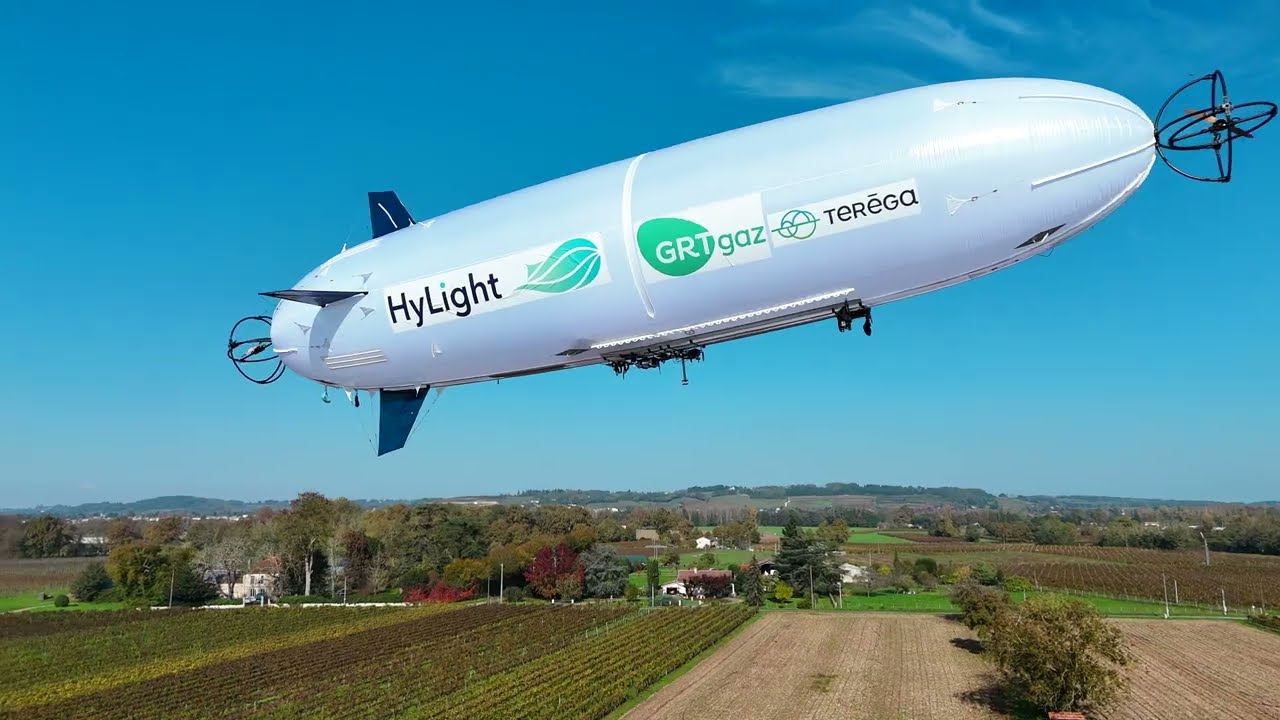
The white disc indicating a text on the envelope, stating that it is inflated with a gas lighter than air (He).
But the article below indicates:
HyLight will be able to develop hydrogen airships on an industrial scale to explore infrastructures in zero-emissions fashion.
The name ‘HyLighter’ seems to suggest a view on hydrogen, but certainly in the future due to regulatory issues related to the danger of flammability.
If this problem is solved, then perhaps some AWE (in addition to those of the airship) doors could open, but nothing is less certain.
1:58 (video in French language): for the final version, the inflation will be with hydrogen, but currently it is helium.

Another video:
I think we could change our methodology to identify a plausible AWE direction.
First, don’t compare with traditional wind turbines, because we’re too far removed from that.
Then, try to see what’s wrong with the various projects. All are penalized: crosswind kite, turbine + aerostat, turbine + kite lifter, tethered-aligned yo-yo, etc.
Ultimately, that’s what we’ve already done. But if we continue, we’ll be able to get a clearer picture and understand why the superior high-altitude wind resources aren’t enough to compensate for the weaknesses, starting with efficiency and reliability.
However, it’s not impossible that the constant examination of AWE possibilities will break through the impasse thanks to scientific discoveries. Everything, therefore, remains to be seen.
Hi Pierre: Another of my repeated sayings is “Wind energy has always been a magnet for crackpots, because wind is invisible, so people can imagine it doing whatever they want, but it does what it wants.”
And as I’ve also pointed out, “AWE is a neodymium super-magnet for crackpots”, because the introduction of another “mysterious” variable makes people think no normal rules apply.
That leads to a retreat to utter fantasy, and people proposing and sometimes building ideas that make no sense. Of course we never know where such a crazy idea might lead, if it sparks another idea that DOES make sense. But that brings to mind the proverbial “waiting for a monkey at a typewriter to author a novel”.
Let’s look at a typical AWE effort. They pretty much all look for “remote islands” or “a remote village” where power is expensive, to rationalize their admittedly-more-expensive-than-a-standard-wind-turbine ideas.
The motivation seems to be to isolate the buyer from other choices, but in reality, the buyer can always choose a regular wind turbine for their remote location. “Small Wind”, as we call sub-utility-scale turbines, has itself been extremely challenged ever since solar panels went from $4/Watt to 40 cents per Watt. Most small wind companies went out of business after that. So I do not think we will ever avoid the need to compare AWE with all other potential energy sources, including, of course, solar. AWE is never going to dominate just because it “seems interesting” or “is fun because we like to fly kites”. It has to actually be better than the other choices. 
If AWE works at high scale, It could be profitable even while being more expensive than other renewable energies, because new resource would be harnessed, expanding the energy mix.
There is a huge scope for reducing fossil pollution (see China), and even in the event of a nuclear revival, AWE would not be in excess if the ease of implementation and the reliability remain reasonable.
I agree there is big hope for the future of AWE and the need to cut fossile based power generation is urgent. I was merely pointing out that the overall activity level is much lower than I was hoping for.
Seems to me too many $ that went into AWE were either «lets put a shitload of money into doing this right», then doing someone’s idea of right but leaving out incremental development, OR just goofing around with a novel idea.
Seems like making sound, incremental projects with medium budget and team size is something the world is not well rigged for.
Right after feeling obligated to bring my Popular Science Invention of the Year AWE turbine to the first High Altitude Wind Power (HAWP) conference in what was it - 2009(?) I felt very alone as the ONLY person there who knew ANYTHING WHATSOEVER about wind energy.
I was just blown away at the level of ignorance, and all the unworkable nonsense the participants talked about. From that point on, I’ve warned anyone who would listen that the field of AWE would go nowhere, due to that lack of - forget “understanding” - there was not even any actual “INTEREST” in how wind energy actually works.
I was briefly swayed by Makani, thinking that all that Google money and the amount of CAD and CFD computer modeling must be showing something that would work, but no, they turned out to be as ignorant as the rest, giving up after what was obviously a “convenient crash” of their prototype. Imagine giving up on a promising project after a single crash! Obviously, by that point, even these people could see that their project was NOT in fact promising.
I mean, seriously, I had still expected them to fail, because “there are a million ways to make SOME amount of power from the wind at SOME cost”, but if the end result doesn’t beat the status quo, and cannot provide an affordable solution, it goes nowhere.
Nonetheless, nobody expects early prototypes to be more economical than established technology, but at least it has to “work” in the sense of being put into production and used, then the cost can be reduced with more experience and volume production.
I had anticipated Makani to at LEAST get a system up and running SOMEWHERE, for SOME amount of time, powering SOME number of homes, as they promised, even though it would eventually disprove the operational and economic viability.
And when Skysails came out with their 100kW+ output numbers, I also thought THEY would have a few systems out there making useful amounts of power for some time, until it also proved to be fun, but more problematic and expensive than regular wind turbines,
What I did NOT expect was for NONE of the “teams” to EVER have ANYTHING in regular operation, NEVER powering even a SINGLE home, after almost 20 years of trying.
So I turned out to be more right than even I had thought. The whole AWE thing turned out to be a complete nothing-burger. The 1000-plus “really smart people” pursuing it turned out to be no more ahead of any curve than all the previous wind-energy-wannabe crackpots who had come before them.
Just as the Pleistocene mammals had misunderstood the fluid nature of what had appeared to be solid ground at The La Brea Tar Pits, and died trying, all the AWE efforts of Holocene ground-dwelling primate mammals have similarly died, through misunderstanding the true fluid characteristics of the wind resource. History repeats…
To this day, it’s hard for even me to believe it has turned out this bad. How could that many people be THIS BAD at anything?
I think it is a matter of whether peoples’ brains and minds have a model of the world around them that reflects reality, versus fantasy.
As always, the wind energy fantasy is thinking one can just jump into a field encompassing 2000 years of continual, incremental improvement, then, knowing nothing about it, improve on it by mere instinct and reflex.
Another problem is whether that brain and mind can accurately model what the opportunity for AWE success actually IS - is there even anything “there” in thinking there is a possibility of providing economical power from the wind with flying devices?
THEN can that same mind and brain accurately model HOW to take advantage of that opportunity - what approach even makes sense or has ANY likelihood of EVEN being OPERATIONAL, let alone an actual success?
THEN, can that same mind and brain effectively EXECUTE the idea it has, hopefully accurately flagged as a valid answer?
It appears to me that the combined minds and brains of the entire wannabe AWE community have failed in ALL of these categories of thinking.
So here we are - nowhere, discussing whether an obviously way-too-expensive, oversized copycat idea, nonetheless actually built, could POSSIBLY make as much power, at as light of a weight as claimed, with a swept area obviously way too small to make more than about 10% of the power claimed, as known by ANYONE with the SLIGHTEST amount of even THE MOST BASIC wind energy knowledge.
So, after 18 years of ignorance, false trails, and empty promises, here we are…
Hi Doug, it is about Minesto (in water), but could apply to (in air) crosswind kites.
Kites are not good converters for wind power, unlike rotating blades. This applies both underwater and in the air. However kites could be useful lifters.
In a certain sense, this is rather good news for electricity generation AWE, as it allows to focus on what might work.
Despite the criticisms that can be made (particularly regarding the required high wind speed for the MW range of the S1500), it seems that China (after Altaeros) has found a promising path with SAWES, while the parachute device does not seem to be progressing.
I also try something with torus.
Hello Pierre: I disagree that putting a lot of money behind the ducted blimp idea make it a good idea. My analysis remains:
-
the cost of building and operating a blimp does not rationalize the amount of power that can be generated, and that
-
everything you’re reading with regard to the supposed MW output capabilities of this concept is simply false information.
Whenever you have someone claiming to “beat the betz coefficient”, that is another red flag - Think: “Dave Santos”… It means they know nothing about the subject, as the betz coefficient is based on the entire intercepted area of the device, so funneling more wind thru a small rotor does not increase the Betz coefficient, but actually lowers it, since the bare rotor achieves the highest fraction of the Betz coefficient, and it goes down from there.
By this point, I’m truly surprised that, as one of the only logical minds addressing the concepts of AWE, you can still be fooled this easily! Flashy websites, outlandish claims, and lots of money spent, do not change the basic rules of physics and economics! Remember when Makani had everyone fooled?
How many times do you need to hear the same lies from a hundred sources before you remember the story of The Boy Who Cried Wolf? The developers of these devices are, far from cutting edge innovators, unable to discerns a proven bad idea, and instead thinking they can do what is really a bad idea, better! Yes, they are doing “it” better - generating false information rather than the stated output, wasting more money on a project that will lead nowhere!
What truly amazes me is that, after 18 years of debunking endless nonsense, the conversation yet remains at the very lowest elementary school level where the most basic concepts of wind energy remain to be even acknowledged, let alone comprehended, and people are still believing utter nonsense and lies in lieu of simple facts!
5 posts were merged into an existing topic: Questions about Moderation
The news is the very recent redesign of the AWEIA website, including new features.
Traditional wind turbines are becoming increasingly efficient and are being developed more and more.
However, after more than 15 years of intensive research, AWE has stagnated despite some notable occasional advances.
AWE has the advantage of high-altitude winds, and paradoxically, too much diversity of methods against it, which struggle to succeed, all of them have the disadvantage of having to ensure both flight and energy production.
Some related topics:
High altitude wind energy? Or to market now? - Analysis / Industry and Market Analysis - AWESystems Forum
Low Level Jets (LLJs) - Analysis / Resource Analysis / Meteorology - AWESystems Forum
This last point is often raised. But, in an initial period, harnessing high altitude wind seems to have been a trigger for AWE. If we combine these two points, we could suggest that AWE is something mobile for high-altitude winds.
So here’s a suggestion: use a live wind map to find the wind where it is, rather than waiting for it to arrive: that’s what AWE could do.
In this case, the ground stations could be trucks moving from one charging point (the electricity produced being fed into the point) to another depending on the wind conditions.
AWE should add a resource rather than rather than trying to subtract a portion from traditional wind energy.
Is there a more detailed specification on Kitemill’s KM2?
From presentation videos I got 45kN pull force and 120kW power during pulling, which leads to a 2.66m/s rope speed and if 1/3 wind speed rule is applied, then that amount of power should be generated in a 8m/sec wind. I recall some figures for kite weight and wing span - 60 kg and 16m, but that might be wrong since I can’t find them now.
I doubt my memory because this seems a very high wing loading (4.5tons) for a 60kg frame 1.33% frame weight/lift force . If wing area is 20sqm (just assuming here leading to an AR of 12.8) then wing loading is 2250N /m2 requiring a forward speed in the range of ~60m/sec (216km/h) and a total L/D ratio of 22.5 (*), which is quite high, leading to a 2kN (45kN/22.5) total drag . If a dyneema rope of 12mm is used it would have ~12tons breaking strength, less than 3x safety margin. With rope drag alone having a significant slice of the total drag.
Edit: (*) is wrong, apparent wind speed is twice the 2.66m/sec rope speed, which means a more reasonable ~11 value for total L/D ratio.
Indeed (from 0:09):
It is confimed on the video on
But “60 kg” looks to be a very low and improbable mass of the kite. I would think a few hundred kilograms. The video provides a value of 5 T, but including the ground station.
That said 45 kN and 100 or 120 kW look to be estimates from the theory. 45 kN could also be a peak value, not necessarily an average value during production reel-out phase. Real measurements on the field with the wind speed at kite height would give a better idea.
But “60 kg” looks to be a very low and improbable mass of the kite
Yeah, that’s the KM1’s weight at 20kwatt, 7.4m wingspan, mentioned here https://wes.copernicus.org/preprints/wes-2025-193/wes-2025-193.pdf
4 posts were merged into an existing topic: Betz limit and power available in the wind
A post was merged into an existing topic: Power to space use ratio
Harmony Turbines | The Perfect Small Scale Wind Turbine? - YouTube
These people say regular wind turbines suck, are ugly, noisy, and don’t work. Their solution will go nowhere because it is a too complicated version of the least-effective type (Savonius), a huge monstrosity that suppsedly produces 400 Watts. That’s the power of a 4-foot diameter propeller.
Their stated advantage is it visually spins in light winds, so your mom won’t ask why it isn’t spinning in a no-wind environment, because people want to feel good about it, even if the winds are too light for it to be generating any power. They actually say the appearance of it spinning in light winds is more important than producing power! Of course they avoid any mention of a power curve, or any actual numbers regarding energy production.
The know-nothing interviewers also promote products like the Aptera solar powered car, which has been in the prototype stage for over a decade. They do not understand simple power arithmetic, and cannot discern empty talk from progress.
Just one more example of how “wind is invisible so people can imagine whatever they want, but the wind does what it does”, and so people who do not understand how wind works make all the typical beginner mistakes.
They are claiming the old chart showing how inefficient the Savomius design is compared to other turbine types is wrong, because maybe someone was paid $30,000 to make Savonius look bad, to promote regular wind turbines, and that Savonius not only makes over 30% efficiency, but DaBiri’s clustering effect can make them even more efficient! Idiocy piled upon idiocy.
They mention their main target market is boats, while their turbines are made from steel and aluminum, so good luck with their monstrosities on boat decks in that salt-water environment!
These people are not headed for The La Brea Tar Pits, they are already stuck in the tar, and do not know it yet. Idiot designers, idiot interviewers, idiot investors - “idiots, idiots, idiots” It’s not a joke, It’s the facts! Maybe a lesson in their somewhere - gee, ya think?