Yeah I think probably I was wrong this time. The rotating drone concept would work well in terms of the wing profile direction. You only need to be able to change the pitch a lot. And I guess it could be challenging to find a foil that works well for both propelling and power generation.
But no need for changing rotation direction or 180 degree flips of blades. 40-60 degrees is probably adequate.
About twisting the wing, I couldnt comment without giving it more thought. It may be har to het something to work well across the operational window.
I’d say a foil with a consistent radius on the top surface, from a sharp leading edge to a sharp trailing edge, might characterize my first attempt at such a rotor. But the bluntness of a leading edge actually helps lift a lot, so maybe the lower edge could be made somewhat blunt for more efficient wind energy use. At least the option to add extra power for a short time, to compensate for less efficiency, could work just to get something airborne. And fewer moving parts (no pitch control) is always an advantage in wind energy, where durability is paramount.
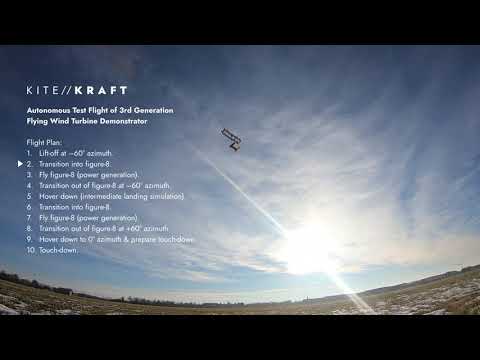
Transition from hover to forward looks to be solved by Kitekraft.
I wonder if the efficiency of the propellers in takeoff mode is not sacrificed for the benefit of efficiency in generation mode. This would be a lesser evil considering that we do not take off and land all the time, while the production of electricity is or should be constant.
Ok. I was thinking about using props for take off and production [dual use blades]. This was done by Makani also, though that project was cancelled before we could all see if it worked.
You can add Kitemill to the list of companies that solved transition from hover to forward I guess. We do this on a regular basis. Of course, once you do that, you are faced with new, more detailed, issues to be dealt with. Something like this is not just solved or unsolved.
For Kitemill’s approach to this, tether reeling is an important ingredient. The original video is showing an untethered drone. To return to that video, I am not sure if untethered flight is super relevant for AWE. You could of course use onboard props for the transition, but because you are already most certainly flying on a taut tether, it may make more sense to just reel in the tether then the kite should fly forward. This is easier said than done though.
If you are not flying on a taut [edit thanks pierre] tether then how to reel out the tether quickly and how to prevent the tether from getting caught in the props or ground obstacles…
Yes, but for Kitemill the motor-propeller are used only for take-off, transition, and landing, since generation is ensured by reeling in yo-yo mode, if I am right. So I guess the issue of double use for the blades looks to not apply.
Well. But still it is apples and oranges, as the system initially shown is without tether, so with the tether, the design space would be quite different.
I dont think transition to hover tethered flight is the «crux» in taking off from ground through going to production. Eg. Going from 0 m altitude to 30 m is certainly more challenging, in real life conditions. Tether is so short kite dynamics are crazy fast, and tether has no curvature to act as damping. Even just flying VTOL on a tether in general is more challenging than the transition IMHO. I would count that double if your design was something like Makani, there the wing areas (main wing and tail) are not contributing to flight authority in gusty winds.
Once at a certain altitude many maneuvers could work; the simplest being just switch off props, a kite designed as an aircraft should fall into a dive and you are done. Or, fly left to right [slithering] to gradually increase flying speed. Or, reverse pumping [winch launch]. Or many other ways I suppose.