It is true that the lightness of the Kiwee blades has been particularly sought after.
To try to approximate the mass difference between a Kiwee type turbine and a conventional wind turbine, we will assume that the main pulley of the Kiwee could have approximately the same mass as the hub of said conventional wind turbine.
From there, the mass of the Kiwee rotor including the blades and the pulley would be roughly the same as that of the conventional rotor including the blades and the hub.
It seems that in the following two examples (the first in the French language), the scale has no influence, with the mass of the rotor including the hub and blades being about half the mass of the nacelle (generator unit) without the rotor.
The entire nacelle with rotor would therefore be three times heavier than a Kiwee rotor of the same power, which is considerable even if it is much less than in the quoted example.
6.7 tons for one blade. 36 tons for the rotor. 68 tons for the nacelle.
The rotor mass (blades and hub) is roughly 1/2 the nacelle mass.
Highlights
• The foundations to design lightweight structures for electrical generators have been set up.
• Wind turbine electrical generator structures have been modelled and designed using low density materials.
• A comparison between a steel structure and the composite structure revealed a mass difference of 43% in favour of the composite structure.
• Potential enhancements have been proposed with a view to carry out more ambitious structural optimizations.
After these last few comments highlighting the problem of the weight of a conventional wind turbine on board, how can we not mention the achievements of KiteX?
Weight nacelle of 130 kg + weight rotor of 60 kg = 190 kg.
I would make two remarks.
We find approximately this proportion, even though we do not have a hub in the classical sense of the term for TWT-11.
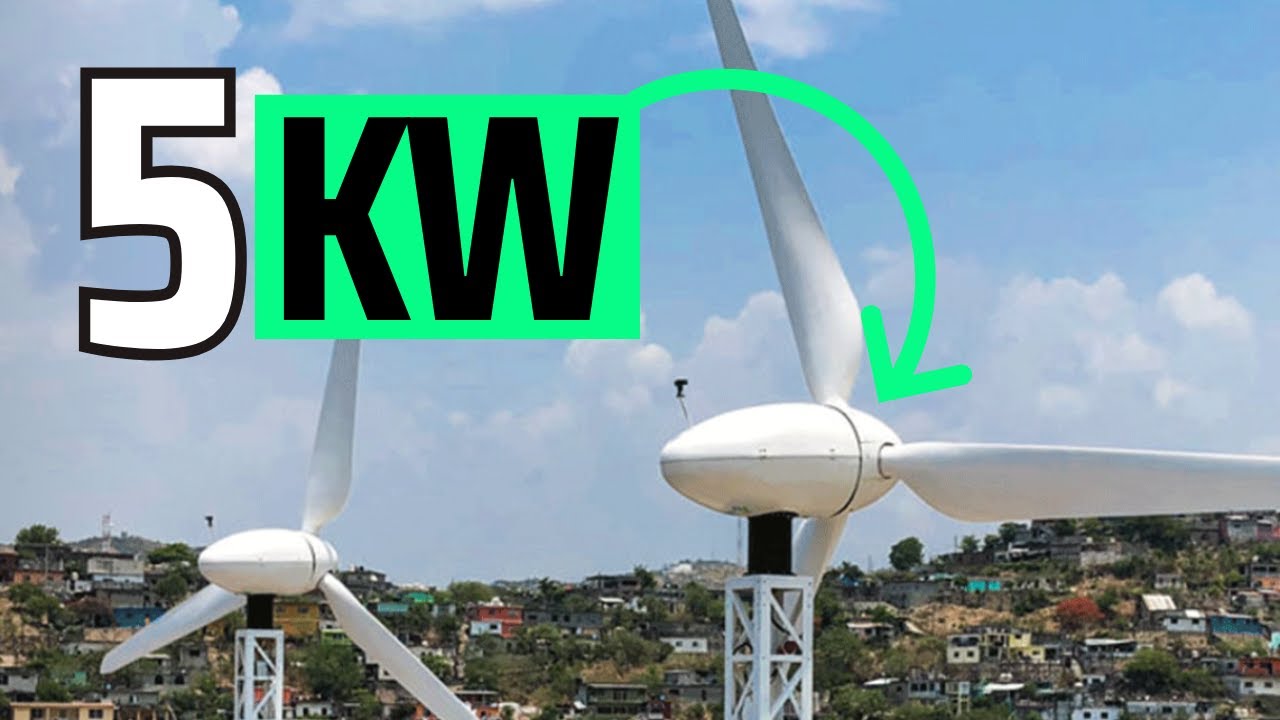
Second remark: the mass (190 kg) is close to that of a conventional wind turbine of also 5 kW (165 kg, video below), with a rotor diameter of only 4.3 m, but designed for a nominal wind speed of about 12 m/s (see the curve in the video below, at 2:07).
It seems that the mass depends on the desired power.
TWT-11 is designed for low wind speeds, allowing for higher production in the year at equal mass.
But since an AWES is designed for strong winds at high altitudes, would it be possible to design something like TWT-11, but for a nominal wind speed of 15 m/s for example? Would its mass then become comparable to that of a traditional wind turbine of the same dimensions (rotor diameter 11 m) but designed for winds of 15 m/s?
Here is an email from @dougselsam, providing some clues on how to gain in lightness.
Hello Pierre: Yes I saw what you posted. Lots of good posts from you, as usual. I was trying to at least somewhat participate in the discussion through emailing you. Was hoping my point, of the possibility of making a generator lighter in weight was at least ascribed to me, by you. I do remember us having a similar conversation previously on the chat group, where I pointed out how it’s easy to BRIEFLY get a HUGE amount of power from a small generator, and in response you asked me if I thought this might explain Makani giving up their effort, knowing their generators overheat if used for long duration continuous output. Anyway, here are a couple of videos showing one of my early prototypes, at WIndpower 2007 in Los Angeles in an on-road demo for an NREL Scientist, and in Blackstar Canyon. where it exceeded 5000 Watts, shown on meters, using a generator weighing 30 lbs., designed and built by me. I could reduce that weight too, if needed. I normally use a thicker stator (heavier) stack to get more power, but this was an early model. Still. these generators are best when the SUSTAINED output is limited to about 1000 Watts, since hour after hour of sustained output above 1000 Watts will eventually cause sufficient heating that a hot spot will develop in the stator, then spread to a larger area, to the point of ruining the stator, which would then be cooked and require a rewind or be thrown away. The viewer may note that I was at a real wind conference, with real wind people in attendance, not just a bunch of delusional know-nothing helpless big-talkers.
Thanks, and if you could just copy-paste this email into a post and say it was an email from me, on your topic, I’d appreciate that. Thanks again! Doug
Breakthrough tiny wind turbine boosts energy output by 83% with 35% less weight
Wind tunnel tests revealed that the turbine can reach up to 450 revolutions per minute and deliver a power output of 2,500 watts at a wind speed of about 32.8 feet per second (10 meters per second).
If this is confirmed, it could also constitute a lead for lighter wind turbines in flight.
In the meantime, see the power curve of a 8 kg 3 kW wind turbine: 3 kW at 15 m/s wind speed, and up to 5 kW at 23 m/s wind speed (how much in a real world? If these measurements are verified and the wind turbine withstands over time, this can be interesting for stronger winds at high altitude), sold in France for a little over 400 euros, just below.
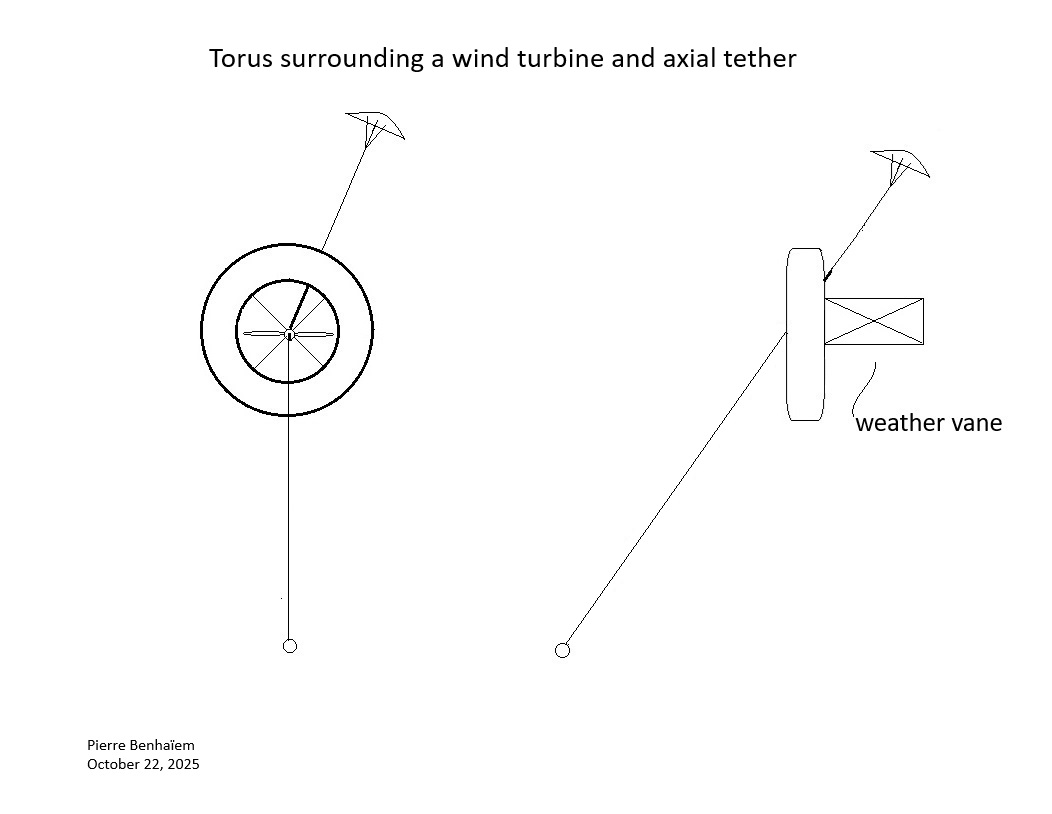
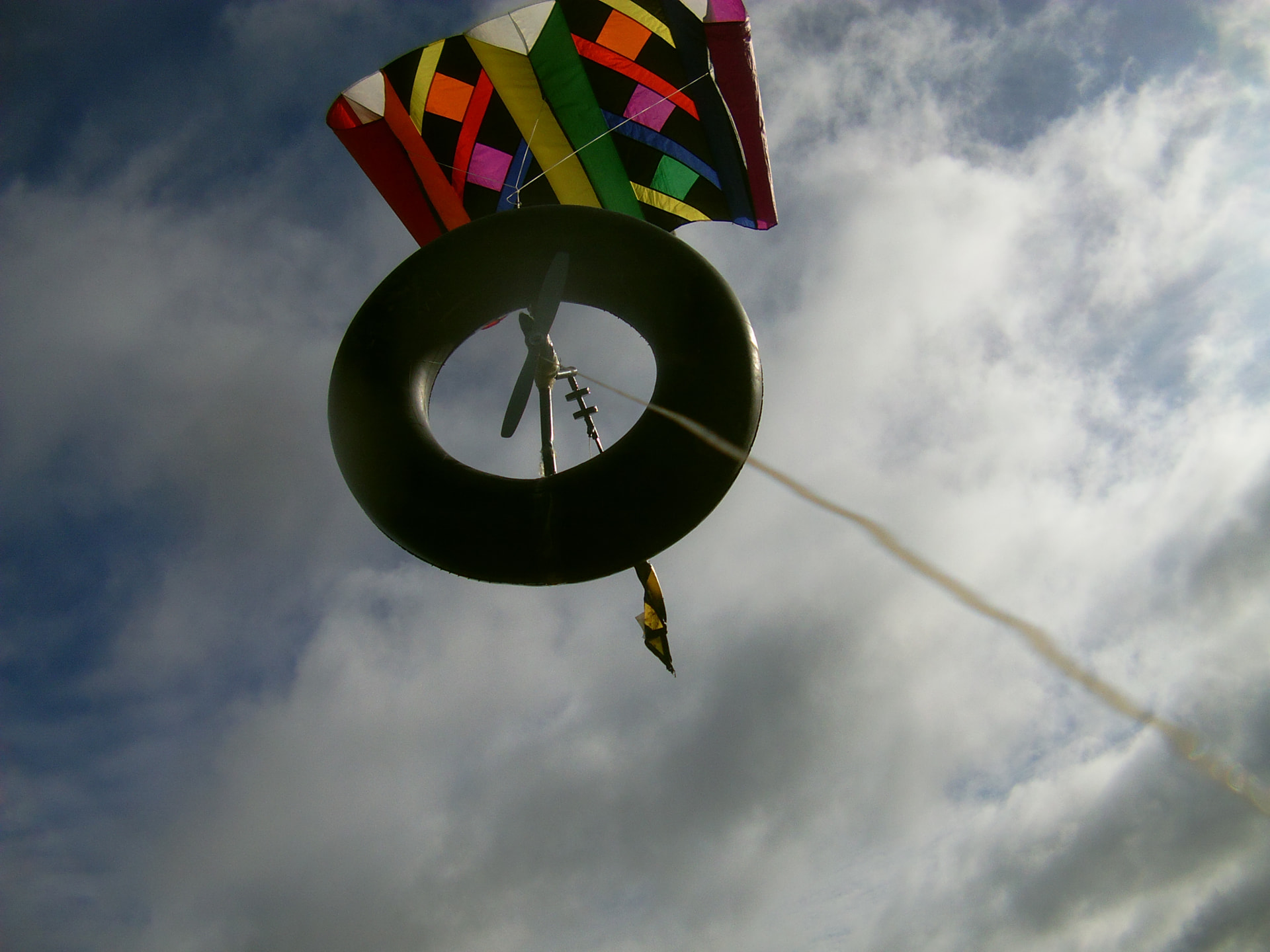
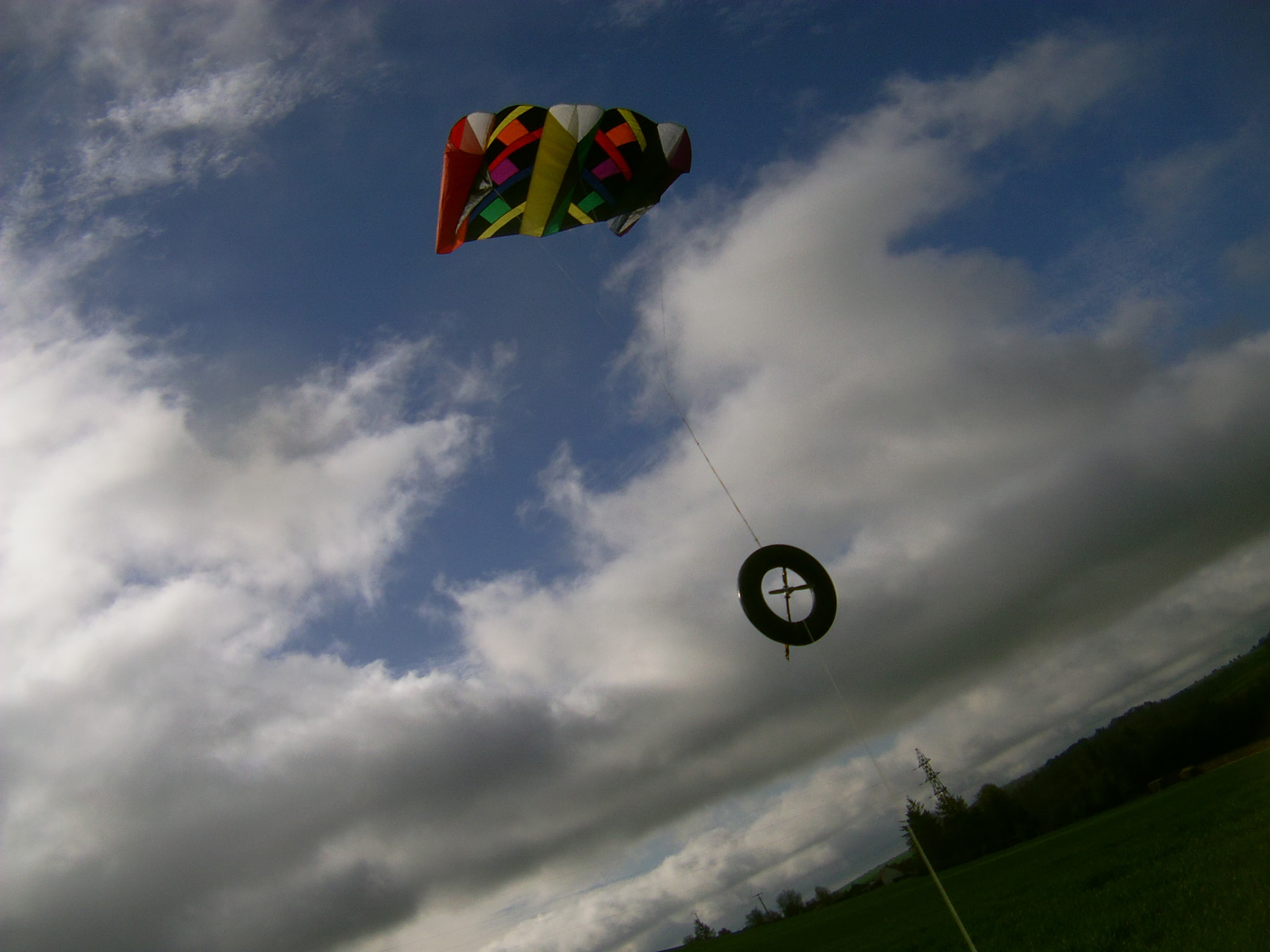
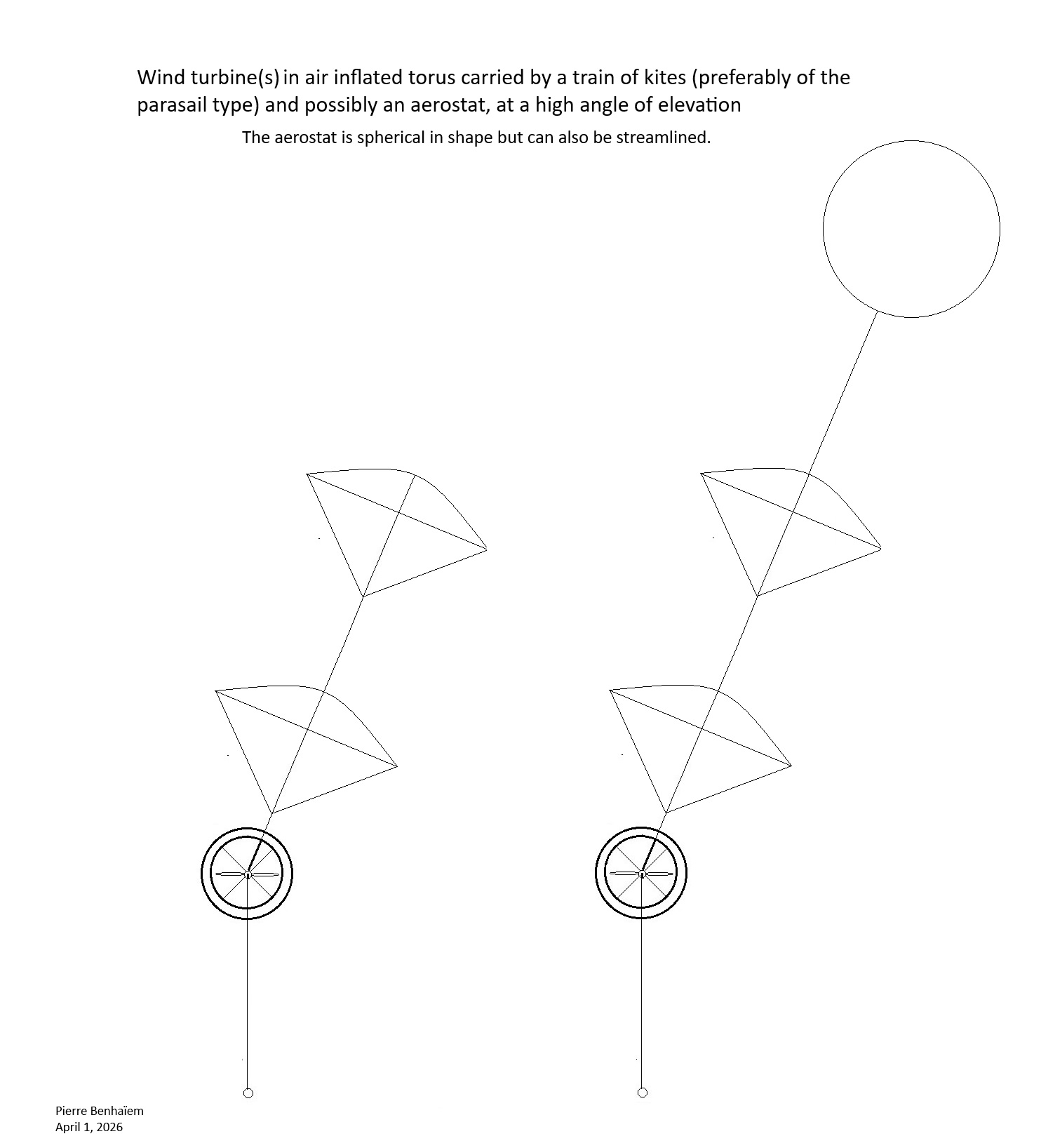
With the wind turbine described above, assuming a rotor diameter of about 2.5 m, a torus with an outer diameter of 4.725 m and an inner diameter of 2.7 m, aerostatic lift of about 10 kg, could be carried by a lifter kite even with light winds.
Thus, we have a regular wind turbine, an aerostat (torus), and a lifter kite.
The moment I saw the title of this post I knew it had to be you. You may remember the crackpot vertical-axis turbine promoter we recently suffered through on Linked-In: He had the same bragging point as the guy and his wife with vertical-axis merry-go-round turbine with folding aluminum buckets in a parking lot next to a wind-blocking industrial building. “It begins spinning at only 2 m/s!” “You don’t have to explain to your mother why it is not visually spinning!” All just stupid-talk. Wind is invisible, so the wannabe wind idiots can run amok and most people won’t know the difference. in fact the main article is interrupted by a little window addressing the Archimedes cone-shaped monstrosity/joke, so most readers will think that is what the article is about.
I’ve seen articles on this supposed “breakthrough” for years, and it is just a regular wind turbine with a slightly different way to make the blade that will probably turn out to be too weak to survive high winds. There’ no way a turbine that light can produce that much power. There;s a lack of pictures or any real info, because they just want to have their press-release with no questions asked. All complete BS.
As a real wind person pointed out in that discussion on Linked-In, there is pretty much zero energy available at such low wind speeds, therefor it is just idiot talk. There seems to be no limit to the amount of idiot talk AWE wannabes will not only tolerate, but embrace!
Interesting that there are no pictures of this supposed world-changing machine. Let me tell you what it really is: They make each blade in two halves that are bonded together to make a hollow blade. It has a very fat root, which allows it to start spinning at low wind speeds. So. like the vertical-axis idiots promoting their garbage, their target customer is someone who has no decent wind resource, and who therefore should NOT even CONSIDER wind energy for their poor-wind site. Other than that, the claims made for that turbine are obviously exaggerated There is a typical lack of info. No good photos or even diagrams. It’s just one more “press-release breakthrough” and it is not worth discussing. It is one more wannabe wind energy nothingburger. The reference you provided shows that it is not even available for sale anymore, if it ever was. Have a McDay!
You dwell on aspects that hardly interest me: the fact that it starts to turn at 2.7 m/s instead of 4 m/s is not the most important thing for high-altitude wind turbines. However, if this model is more efficient (with strong winds), why not? As for the sturdiness of the blades, we’ll have to wait and see.
It’s true that references to snail-type wind turbines, which are not efficient at all, confuse the message, but I don’t mind.
This led me to an existing small, low-cost wind turbine, whose power curve increases up to a wind speed of 23 m/s, which intrigued me: see my previous message.
To get to the heart of the matter, it seems to me that an AWES should include a regular wind turbine and efforts should be made to make it as light as possible.
Wait, I “dwell”? On the relevant facts? “Aspects that hardly interest you”? Oh, you mean all the aspects that determine how the stupid thing can possibly work? The aspects that real wind people see at a glance as typical newbie nonsense? Those aspects?
Well, your endlessly-self-conflicting assertions convey at least an ongoing curiosity and interest in airborne versions of wind energy, but the fact remains that any conversation about wind energy with people with zero experience with real working wind energy systems is always extremely limited, and always fraught with the same old typical newbie errors.
In this case you see one more “press-release breakthrough” about some supposed “innovation” in turbine design, lighter than necessary, developed by wind newbies who are unfamiliar with all the well-established design drivers for working wind turbines that can last even a few hours in a strong wind, let alone decades, and here we are, back “discussing” the latest offerings of a press-release describing an innocently hopeful prototype by the latest “Professor Crackpot” who is under mind control, afflicted with “global warming derangement syndrome” thinking that logic, experience, and facts won’t matter, just the good professor’s typical newbie gut instinct with all the typical beginner mistakes included, such as “it starts at low windspeeds!” (like no real wind people ever thought of that), and “it’s lighter weight” as though their inexperience in turbine design and manufacturing are somehow an “advantage” when in reality, this mere prototype would likely demonstrate once again, for the thousandth time, how strong wind turbines need to be to survive, how heavy the generator must be to handle sustained high winds, etc., while all these simple facts are lost on the perpetual newbie crowd.
Ome day you are pronouncing AWE as a failed dead-end, with no hope of success, ever, by any means, going on to say the forums are a waste of time and you are never going to post again, and a few days later you are back on the latest forum, defending “Professor Crackpot’s” latest offering, saying it belongs in the sky!
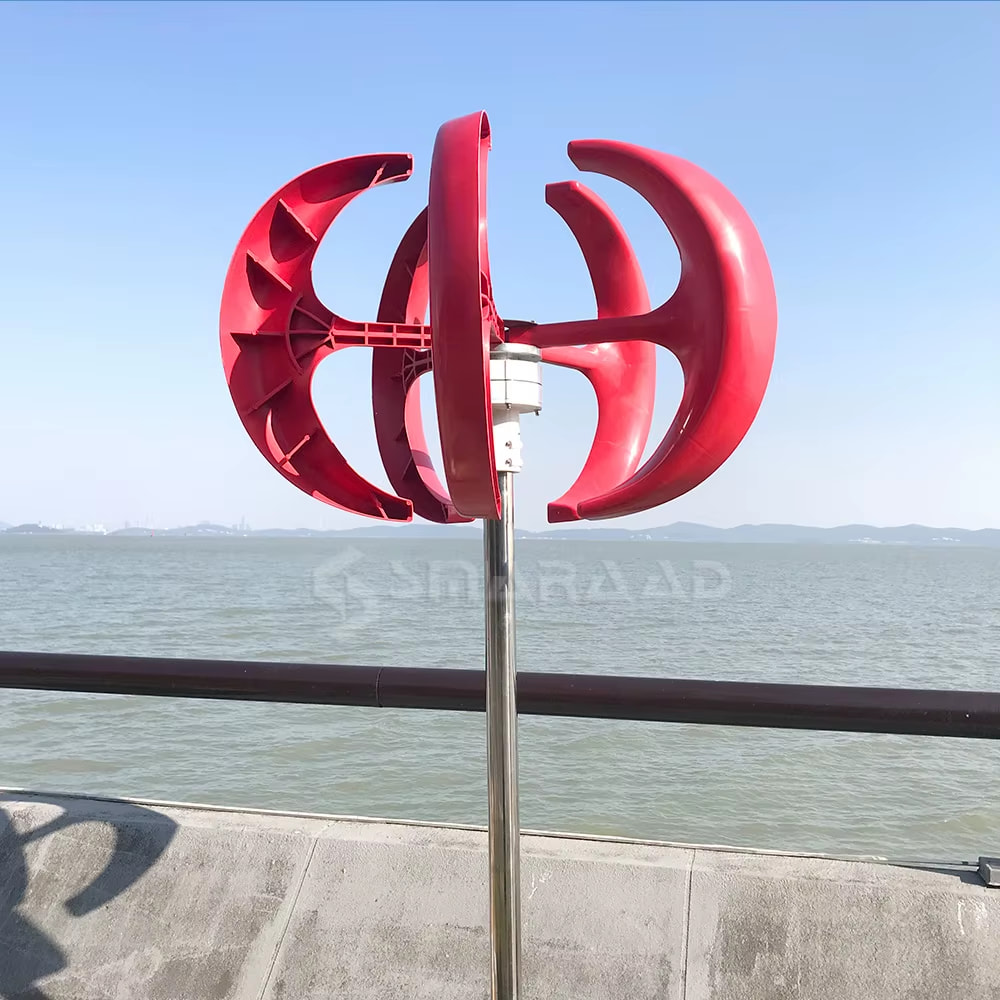
There you go: a drag-based vertical-axis plastic toy turbine, with less than one square meter of swept area, claiming 5000 Watts in the title, then 3000 Watts as you read on, then less and less wattage as you see the tables in the description, while any “real wind person” (a term you have protested in the past) would ignore or just consider as humor.
You recently pointed me to a discussion of a drag-based, roof-mounted, vertical-axis turbine on Linked-in that included “real wind people” and you could see the result: Everybody in the discussion told the V-A advocate who had started the discussion that he was 100% full of hot air and knew nothing about the subject matter and was lying. Nobody defended him. Everybody knew the deal. Everybody but the V-A turbine seller himself, who as we noticed, wrote almost identically to that person we often bring up here, but who is no longer allowed to post here. It only illustrates that some people have good writing skills, but zero engineering, logic, or math comprehension.
Anyway, sure it would be nice to suddenly have a lighter weight turbine to hang from a kite, but as always, the tradeoffs between instantaneous power output capacity, and the ability to maintain high output for hours or days on end, do not change just because a know-nothing “author” or “journalist” stumbles across the latest “Professor Crackpot” press-release “breakthrough”.
These discussions would not even take place in a venue of 100% experienced wind energy people. It’s only perpetual newbies with their feet firmly dug in against ever learning or knowing anything about wind energy who can endlessly go on repeating the lies of other wind newbies. Real wind people just laugh at the absurdity of it all.
Anyway, you have asked me in the past why I think no “real wind people” have ever been involved with AWE. Well, one reason is that they understand the subject matter, what works and what doesn’t, and another is they have experience in running real wind systems so they know what survives and what fails, how much generator weight it takes to make a certain amount of steady-state power, how wind energy needs to be “set-it-and-forget-it”, and how any wear points are problematic for longevity and must be eliminated to the extent possible. Awe people instead focus on whether people will spend their days flying AWE systems “over New York City”, climbing around on ropes at thousand of feet in the air over traffic, piloting kites for zero pay, but instead “for the honor”… - yes this was actually a real discussion by that same idiot on these same forums! Well, I hate to break the news, but “real wind people” are just a liitle more aware of reality than that…
I am examining every AWE possibility, so far I haven’t seen anything promising.
If a regular wind turbine should be used, given that mass and drag cannot be reduced to a certain extent (which remains to be seen concerning the mass), hydrogen-filled balloons remain an option in addition to kites whose lift remains low and subject to wind variations, as helium is too expensive and scarce. Hydrogen is not currently reused, and if it is, there should be no moving parts involved.
For individual use, corresponding to an external diameter of the torus of about 3.5 m to about 22 m, the configuration can be a thick torus inflated with helium, or a thin torus inflated with air, and a lifter kite (favorite solution) or an aerostat.
The photos show an approximation of the kite’s dimensions relative to the wind turbine, which is tiny in comparison. Launching a large wind turbine requires considerable lift, which can be achieved by a train of kites plus a hydrogen-inflated aerostat. AWE is expected to be much more expensive than traditional wind power, but that’s the price to pay for a more abundant resource.
For utility-scale, when several elements are planned, the torus can be inflated with air to mitigate the complexity and the cost. Thus, an aerostat without moving parts causing frictions could be preferred to allow the use of hydrogen, which is cheaper and more widespread than helium. In addition, a train of kites provides the required variable lift proportional to wind speed […]
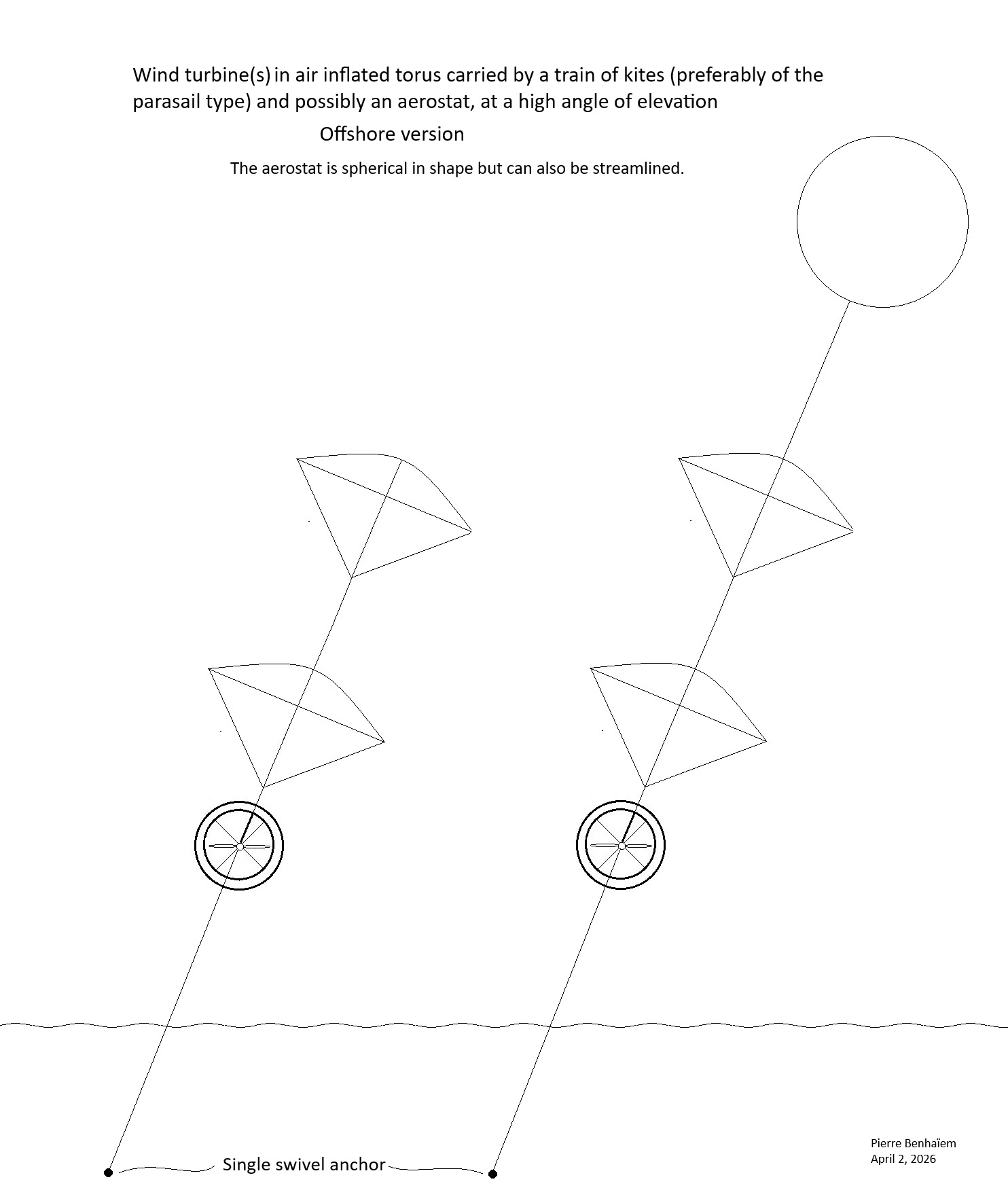
An offshore version with a single pivoting anchor is being studied. The torus with the windturbine(s) inside can also be used as a floating platform at rest.
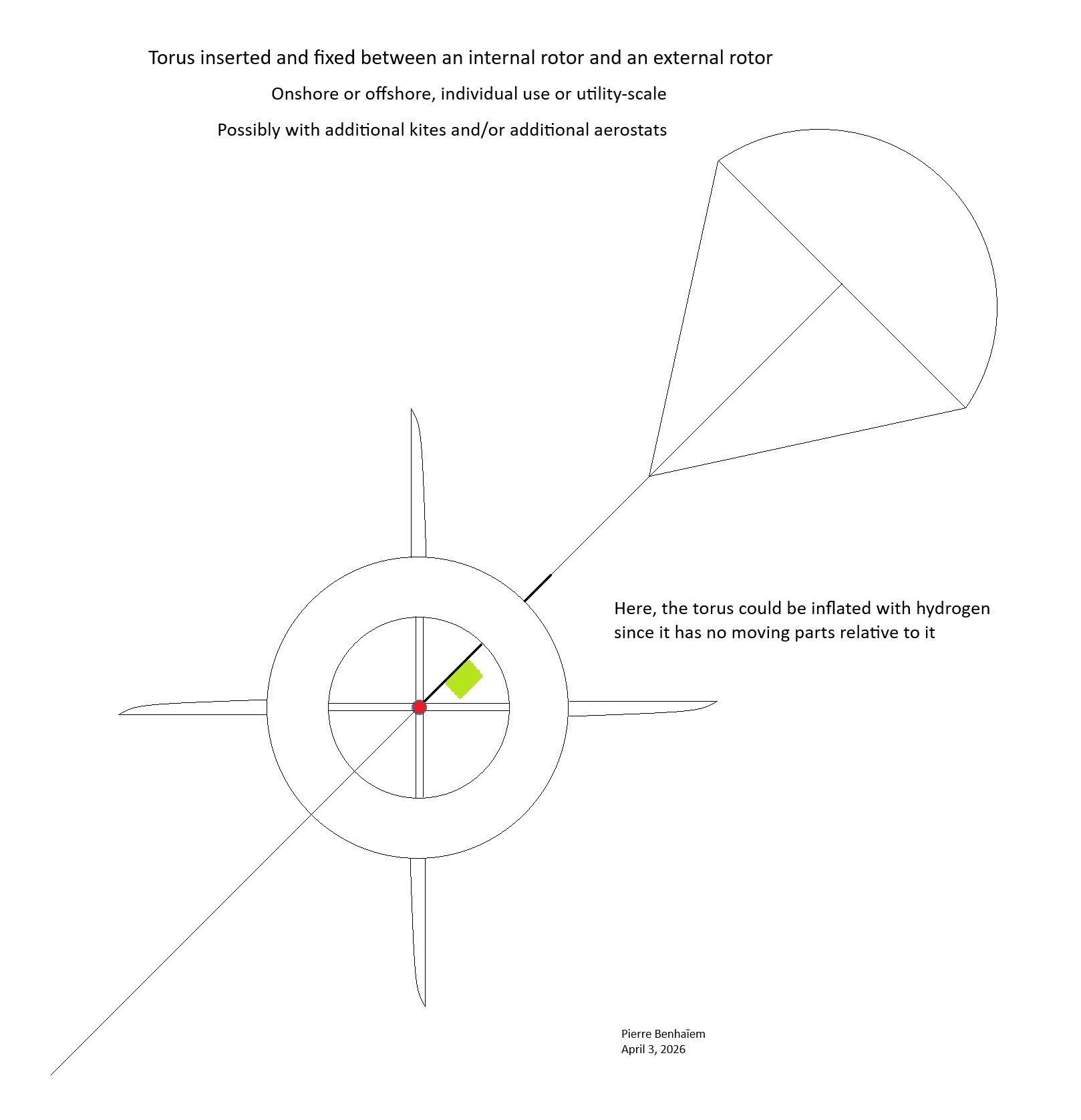
Said torus could be inflated with hydrogen because it does not have moving parts nearby, such as blades. Indeed, the internal and external blades rotate with the torus, so there is no relative movement with respect to the torus itself. The volume in the torus could lead to a sufficient aerostatic lift, although additional kite(s) or/and aerostat(s) could be implemented.
Moreover, the internal blades (slower because they are closer to the central generator) act like spokes, reinforcing the structure.
Thus, this design is simpler and more robust and could scale further. However, the external blades do not benefit from the protection and wind acceleration provided by the torus.

 Doug
Doug