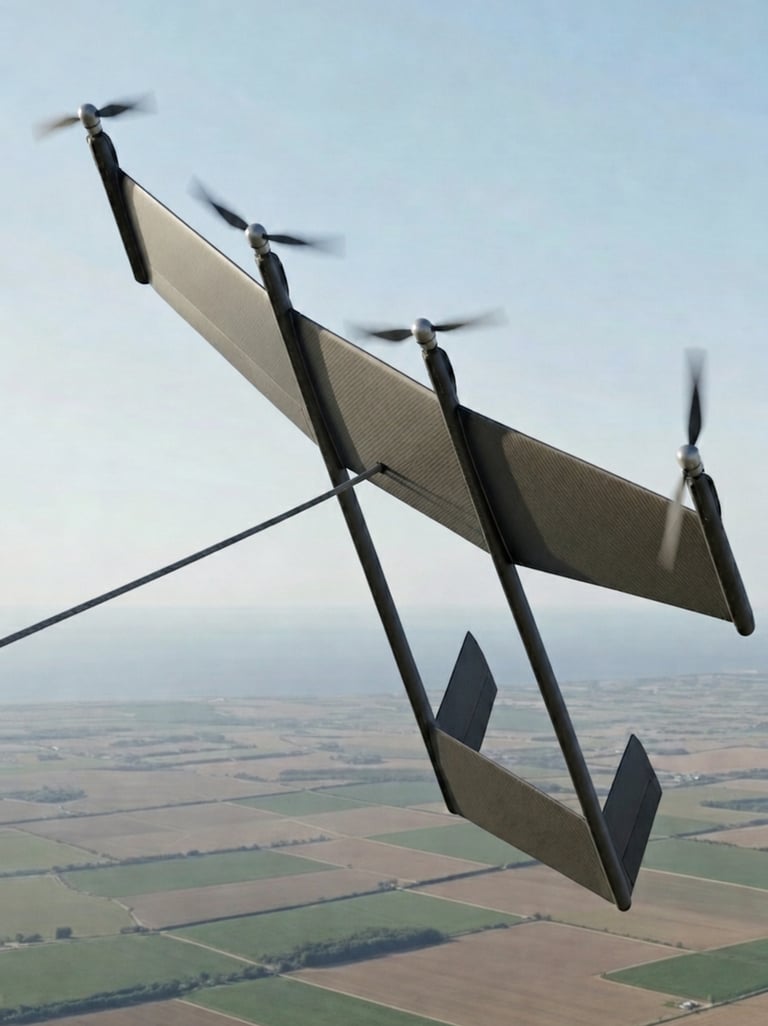
A few quotes from the thesis are mentioned, allowing us to highlight a few key points of the concept behind Ventoplani.
Page 41:
Windplanes are expected to reach higher capacity factors than conventional turbines because of the lower CapEx, thus they have lower rated wind speed. Wind turbines typically reach rated power at ≈ 10 m/s.
We chose here to design the windplane and the tether, which is the component transmitting the aerodynamic thrust to the ground, at a wind velocity representative of the rated wind speed for windplanes vw = 7 m/s.
Page 42:
The design lift coefficient is found to be ˆCL ≈0.70 for all designs, corresponding to the maximum lift-to-drag ratio of the airfoil.
Page 45:
To minimize the power dissipated in parasite drag, the wing speed ratio shall be as constant as possible. To obtain a constant velocity, the onboard turbines should convert all the potential energy to electric energy, avoiding the conversion to kinetic energy.
Page 48:
If the wing is designed to operate at the maximum lift-to-drag ratio of the airfoil, the optimal wing aspect ratio is finite and has a low value. Low aspect ratio designs are easier to be manufactured and meet the weight requirements. Gravitational potential energy is being exchanged with kinetic energy, aerodynamic energy and electric energy over one revolution.
Pages 105 and 106 (Conclusions):
Since the reference area is taken to be a function of just the wingspan, looking for the design which maximizes this power coefficient is equivalent to posing the question “Given a wingspan, which design maximizes power?”.
The optimal designs are obtained by operating the wing at the maximum lift-to-drag of the airfoil. Airfoils designed for high lift-to-drag ratio are used for wind turbines and shall also be used for windplanes.
The aspect ratio for windplanes has a similar physical meaning to the solidity for wind turbines. The optimal aspect ratio is finite, as the optimal solidity for wind turbines, and has a low value.
If gravity is included in the model, the gravitational potential energy is being exchanged with the kinetic energy, the aerodynamic energy and the electric energy over one revolution. Since this exchange comes with an associated efficiency, the plane mass and the related trajectory are designed to reduce the potential energy fluctuating over the loop. Reducing the potential energy means reducing the turning radius and the mass. However, for decreasing turning radii, the available wind power decreases because the windplane sweeps a lower area. For these two conflicting reasons, the optimal mass is finite. Depending on the independent variables, extremely light designs might then be not required.
My first opinion: it seems that there are interesting elements to study, including gravity (see just above), as well as the question raised right away: “Given a wingspan, which design maximizes power?”