Not AWE but an interesting application of the «large diameter turbine». Curious to hear what you make of this
So those are great claims if you’re going to meet investors in posh suits who never left the city.
I presume it was all AI generated for a "make a business plan " slop quote
I agree it looks too much AI generated, at least too much to the level of detail the idea has been pushed, but I think the concept might have some assets and could be further improved. Might it be interesting from a structural point of view ?
This design is just more typical know-nothing newbie nonsense, without bothering to go into the details. All their claims are more typical ignorant, inexperienced, wishful thinking, and nothing more. Anyone who can’t see that at a glance is also a know-nothing perpetual newbie. 
This design was discussed a long time ago. The other name of WhisperRing was Megawindforce.
Some notable thoughts in the previous discussion are cited below.
In addition large-diameter generators raise the issue of very large and very expensive slewing bearings.
In this old discussion, an alternative solution was mentioned with the link below.
Beyond this, increasing generator size makes it more and more difficult to guarantee that direct-drive turbines can maintain the size of the air gap, i.e., the radial distance between the generator rotor and stator.
The solution
This is where the LIGHTWIND project comes in. Its objective is to develop a lightweight, segmented drive train for offshore wind turbines based on the patented OptiGen technology. This modular generator concept with roller-rail assembly results in a much more compact design and reduced weight even as the power increases.
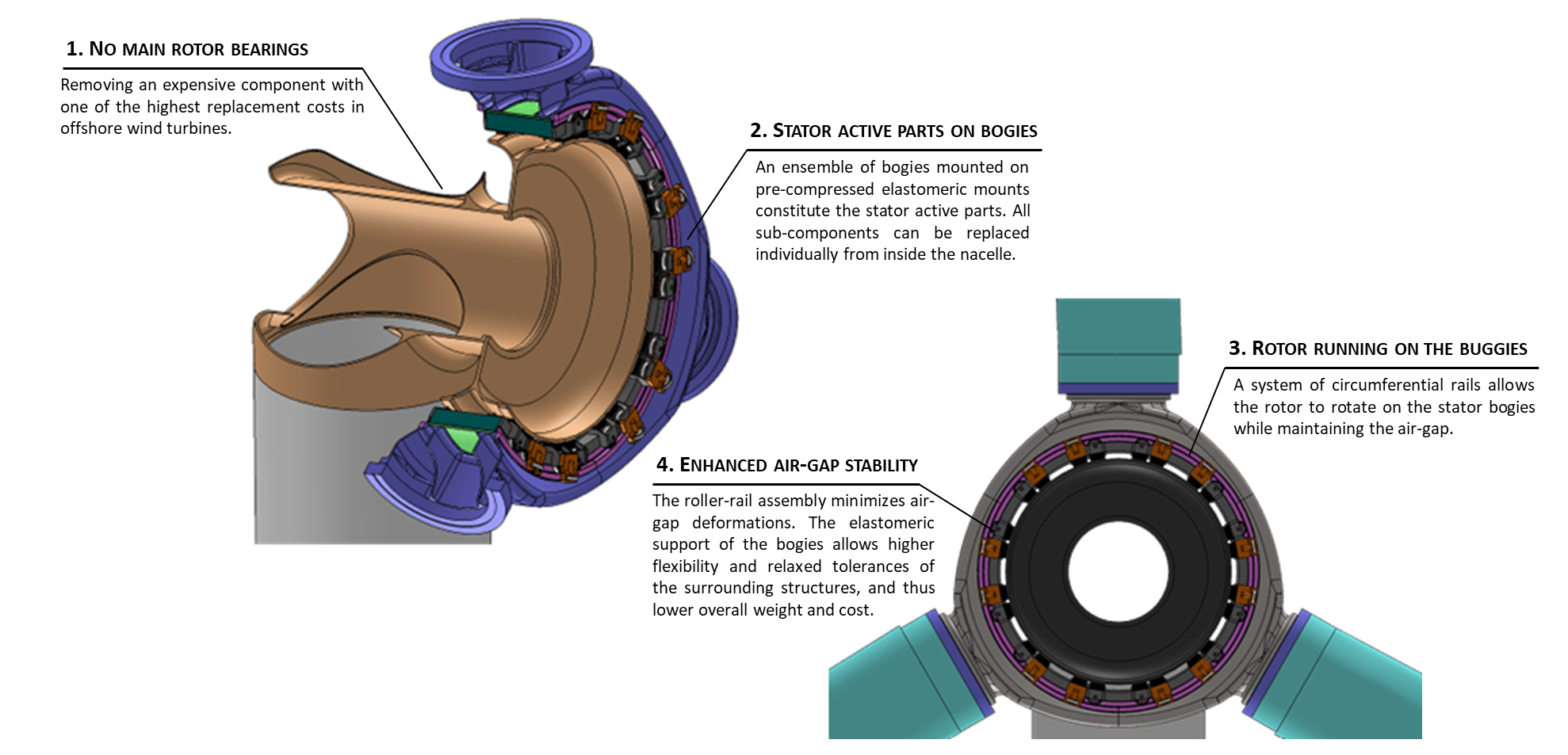
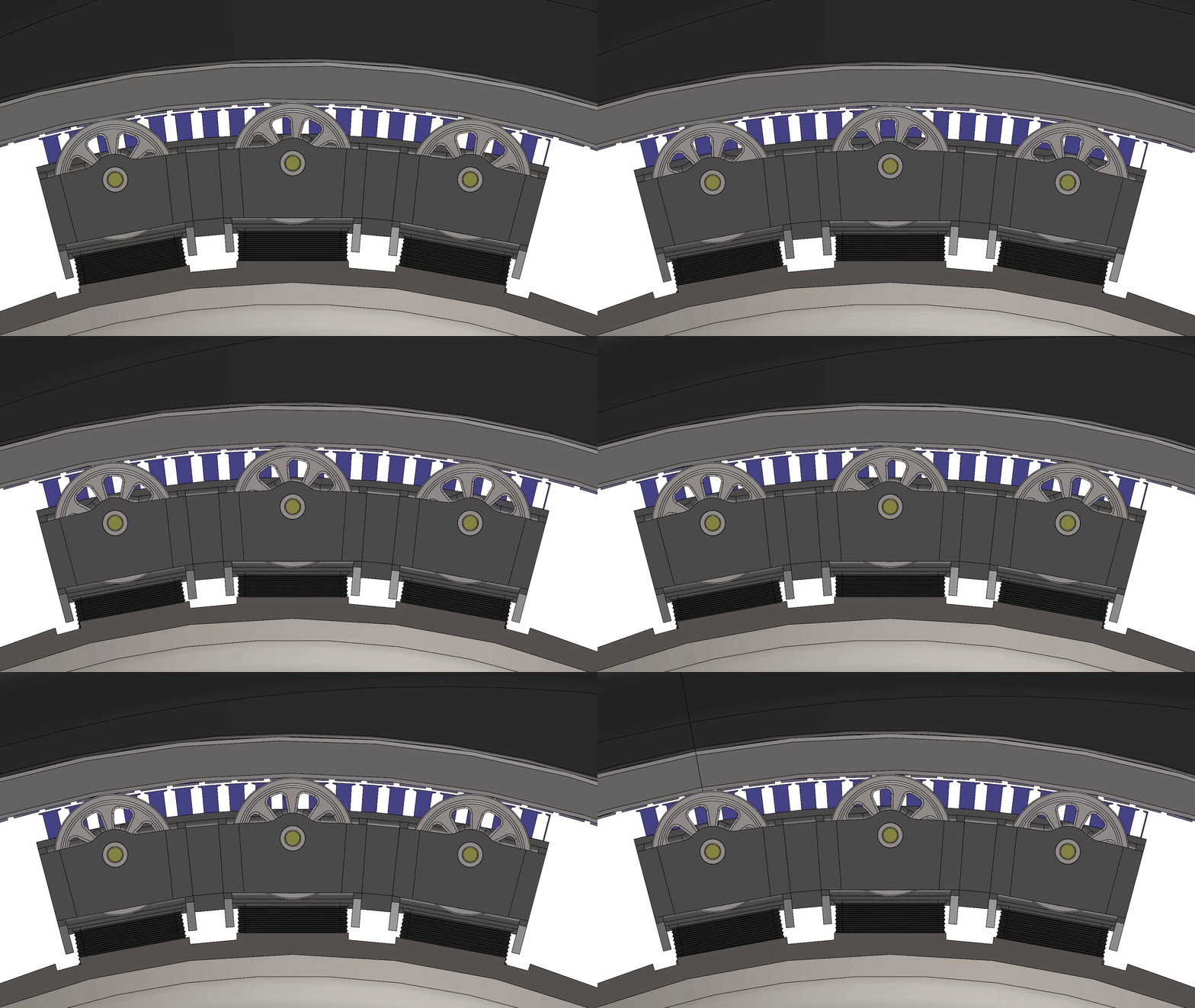
What is your opinion on this wheel-rail concept compared to slewing bearings? Some possibilities for AWE?
After a second look, it seems to me that the wheel-rail system could lack resistance to wind force, compared to slewing bearings.
In any case, it seems that very large diameter generators, although designed for a higher peripheral speed and therefore a lower expected mass (which could be advantageous for AWE), present implementation issues.
I tried to transfer something of large diameter to an AWES here, using concentric toroidal ballutes. But the inflatable torus, although being lighter, could have insufficient rigidity, in addition to other issues.