And at 11:45, there is an indication that the tower would be pressurized to 100 atmospheres. I don’t think this could work with Tensairity™ structures whose inflation pressure (with continuous adjustment by fan) is very low, barely above atmospheric pressure if I remember correctly. But for a smaller version of the tower, why not?
At 14:42, “an active tower that would lean under the force of the wind”, see the graph with deformations, as well as Figures 4A, 4B, and 4C of the patent below.
I would like to know how flywheels, extreme pressures, helium or hydrogen inflation, are managed. There are some indications in the patents, for example this one, mentioning a gyroscopic wheel 660 (Fig. 3B) as a flywheel:
As usua;, the conversation degenerates into idle dreaming, without any structural basis, knowledge of the real forces. especially with regard to wind forces. Typical “Professor Crackpot” territory. Just cuz something “sounds good” doesn’t mean it makes any sense.
There are no tori. The original concept has inflated “cells.” A lattice tower could have tensairity beams making up the lattice.
Those are all unnecessary add-ons to the main idea, an inflatable tower, so are distractions.
More useful distractions would for example be the materials you would choose, the desired strength of the beams, their internal pressure, the tensile strength of the materials, resistance to wear and UV radiation, and so on.
And why an inflatable tower is interesting: the height you can make a tower is dependent on the specific strength of the materials you use. That means that a wooden tower has a higher theoretical maximum height than a steel tower for example. Perhaps an inflatable tower has a higher limit still, while being mostly air, so while being relatively inexpensive.
How do you make the connection between the potential height of an inflatable tower and that of a wooden tower or another type?
Now here is a list of the tallest structures in the world. You can see structures of type “skyscraper”, “lattice tower”, “guyed mast” and a few others, where steel plays a leading role.
I do not see inflatable towers.
I do not see wooden towers.
US9085897B2 patent I mentioned here includes “flywheels, extreme pressures, helium or hydrogen inflation” as means to achieve the 20 km tower.
Since it is not possible to predict whether such a project is feasible, it is best to stick to the existing wind turbine structures, being steel towers, in tube or lattice, or concrete towers, as shown below.
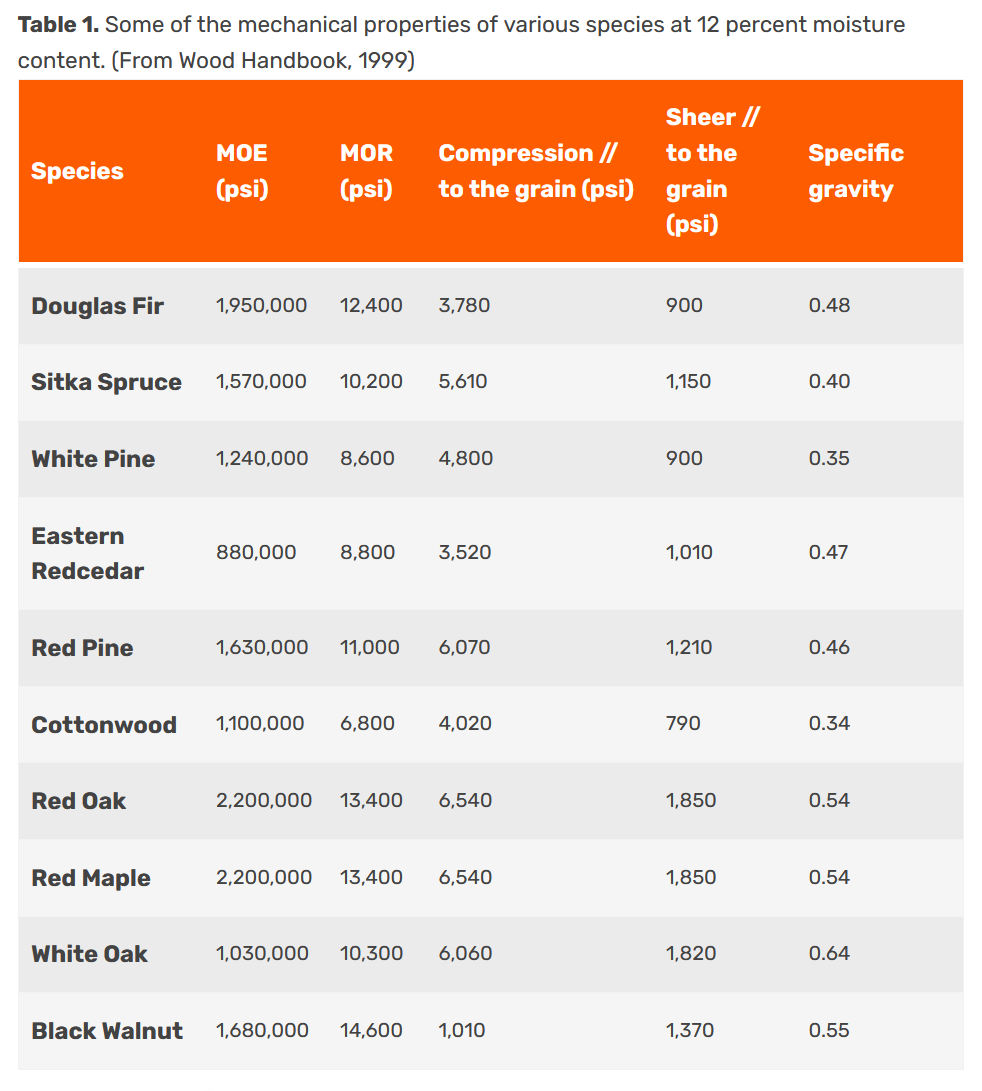
The compressive strength of a material tells you how much weight you need to crush a piece of a material (of a certain cross-sectional area). You take that weight, and divide it by the weight of a one meter length of the material (with the same cross-sectional area), and you get the maximum theoretical height you can make a tower from that material.
See also the breaking length from the Wikipedia article. For pine that is apparently 22.7 kilometers. For steel it is 4.73 kilometers. For dyneema it is 378 kilometers.
Parallel to the grain white pine can take 4800 psi (33 MPa) (perpendicular to the grain it is almost 10 times weaker). So a cross-sectional area of 1 m^2 can be crushed by 33 Mpa / 9.8 = 3.37 Mkg. Its density is 350 kg/m^3. So if my calculation is correct the theoretical maximum height of a tower made from pine (with the same cross-sectional area at the bottom as at the top) is 3.37 Mkg / 350 kg = 9621 meters.
You can do the same calculation for steel.
I imagine the calculation for an inflated beam, or a tower made from inflated beams, is going to be more involved, probably involving hoop stress.
That is the last limit. Earlier limits are bending strength and wind loads for example. To mitigate those you change the cross-sectional area of the tower. You make it a tube to make it stronger against bending, and perhaps you allow it to rotate and make it a teardrop shape for wind loads, or make it a lattice tower instead.
From the Wikipedia article about “Specific strength”:
Another way to describe specific strength is breaking length, also known as self support length: the maximum length of a vertical column of the material (assuming a fixed cross-section) that could suspend its own weight when supported only at the top.
It follows that by itself, the specific strength of the material used is far from sufficient to determine the height of a tower. Otherwise, how can we explain that steel plays a major role in the tallest structures and wind turbine towers? There are other mechanical constraints depending on the materials considered: here are two (below). There are also structural features.