After some analyses and recent experiences, it turns out that the rope-drive system is not operable unlike, for example, that of the Kitewinder Kiwee One [5]. The patent [31] indicates a problem when the pulley guiding plan (here around the Savonius or Darrieus H-VAWT rotor) is perpendicular to the axis of rotation. This problem is not solved with the addition of the lifter kite. This conclusion is also applicable to similar devices [32 and 34].
It is the reason why a last design is sketched, including ring generators aloft.
(PDF) Vertical axis wind turbine(s) connected to Flettner or Sharp balloons. Available from: https://www.researchgate.net/publication/384229571_Vertical_axis_wind_turbines_connected_to_Flettner_or_Sharp_balloons [accessed Aug 30 2025].
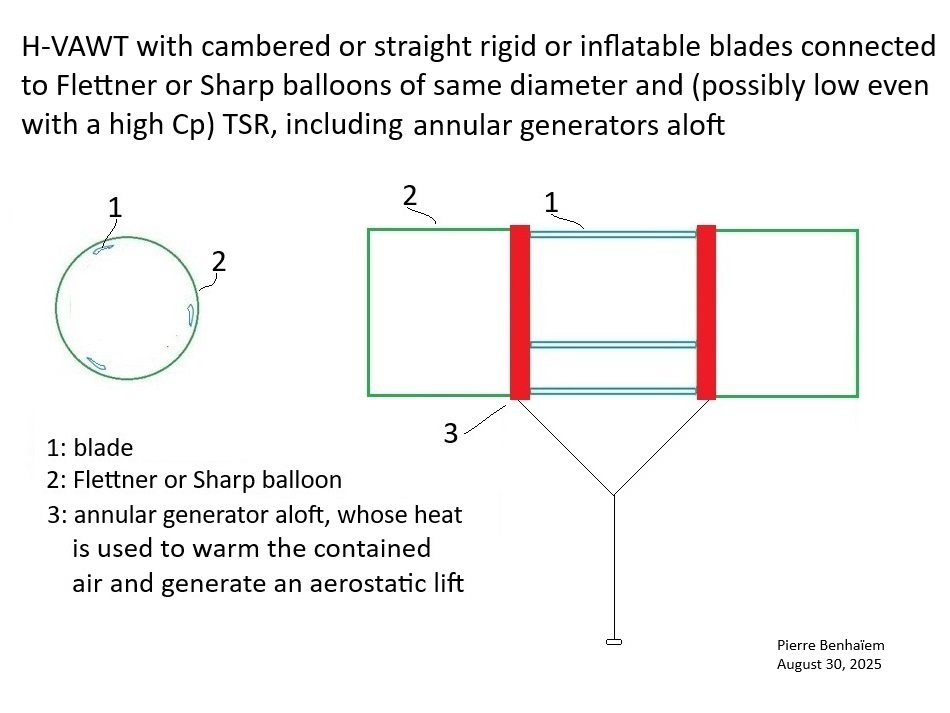
Annular generators aloft for the variant above (Numerical assumptions…), static flight
The difficulty of rope-drive transmission is circumvented by the implementation of ring generators, the stators being the fixed parts hold with the tethers also conveying electricity, while the rotors rotate at the same time as both balloons and H-VAWT. This arrangement looks to be the more promising among the others in this preprint.
Takeoff and landing are facilitated and can be automated. Indeed, the AWES can rest on the ground and land via the shells covering the fixed stators of the respective generators which are used as motors to initiate rotation and takeoff, while the balloons benefit from a slight aerostatic lift from the heat produced by the motor-generators.
(PDF) Vertical axis wind turbine(s) connected to Flettner or Sharp balloons. Available from: https://www.researchgate.net/publication/384229571_Vertical_axis_wind_turbines_connected_to_Flettner_or_Sharp_balloons [accessed Aug 30 2025].