Self-rotating Magnus effect-based balloon in pumping mode or as a lifter
An excerpt:
Vertical axis wind turbine(s) connected to Magnus effect-based balloon(s) in pumping mode or as lifter
The high solidity, due to the requirement of a high-power coefficient despite a low tip speed ratio (TSR) [15], is also an advantage for a better connection between the balloon(s) and VAWT(s). Furthermore, high solidity allows for a higher torque, which facilitates starting. The low TSR reduces the time to accelerate the rotation and the time to stop it.
We still do not know the positive or/and negative impact of VAWTs on overall efficiency in pumping mode for the whole, especially when a possibly more powerful vertical trajectory [13] is used, knowing that VAWTs only create drag aside wind power.
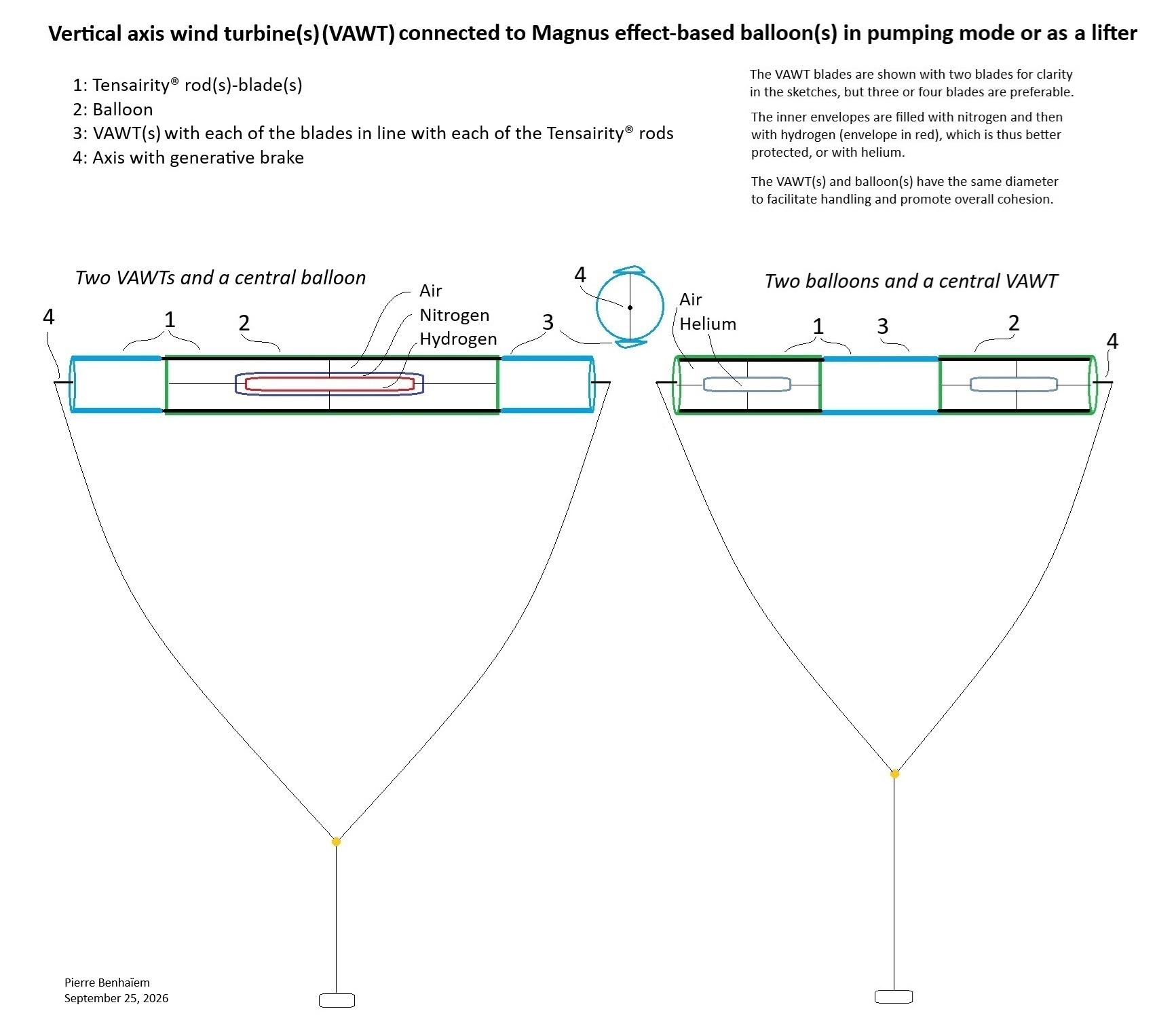
A Tensairity ® [10] rod also becomes a support for an inline VAWT blade at each end when a central Magnus balloon is installed; or conversely one Tensairity ® rod in each of the two end Magnus balloons becomes a support for an inline VAWT blade when a central VAWT is installed, each of the Tensairity ® rods being then on either side of each of the blades. This results in two symmetrical arrangements, preferable for flight balance. These symmetrical arrangements can be explained again as below.
When the balloon is central, two VAWTs are aligned on either side of the Tensairity ® rods in their extensions, with one blade in line on either side of each Tensairity ® rod, thus carrying two blades.
When the VAWT is central (experiment on video) [11], two Tensairity ® rods are aligned with one blade of said central VAWT.
Besides the two previous symmetrical configurations, we can also have an asymmetrical configuration with a VAWT for a balloon (experiment on video) [12] with Tensairity ® rods-blades, so one Tensairity ® rod per VAWT blade.
Three or four blades per VAWT may be preferable and correspond respectively to three or four Tensairity ® rods or pairs of Tensairity ® rods. Furthermore, compression elements (Tensairity ® rods) on several sides of the inflatable beam are useful when the load direction changes [10] due to wind force distribution during rotation and allow for improved balancing during rotation. Therefore, Tensairity ® rods have a dual function: they contribute to rigidity as we know and serve as supports for the inline blades.
The inflation methods (an inner hydrogen-filled envelope inside a nitrogen-filled envelope, inside an outer air-filled envelope; or a helium-filled envelope inside an outer air-filled envelope) outlined in the sketches are interchangeable.