Experiment Findings is a rarely used category that fits the content well. The content has been completed with outdoor experiments. Some excerpts in addition to the sketch and the photos above:
Experiments of the elements with a fan
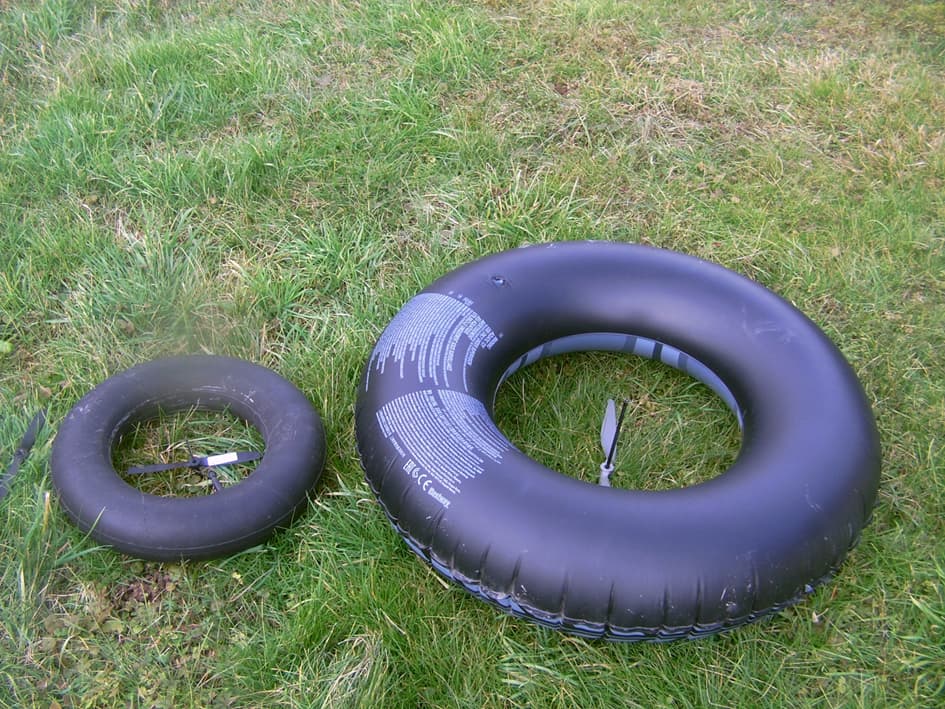
With a 40 cm diameter fan, I experimented a 23 cm diameter propeller alone, then inside a tire (inner tube) of 42 cm outer diameter and 24 cm inner diameter. And the propeller spun much faster inside the tire than alone. My measuring instruments were the sound produced by the propeller, and the pain of the fingers to stop it, with (ouch!) or without a tire. But as wind speeds were too variable depending on the location in relation to the fan, outdoor experiments with natural wind were necessary.Experiments of the elements outdoor
The same tire (inner tube) was used, with the same 23 cm diameter propeller then a 20 cm diameter propeller. A buoy of 85 cm outer diameter and 38 cm inner diameter was also experimented, with a 35 cm diameter propeller.
Wind speed was 3-4 m/s. The rotation of both 20 cm and 23 cm diameter propellers was faster within the 42 cm tire than that of the same propellers alone, while the rotation of the 35 cm diameter propeller was significantly faster than that of the same propeller alone.
Likewise, placing my face inside the buoy, I felt a significantly faster wind.
A little later, the wind having decreased (being 2 m/s), measurements were made with an anemometer, also showing an increase in wind speed in the middle of the tire, and a significant increase in the middle of the buoy. The wind speed having been variable, it was difficult to quantify it, and was perhaps of the order of 1.25 times with the buoy.
The elements used outdoor
(PDF) Flexible kite carrying a turbine within a torus-shaped balloon. Available from: https://www.researchgate.net/publication/388800040_Flexible_kite_carrying_a_turbine_within_a_torus-shaped_balloon [accessed Feb 10 2025].
Page 5:
With an entire volume of 220 m³, the balloon has a lifting force of 130 kg (without cable loop)
So the weight of the torus could be about 90 kg, so far less than the weight of a corresponding wind turbine inside.
More accurate measures and data could help to see if shrouded-shaped balloons would be far better by taking account of the weight.
About shrouded wind turbines:
The shrouded wind turbine with a brimmed diffuser has demonstrated power augmentation by a factor of about 2–5 compared with a bare wind turbine, for a given turbine diameter and wind speed.
Also:
DWT’s wind turbine produces 50% more energy than a conventional turbine with the same rotor size.
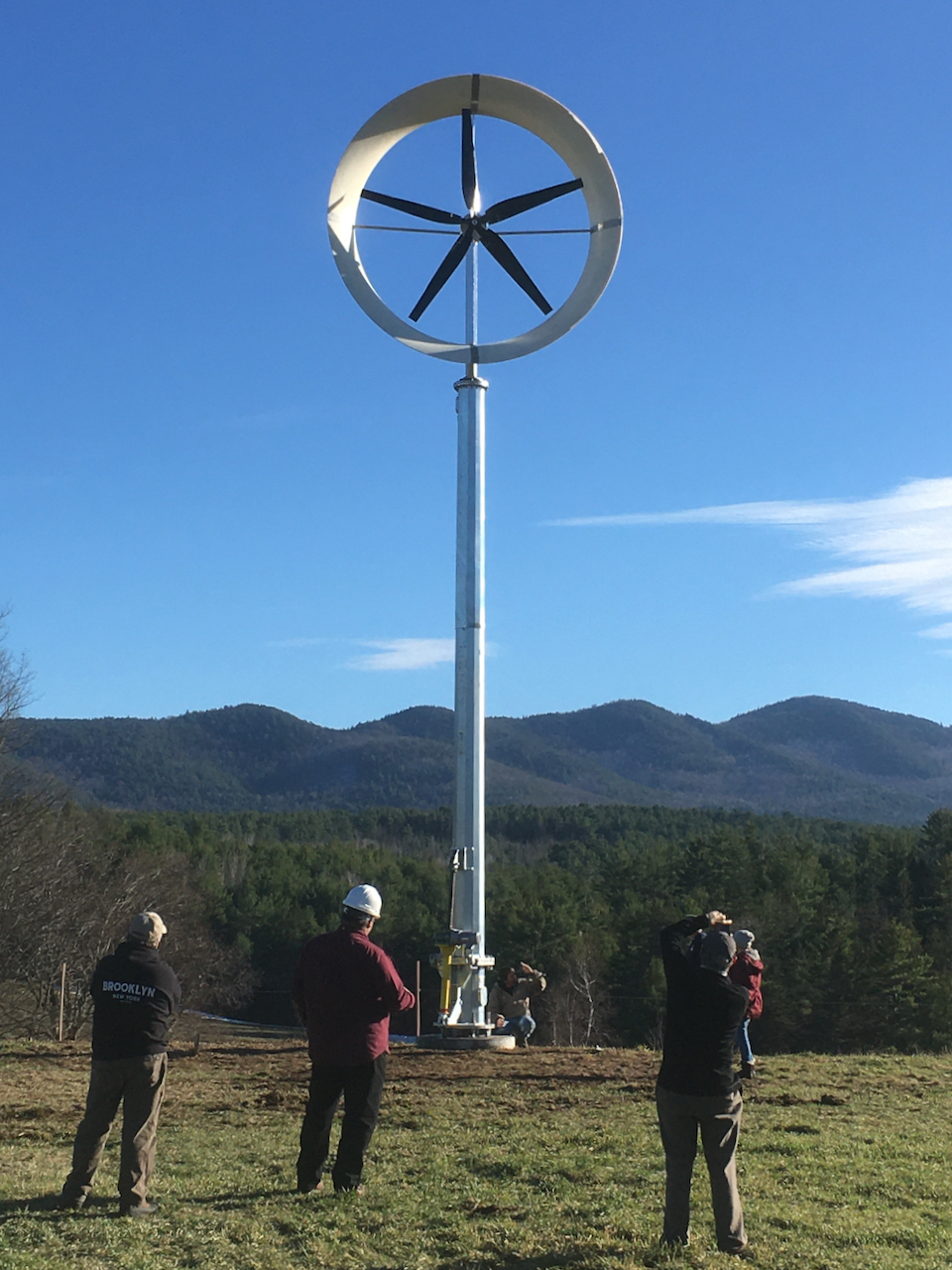
@dougselsam will perhaps tell: why adding weight due to the shroud while a larger rotor will be less expensive?
Sure, the weight of a shroud is significant. But inflatable cheap and light shrouds (like the experimented tire) could perhaps be used for some AWE configurations I mention in these experiment findings.