Indeed architectures discussed are not the same although they also contain several connected kites. It is why several topics are used. I gather them in a comment.
I like the term MAWES
(Not least because it is used on the island to describe less towny folks on the North end and West side)
I think to insist multi-kite implies one set of multi-kite configurations would be wrong.
multi-kite rotor yo-yo
multi-kite network lifter
multi-kite mechanical drag mode rotor
multi-kite flygen drag mode
multi-kite laddermill or spider-mill (if one ever gets built)
multi-kite arches and stacks have existed for many years.
There are several sorts of MAWES. And also there are also various purposes and concerns. So IMHO several topics with some links between them can facilitate the understanding.
Collecting resources and threads on a topic is what wikis are good for. Please put links to all forum threads in this wiki:
I’ve removed the wiki status from this thread, as it wasn’t used as a wiki:
(post withdrawn by author, will be automatically deleted in 24 hours unless flagged)
1 Like
Modeling and normal mode analysis of tethered multi-aircraft systems
Rachel Leuthold & Gonzalo Sanchez-Arriaga
Two complementary simulators aimed at the dynamic analysis of airborne wind energy systems based on multi-aircraft congurations are presented. The rst model considers a train of stacked aircraft linked among them by two inelastic and massless tethers with no aerodynamic drag. The architecture of the mechanical system in the second simulator is congurable, as long as the system is made of a set of aircraft linked by an arbitrary number of elastic tethers. In both cases, the aircraft are modeled as rigid bodies. An analysis of the symmetric equilibrium state and the corresponding normal modes of a train (stacked conguration) of aircraft was carried out. It revealed that the higher the position of the aircraft in the train, the more they participate in the longitudinal modes. However, all the aircraft roughly participate equally in the lateral-directional modes. Tether inertial and aerodynamic drag eects increase the equilibrium angles of attack of the aircraft and the tether tension at the attachment points. The potential applications and computational performance of the two codes are discussed.
Talking of multi-kites…
An obvious question in wind energy is
OK a 3 blade rotor makes power, Will more blades make more power?
Fair
My next system will be 3 rotors x 5 blade rings 15 blades
So obviously I’m in the yes camp…
However this only works with certain caveats for efficiency sakes.
Open rotors, blade solidity, foil choice, tip speed ratio and more all make a huge difference.
Rotor dynamics aren’t easy or obvious
Here’s a grand old intro
http://www.fao.org/3/ah810e/AH810E10.htm#10.1
the link was from christofs presentation
We are back to this topic: Question about power curves - #11 by tallakt
All I can say right now is that the rules will be different for AWE compared to traditional windmills. We get a larger swept area for free, and then we cant/dont need to attain that highest efficiency. My guess is AWE is more flexible, and probably more difficult to get right.
1 Like
Another good reference for generic multi-wing AWE systems is
A Betz-Inspired Principle for Kite-Power Generation Using Tethered Wing
by Sean Costello
Should do but… I’m not 100% sure this analysis holds in application to rotary multi-kites.
Someone with better dynamics put me right please
Modeling and Natural Mode Analysis of Tethered Multi-Aircraft Systems
As for the scaling of rotary networks… Just to go over this again.
here’s what my model says the shape of a soft line network flying 4 layers of 6 standard L/D=7 kite blades will look
red - green line colour scale is relative line strain.
sets of arrows are relative force vectors coloured per line to make it clearer.
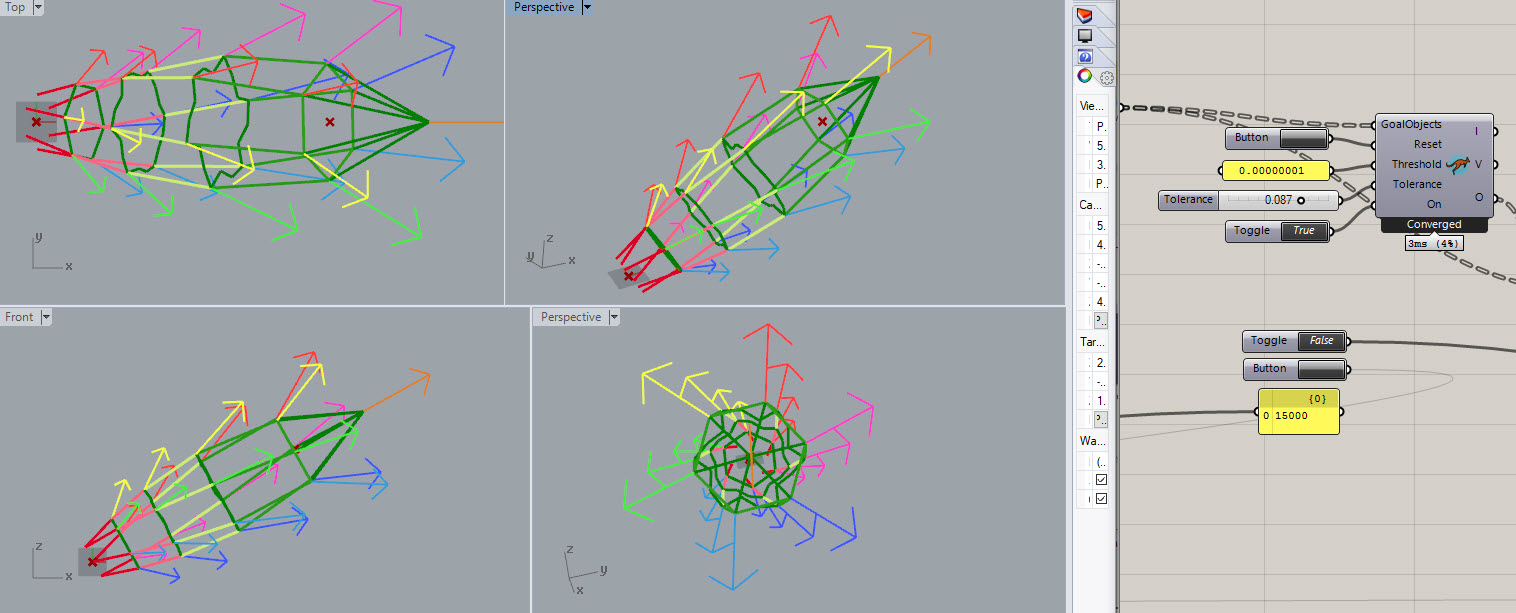
If I add a bunch more layers and kites on the same overall shape with the same pattern of force
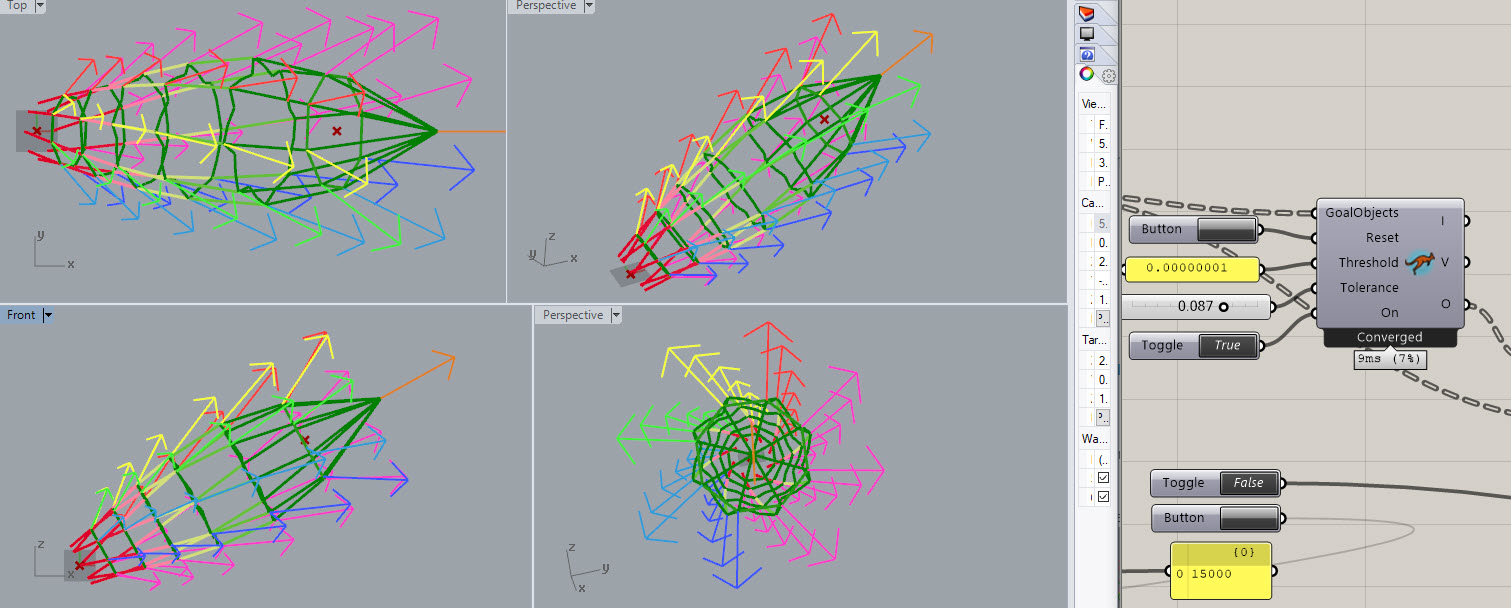
You get basically the same net shape out.
The lesson for me is. Fly any kite in a circle and the tether flies in a cone.
The corollary is How do you make a tether fly in a cone shape? Attach a circle flying kite to it.
How can you make use of a tether which flies a cone shape? Truncate the bottom of the cone so that it is forced to fly a circular track.
Feel free to examine the model yourself
conic net twist demo for forum.gh (70.4 KB) conic net twist demo for forum.3dm (55.7 KB)
1 Like
Posted before, several times, but here it is again with some extra links:
After around 11:30 in the talk Moritz Diehl mentions:
He also mentions Dynobud, in use at Makani at the time:
And at 14:15 in the talk:
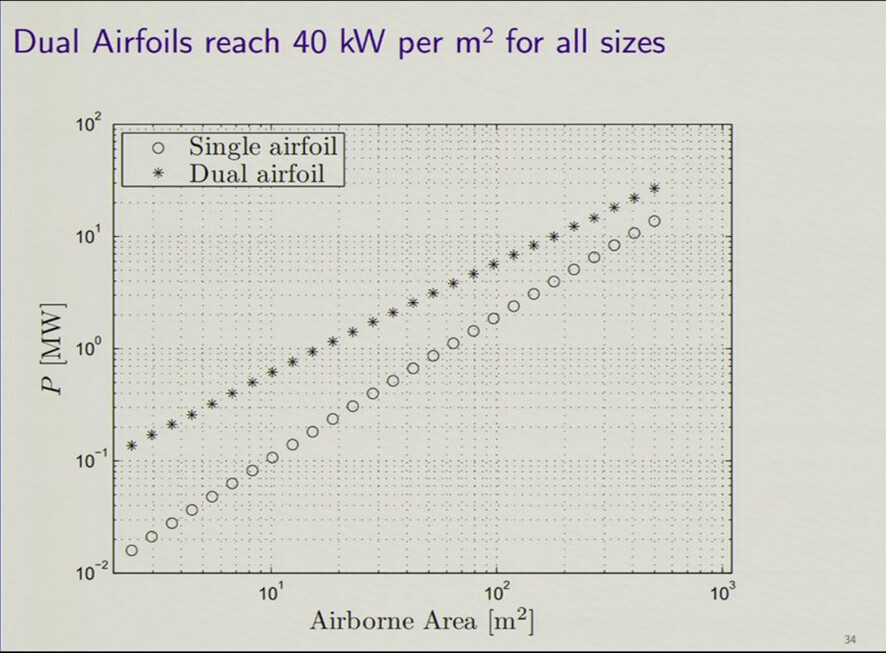
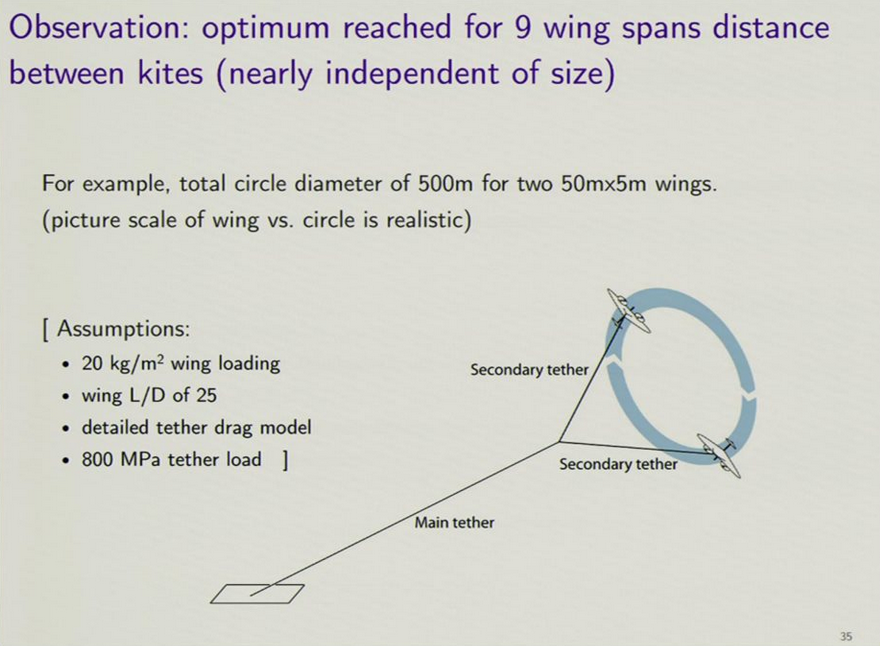
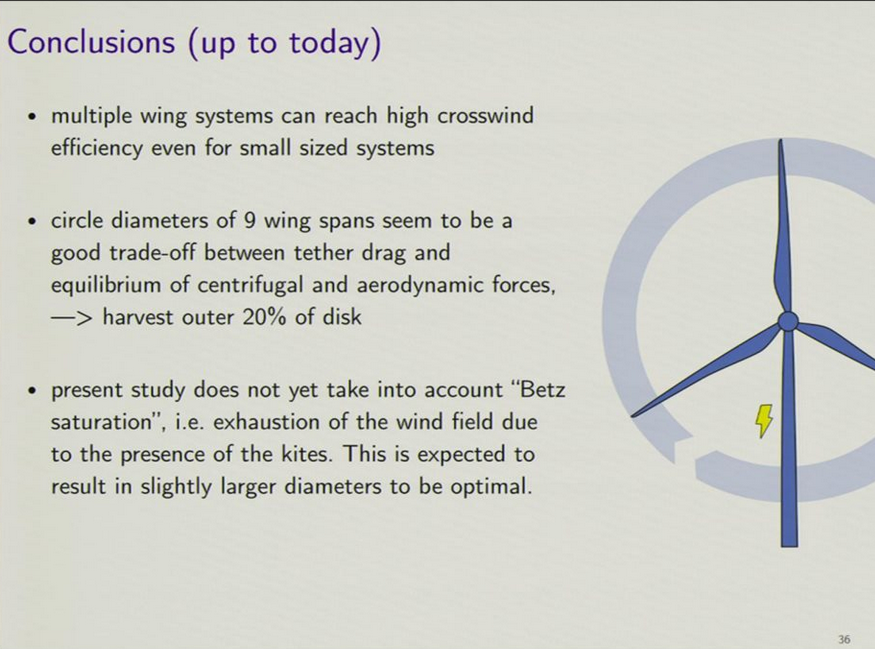
And he was presenting the result from this 2013 study:
Preprint available for
Vertical Airborne Wind Energy Farms with High Power Density per
Ground Area based on Multi-Aircraft Systems
Jochem De Schutter1 , Jakob Harzer1 , Moritz Diehl1,2
From Introduction:
Multi-kite airborne wind energy systems (MAWES) connect two or more equivalent kites via secondary tethers to a main tether. As the kites orbit around the main tether, the MAWES can produce power as the main tether reels-in and out, turning a generator.
It looks like MAWES could be related to crosswind kites flying a loop, so something not too far from some rotary devices at least considering the upper part of the device.
The MAWES discussed here include a single main tether and multiple wings.
Conversely, a multi-anchored kite or kite network includes several anchors surrounding a kite or kite network.
MAWES look much more promising, at least because the wings are not blocked in webs of tethers, pulleys and anchors likely unable to allowing the implementation of a higher kite area flying fast enough and transferring wind energy. Conversely MAWES wings are free to fly fast and move in any directions thanks to the single ground station which can rotate according to wind direction. It is therefore not surprising that MAWES configurations are widely studied, even in Some tethered aviation concepts like this one.
For some MAWES it may be beneficial to be able to fold the wing/blade elements
to depower the overall drive/lift/thrust/tension
Some new examples of foldable wings I’ve seen lately coming from wing foiling
Which both make the wing foldable (and store away in a small size) while foiling on the water…
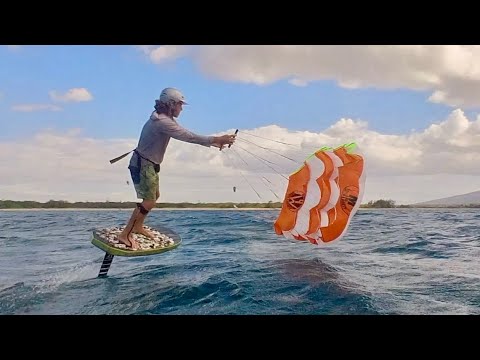
and
1 Like
Amazing how little power that board needs to stay in motion and above the water. That guy is very good at it. I was thinking that kite is so small and so low that it almost doesn’t seem to be pulling the guy along most of the time. Then he just stows the little kite away and keeps going by occasionally pumping the board with his legs. Holy cow! In the background are typica kiteboarding kites 10 times as big, ten times higher!
OK this is getting off topic but I can’t help.
Just came off the water from wing foiling with my youngest son.
What amazed me when we first got going was just how high into the wind these ugly, blunt, wings with massive dihedral can go… The secret isn’t the wing though, it’s the beautiful foils underwater. They are so sleek and efficient. They glide through chop, they have minimal drag. They ping the board into better apparent wind.
Being a windsurfer at heart I didn’t think I’d like it.
It’s so much fun
1 Like
Surprisingly «zen» activity. I also thought it looked a bit weird at first, but I had already learnt my lesson with SUP many years ago