weifeng:
我的回复是通过AI翻译的。看到你查的资料我也看过,但真实的情况,比你看到的更恶劣。你计算的是13m/s风速下的功率成本,如果把风速调整到5m/s,那么现有的发电成本要涨到10倍。一个重要的问题是,单个风叶的扫风面积按照功率从小到大,基本上是5千瓦一下,1.5m²/kw;10kw以上3-4m²/kw;兆瓦级7-8m²/kw;中国现在超大型风电9-11m²/kw;但就算是这样,一个100kw的现有风力发电设备,满功率小时数也就2000小时。平时这100kw的发电机,也只有10kw左右能用,其余的90kw就是闲置的。如果用我的方案用10kw的发电机,年发电量就和100kw发电机的年发电量相等了
Translation: My response is translated via AI. I have also seen the information you looked up, but the actual situation is worse than what you see. You calculated the power cost under a wind speed of 13m/s; if the wind speed is adjusted to 5m/s, then the existing power generation cost will increase to 10 times. An important issue is that, according to power from smallest to largest, the swept area of a single wind blade is basically under 5 kW, 1.5m²/kW; above 10kW, 3-4m²/kW; megawatt-class, 7-8m²/kW; China’s current ultra-large wind power, 9-11m²/kW; but even so, for an existing 100kW wind power generation equipment, the full-load hours are only 2000 hours. Normally, only about 10kW of this 100kW generator can be used, and the remaining 90kW is idle. If my solution is used with a 10kW generator, the annual power generation will be equal to the annual power generation of a 100kW generator. If you are more careful, you will find that the reason why scientists are not unwilling to expand the ratio of blade swept area to power is because the higher the wind speed, the greater the wind energy captured by the blade, and it basically reaches the limit at 13m/s. However, if my technical solution is adopted, there is no limit to this ratio of blade swept area to power.
weifeng:
你计算的是13m/s风速下的功率成本,如果把风速调整到5m/s,那么现有的发电成本要涨到10倍。
You calculated the power cost under a wind speed of 13m/s; if the wind speed is adjusted to 5m/s, then the existing power generation cost will increase to 10 times.
I don’t know where you got the 13m/s you say I used, but 13^3/5^3 = 17.576 . So in 5m/s wind you would need 18 times as many wind turbines or wind turbine area to produce as much power as in 13m/s wind.
If you don’t give your sources and write out your calculations, we cant check your work. But, yes, obviously when you choose a site that has an average wind speed of 5m/s, you are losing money. Micro wind turbines usually are placed poorly, like we saw in the study with the 3.75% capacity factor.
Here is a calculator to how much power is available in the wind at different wind speeds, \frac{W}{m^2} : Wind Power Density Interactive Calculator | FIRGELLI
An AI response below, checked and edited. I haven’t checked and corrected the Actual Industry Reality numbers. I look at that after the AI response. Note that this does not use your “单个风叶” (single blade) metric. That’s not a metric I am familiar with and I don’t understand why you would want to use that.
When you invert the metric from m^2/kW to kW/m^2 , you change the metric from “Swept Area per Kilowatt” to “Power Density per Unit of Swept Area” (单位面积功率密度). This measures how much power capacity a turbine can squeeze out of every square meter of its rotor blade circle.
To convert the original numbers, we calculate \frac{1}{\text{Value}} for each range.
The Inverted Values
Category
Original Claim (m^2/kW )
Inverted Claim (kW/m^2 )
Actual Industry Reality
Verdict
Small (<5 kW) Under 1.5
Above 0.67 kW/m^2 0.2 - 0.5 \text{ m}^2/kW Inaccurate. Small residential turbines are aerodynamically inefficient (C_p \approx 0.25 ) and sit close to the ground where wind is weak. They actually require a larger relative swept area (e.g., a typical 2.5 kW turbine needs about 11.3 \text{ m}^2 , giving it a ratio of 0.22 \text{ m}^2/kW
Medium (>10 kW) 3 - 4 0.25 - 0.33 kW/m^2 0.18 - 0.29 \text{ kW/m}^2 Roughly Accurate. This matches standard industrial mid-sized models.
Megawatt (MW) Class 7 - 8 0.125 - 0.143 kW/m^2 0.22 - 0.33 \text{ kW/m}^2 Inaccurate. Standard utility-scale onshore MW turbines (like GE Vernova’s 3.4 MW ) around 0.22 to 0.33 kW/m^2 . 0.125 - 0.143 is too low for a standard build.
China’s Ultra-Large 9 - 11 0.09 - 0.11 kW/m^2 0.22 - 0.43 \text{ kW/m}^2 Highly Inaccurate. China’s record-breaking mega-turbines have massive blades, but their generators are equally massive. For example, the Mingyang MySE 16-242 (a 16 MW behemoth) has a swept area of 46,000 \text{ m}^2 . 16000 \div 46000 = \mathbf{0.35\text{ kW/m}^2} .
Inverting the metric makes the logical flaw in the premise much easier to spot:
The inverted claim states that as wind turbines get massive, they become drastically less efficient at harvesting power per square meter (dropping from 0.67 down to 0.09 kW/m^2 ).P_{\text{density}}=\frac{1}{2}\cdot \rho \cdot v^{3}\cdot C_{p} \rho is air density, v is wind speed, and C_{p} is aerodynamic efficiency).*
Because giant megawatt turbines sit higher in the sky, they access much faster, smoother wind speeds (v ). Partly because velocity is cubed (v^{3} ), real-world massive turbines have much higher power densities (kW/m^2 ) than small ones , usually hovering around 0.25 to 0.40 kW/m^2
The data incorrectly suggests that China’s ultra-large wind turbines are heavily underperforming in power density.
To check the power densities:
Siemens-Gamesa SG 5.8-155 - Manufacturers and turbines - Online access - The Wind Power 307 W/m², rated wind speed 11m/s.GE Vernova GE Haliade-X 12 MW - 12,00 MW - Wind turbine 315.8 W/m², rated wind speed 10.5 m/s.Shandong Swiss Electric YZ190/10.0 - Manufacturers and turbines - Online access - The Wind Power 353 W/m².
Wind Turbine Power Output Calculator — Rotor Power in W
The Wind Turbine Power Output Calculator estimates the theoretical electrical power output of a wind turbine in watts (W) using the standard aerodynamic power equation P = 0.5 × ρ × A × V³ × Cp × η, based on air density, rotor diameter, wind speed, power coefficient, and generator efficiency.
You multiply this with Capacity Factor (CF) and hours in a year (8766) to get an estimate of yearly electricity production:
Yearly electricity production (Wh) = CF × 8766 × 0.5 × ρ × A × V³ × Cp × η.
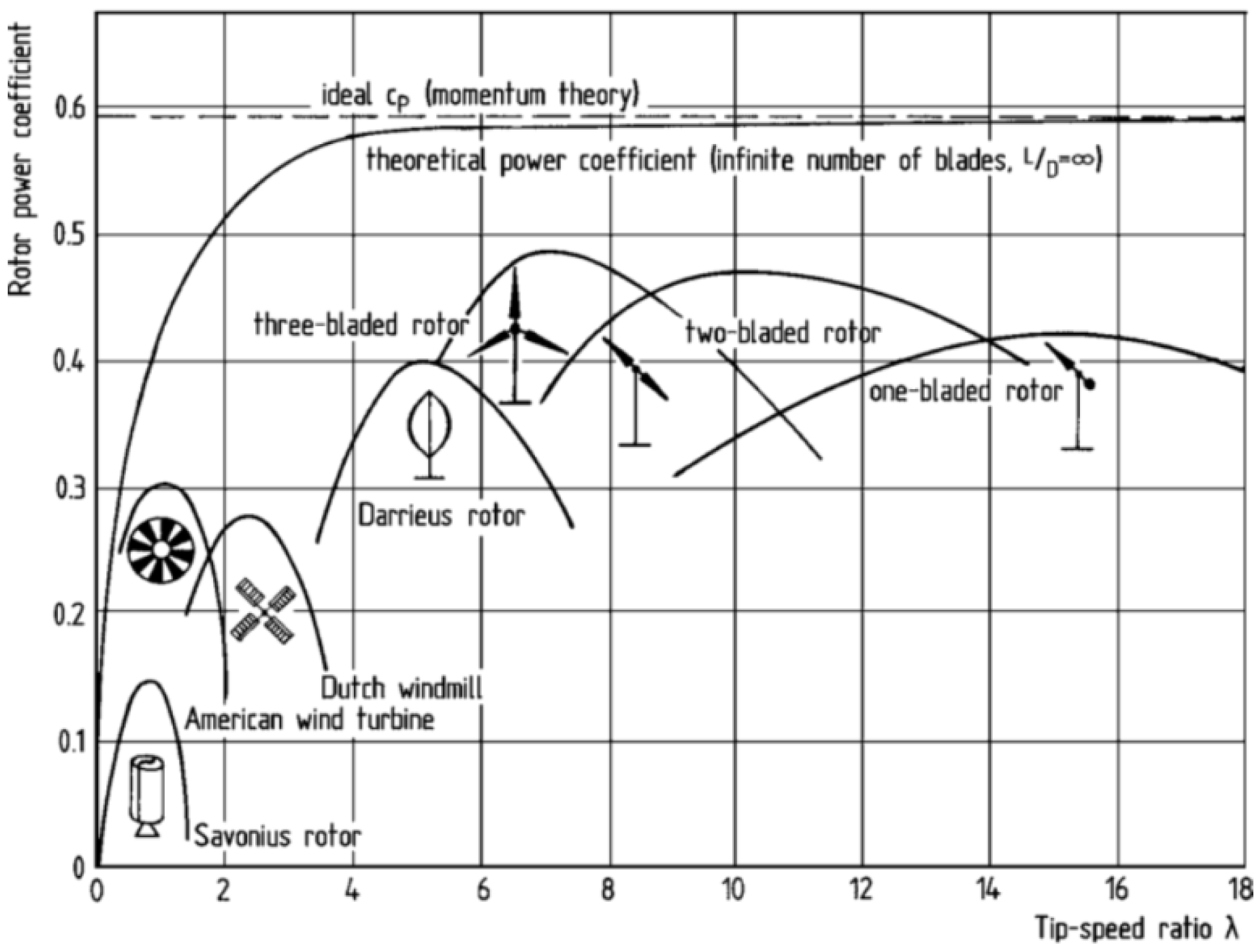
Power coefficients of different wind turbine types:
Wind-turbine aerodynamics - Wikipedia
Experimentally it has been determined that a large CD
This result agrees with the below, but we have discussed this image on the forum before - it might have a mistranscription -, and it is an old result.
energies-16-02774-with-cover.pdf (2.1 MB)
Again, electricity, yearly (Wh) = CF × 8766 × 0.5 × ρ × A × V³ × Cp × η
For a Savonius wind turbine with a capacity factor of 3.75% typical for micro wind, area of 1 m^2 , rated wind speed of 10m/s, power coefficient of 0.16, generator efficiency of 90%:
Electricity, yearly (Wh) = 0.0375 × 8766 × 0.5 × 1.2 × 1 × 10³ × 0.16 × 0.9 = 28.4 kWh
You can improve on this by choosing a better site that would give you a better capacity factor.
You now want to improve the capacity factor by, essentially, coupling more rotor area to a single generator in low winds, thereby reducing gearing efficiency and probably the power coefficient.
Have you looked at:
How undersizing the generator affects the power coefficient of a wind turbine? By doing that you change the tip speed ratio of the turbine away from the optimum.
How the aspect ratio of the turbine blades affects the power coefficient?