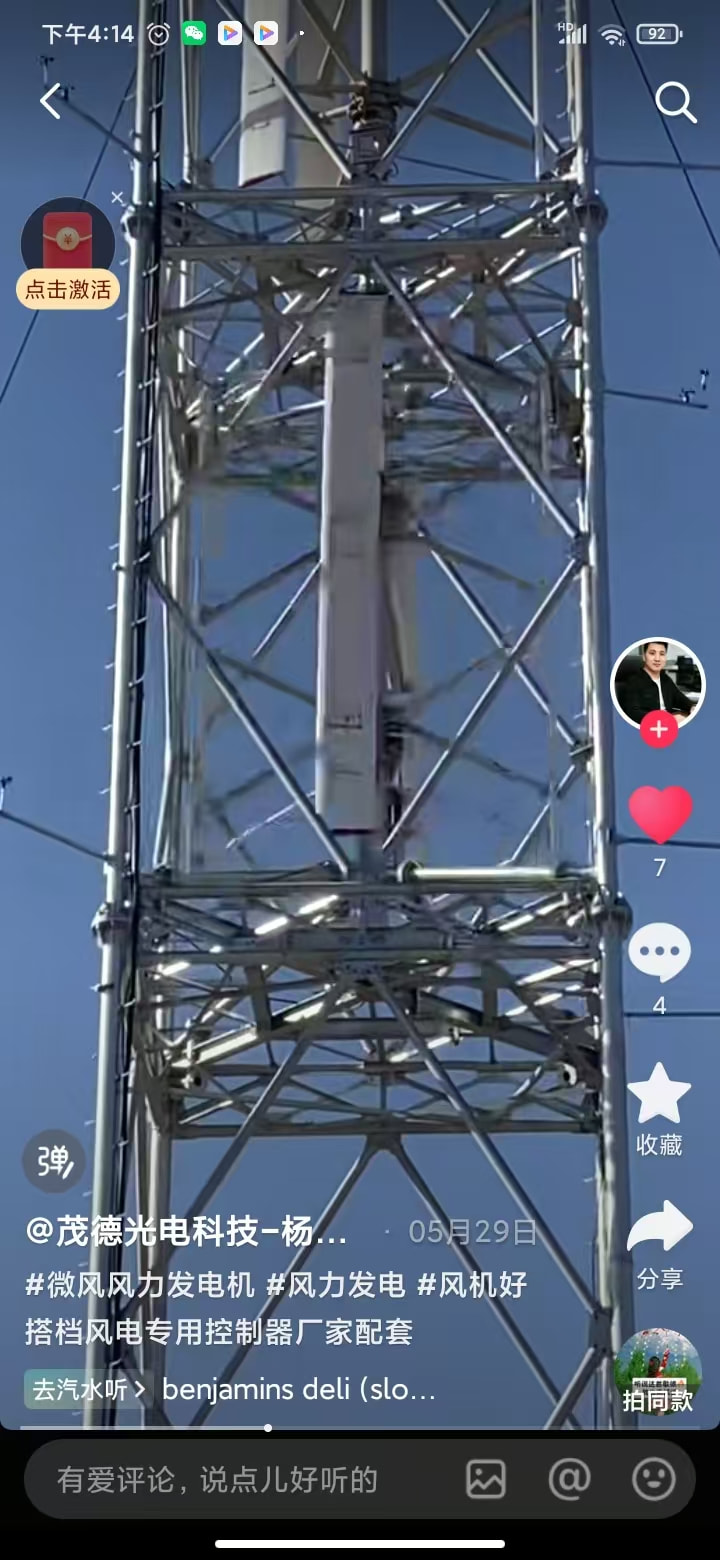
We hold a fully authorized Chinese patent for innovative micro-wind power generation technology, solving the key drawbacks of traditional wind turbines, including difficult startup in low wind speed, unstable power output and voltage fluctuation under variable wind conditions.
Core Technical Advantages:
1. Full power generation is realized at a low wind speed of 3-5m/s, greatly improving power generation efficiency in low-wind areas.
2. Stable constant voltage and constant power output is guaranteed within the conventional wind speed range of 5-20m/s, ensuring continuous and reliable power supply.
Main Application Scenarios:
Green carbon clean power generation, off-grid power supply for remote areas, power support for AI equipment, distributed micro wind energy systems and other new energy projects.
The patent has complete legal procedures and clear ownership, ready for technology transfer, industrial cooperation and project commercialization. Relevant enterprises, developers and researchers are welcome to leave messages or contact us for in-depth negotiation and technical cooperation.
Abstract
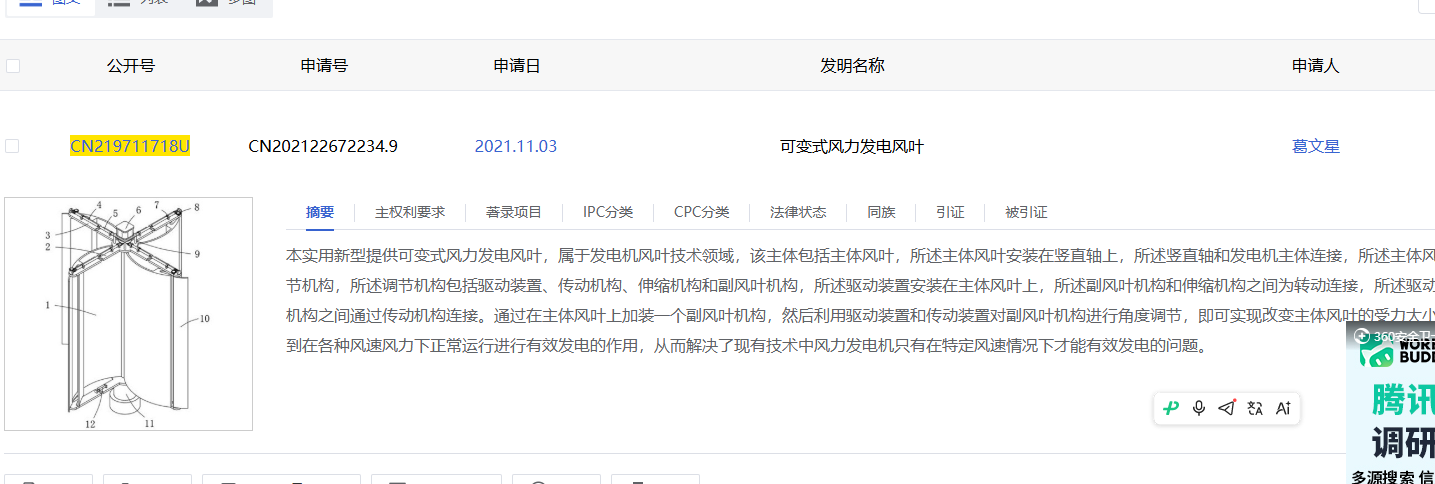
The utility model provides a variable wind power generation fan blade, which belongs to the technical field of power generator fan blades, and comprises a main body fan blade, wherein the main body fan blade is arranged on a vertical shaft, the vertical shaft is connected with a power generator main body, an adjusting mechanism is arranged on the main body fan blade, the adjusting mechanism comprises a driving device, a transmission mechanism, a telescopic mechanism and a secondary fan blade mechanism, the driving device is arranged on the main body fan blade, the secondary fan blade mechanism is in rotary connection with the telescopic mechanism, and the driving device is connected with the secondary fan blade mechanism through the transmission mechanism. The auxiliary fan blade mechanism is additionally arranged on the main fan blade, and then the driving device and the transmission device are utilized to conduct angle adjustment on the auxiliary fan blade mechanism, so that the stress of the main fan blade can be changed, the effect of effectively generating electricity under normal running of various wind speeds and wind power can be achieved, and the problem that in the prior art, the wind driven generator can effectively generate electricity only under the condition of specific wind speeds is solved.
Patented Technology for Series and Parallel Connection of Multiple Wind Turbines – Sincerely Available for Transfer. This technology enables full-rated power generation at wind speeds as low as 3–5 m/s, and maintains constant voltage and constant power output across a wide wind speed range of 3–24 m/s. Contact: +86-15893067785.
I have a superior technical solution that eliminates the need for large bearings and significantly reduces costs. The patent is available for full assignment.
Explain how your comment is relevant to specifically this topic, where you posted it originally? I don’t see the relevancy. We all have superior solutions to every possible idea.
Edit: The below reply talks about the relevancy of your concept to AWE, not specifically to the topic you originally posted it to. So I’ll move the comments to your own topic.
When it comes to wind power generation, controlling the generator speed is inevitable. Within current technology paradigms, the default solution is simply scaling up the gearbox. However, this approach is fundamentally insufficient for airborne wind energy systems.
If we instead implement parallel and series control of multiple rotor sets, it fundamentally changes the equation—both your generator design and the overall system architecture could achieve a stable power output.
The core relevance lies in this question: Do you require a stable power input? More importantly, how do you address power fluctuations when facing rapid changes in natural wind speeds?
The rotors are interconnected via electromagnetic clutches. By monitoring real-time fluctuations in generator speed, the system dynamically engages or disengages specific rotors to adjust the active rotor count. This mechanism ensures that the generator’s rotational speed is consistently maintained within a predefined stability band.
I have already filed a patent for this technology and am currently seeking to license or assign it.
AWE is not traditional wind, and the AWE efforts are not toward micro-wind power generation.
Here is the conventional proposed solution for the power fluctuations in AWE: AE4T40-2025-26 Lecture 12: Example Exam (You build a wind farm and have the individual systems be out of phase with each other in regards to when they reel in and reel out.)
I don’t think your concept will work for AWE because, for example:
(1) the systems, like conventional wind turbines, are too far apart from each other to connect mechanically;
(2) the speed of reel in and reel out is controlled, you can’t disconnect the generator from the drum.
I think the solution you mentioned is similar to generating power using a towrope from a boat on a river. Before the towrope is fully tensioned, the rotational speed can indeed be controlled, but the cost-effectiveness of power generation is hard to manage due to the length of the towrope.
In contrast, my proposed solution uses multiple wind turbines to drive a single generator, with this multi-turbine generator unit installed on a boat. By using multiple small turbines instead of a large-scale one, the total swept area remains the same while the overall mass is reduced, which actually increases power generation.
Applied to high-altitude wind energy, this multi-turbine generator setup would only require reducing the number of turbines or decreasing the swept area of each individual turbine. This should be the most cost-effective power generation solution.
My proposal might come across as a bit challenging to your ideas, but your concept could definitely be tested on a boat first to reduce experimental costs.
Luck is on my side, but I lack the resources to enforce my rights. Faced with infringement by competitors, I simply don’t have sufficient funds to file lawsuits or apply for asset preservation orders. Therefore, I am looking to sell my patent.
Moreover, the core of my patent is not limited to either drag-type or lift-type rotors. Rather, it covers a system in which multiple sets of wind turbines are coupled to drive a single generator.
I am sincerely seeking to sell this patent. Given the enormous scale of the Chinese market, I believe this opportunity will be of genuine interest to you.Processing: 微信图片
_20260809203958_12_7.jpg…
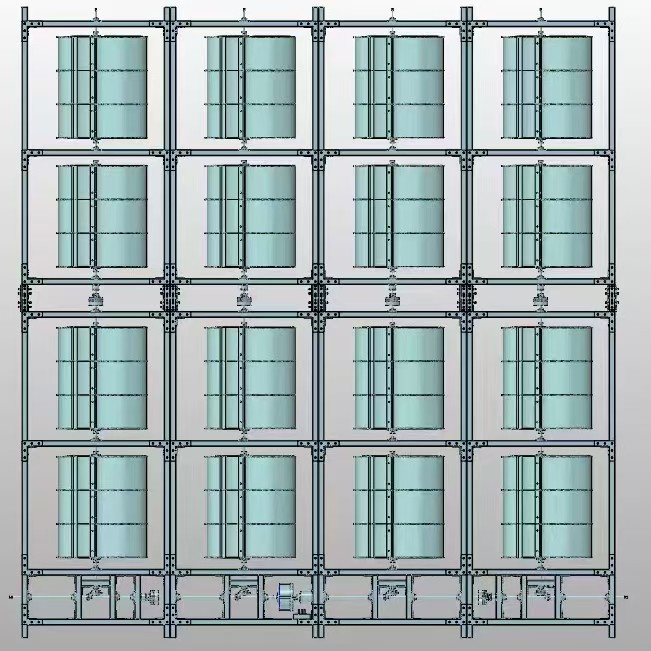
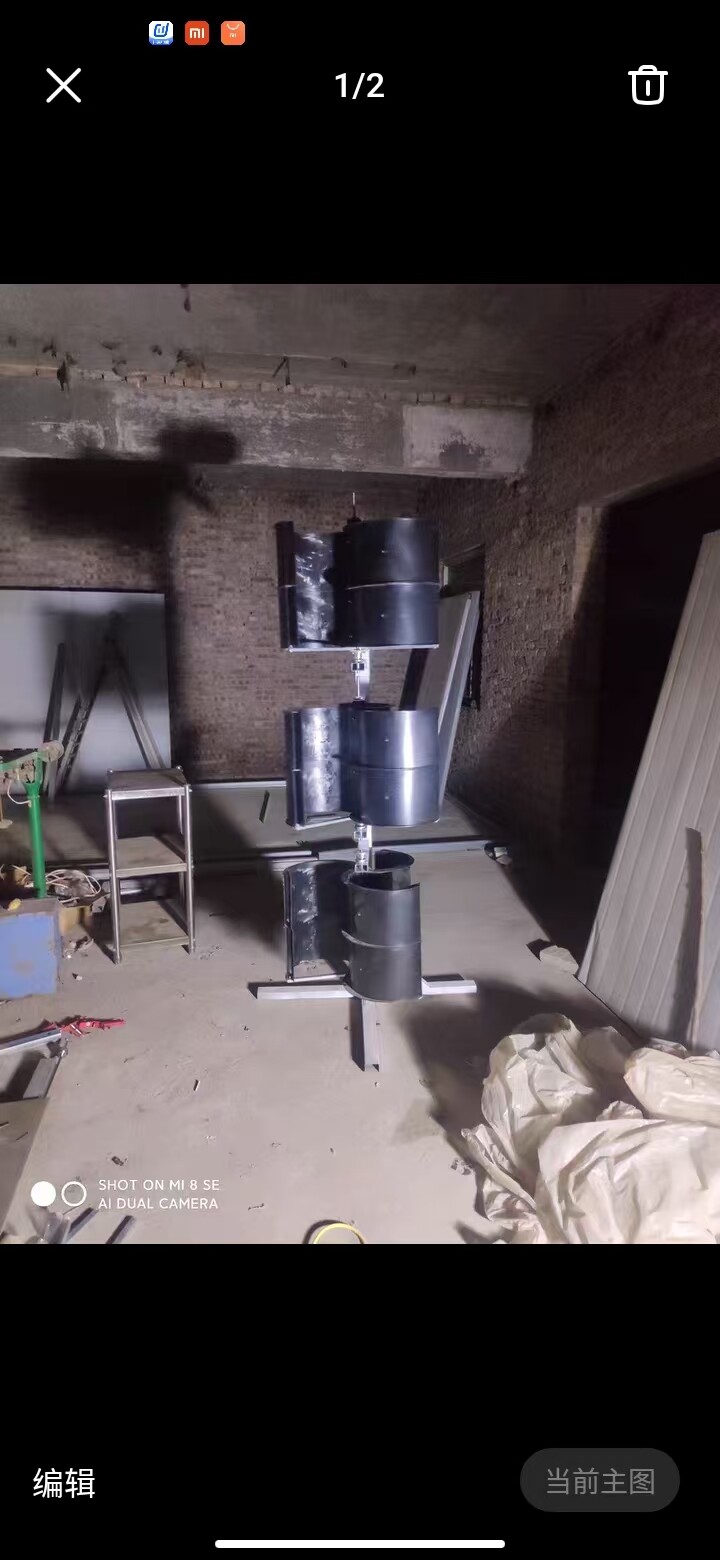
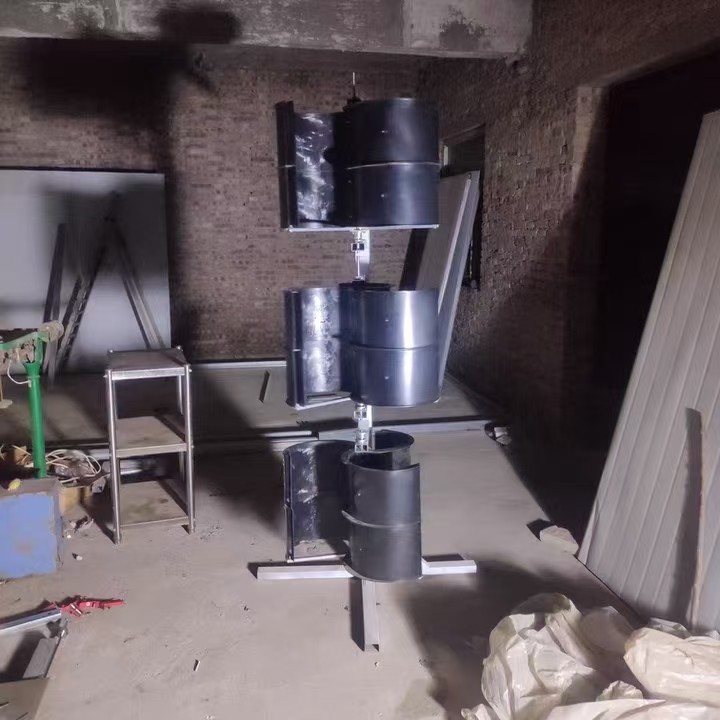
The black wind turbine on the rooftop is my design, while the other photo is a promotional image from a domestic company that infringes upon my patent.
Constant-voltage and constant-power power generation spanning breezes all the way to typhoon-force winds represents the future of wind power.
For hundreds of years, wind power generation has failed to deliver true constant-voltage and constant-power output. This fundamental drawback has prevented wind energy from competing on an equal footing with thermal, hydropower and nuclear power generation. To break through this bottleneck, the drastic fluctuations in natural wind speed must be addressed. The design utilizing multiple wind rotors to drive a single generator resolves this industry-wide pain point ingeniously by dynamically adjusting the overall wind-swept area.
This technical solution has secured patent protection within China. I am placing this patented technology up for sale with a minimum asking price of one million.
I hold full ownership of this patent solution. Two enterprises within China are currently engaged in infringing sales of related technology. Should a technology sale be concluded, our legal team will furnish you with sufficient evidence for infringement enforcement。
We hold a fully authorized Chinese patent for innovative micro-wind power generation technology, solving the key drawbacks of traditional wind turbines, including difficult startup in low wind speed, unstable power output and voltage fluctuation under variable wind conditions.
Core Technical Advantages:
1. Full power generation is realized at a low wind speed of 3-5m/s, greatly improving power generation efficiency in low-wind areas.
2. Stable constant voltage and constant power output is guaranteed within the conventional wind speed range of 5-20m/s, ensuring continuous and reliable power supply.
Main Application Scenarios:
Green carbon clean power generation, off-grid power supply for remote areas, power support for AI equipment, distributed micro wind energy systems and other new energy projects.
The patent has complete legal procedures and clear ownership, ready for technology transfer, industrial cooperation and project commercialization. Relevant enterprises, developers and researchers are welcome to leave messages or contact us for in-depth negotiation and technical cooperation.
Since a wind speed of 15 m/s represents only an average, the actual conditions can fluctuate drastically—from 15 m/s one second to 0 m/s the next. For this reason, conventional wind power technologies are unable to achieve constant voltage and constant power generation. Fortunately, my patented technology offers a solution to this challenge