[quote=“tallakt, post:43, topic:3045”]
Claude AI?那你应该问通过多组风轮控制一个发电机,风速高的时候,风轮数量少,风速低的时候,风轮数量多,能不能让风力发电机实现恒压恒功率发电。
I argue you are nor serious, you did not explain well how you expect to achieve you fabulous claims. Also you did not provide a reference to your patent. I believe @PierreB did but can I be sure we are talking about the same patent?
Anyways hoisting anything like the pictures you provided to make it AWE seems completely farfetched. You dont argue how you will do this, just keep regurgitating how good it could have been.
Right now you are on my «scam» radar. If you want to be taken seriously put your professionalism and knowhow to use…
1 Like
就像我看待AWE一样,涉及到的原理和理论非常的容易理解,我不太明白,我已经把专利的样机拿出来,而且样机没有封闭的情况下,能出现多大的误差?
如果你需要我拿出专利证书完全没有问题,但你不会想我把整个技术细节全部说出来吧?
Better late than never.
I think it depends on the intended purpose. If it’s for electricity production, we know that Savonius wind turbines aren’t efficient, let alone stacked. This was just confirmed (once again) to me by two wind energy experts who took a quick look (which is enough) at the link I provided without specifying what it was: if I repeated what they said, I’d be moderated again on this thread.
However, if we consider professionalism from the perspective of the following quote, things can be viewed differently. In particular, we can better understand the bursts of aggression (not moderated) that replaced the lack of response on the specific points I highlighted.
这种刻意的贬低的方式,会让人觉得很低级,尤其是面对强大新生技术的时候。因为我看到的不是什么你的技术很牛,反而让我感觉到了……那种,那种,怎么说呢?就如同一个现在的我看到幼儿园的孩子一样。
没有资金和知识,又想假冒投资人和专家的,只能收货羞耻!
Good luck. Get back to me when you are speaking technical
The patent seems to mainly talk about one rather convoluted way to add flaps and actuate them from a single stepper motor.
Adding flaps to wind turbines is being researched and might have benefits, some search results:
https://www.sciencedirect.com/topics/engineering/blade-flap
Image 9 from the patent. This to me looks like pitch control. Obviously large wind turbine have pitch control. Some small wind turbines have pitch control too. Other than that as drawn the mechanism spoils the wind and adds drag, and its perhaps marginal benefit, I don’t immediately see flaws with the design, if intended for small wind turbines. It reminds me a bit to what kitex is doing.
I’d probably put the motor in the housing in (21) though.
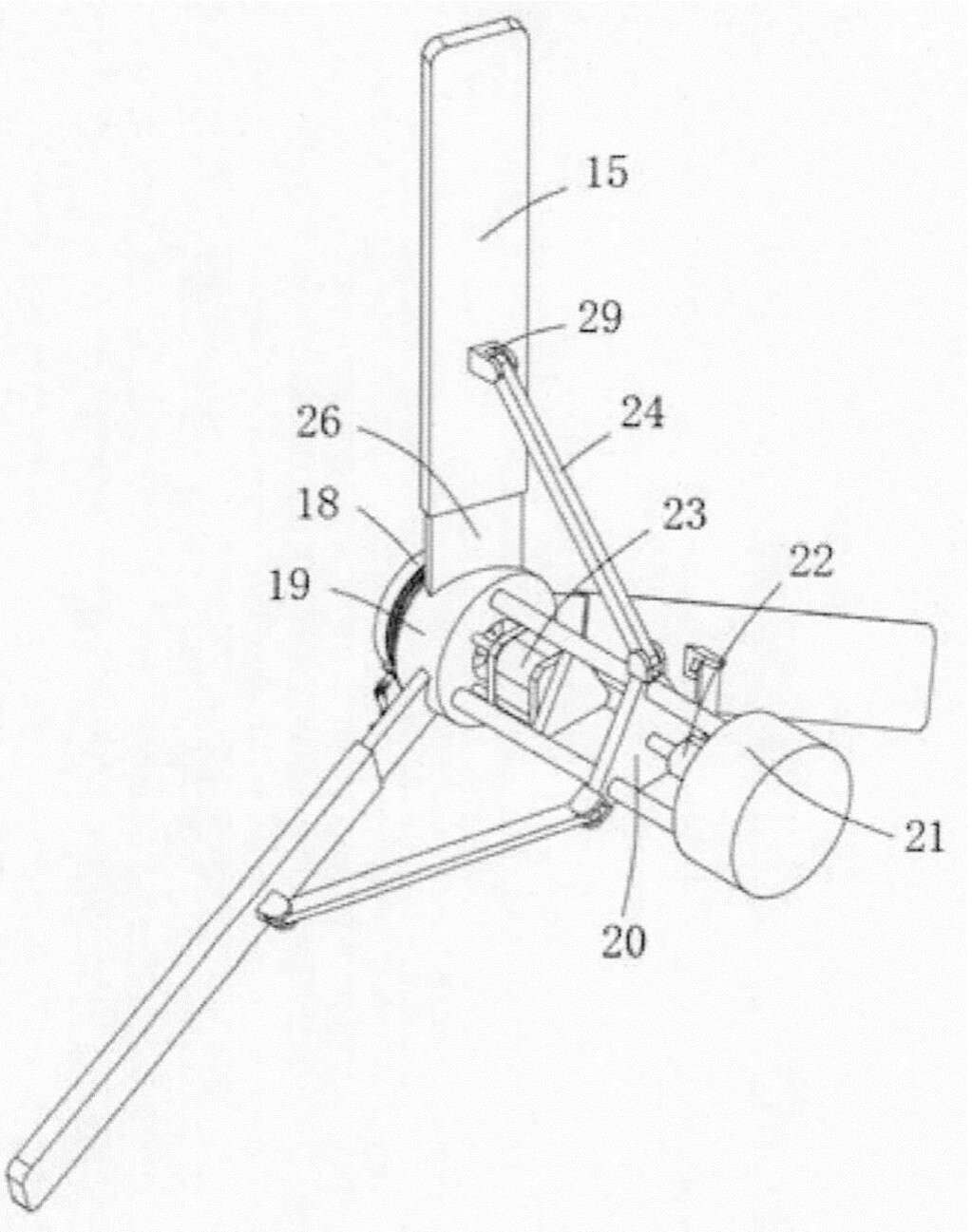
Hi @Windy_Skies its kind of you to see the positives. The idea of extending the flaps on a wind turbine is «discussable». Though the design you showed seems very comlicated for what it does.
In small scale it could not compete in price/wattage with all those moving parts. (I invite the author @weifeng to prove otherwise by setting up a simple cost breakdown)
In larger scale it could not hold structurally in my opinion. There are so many aspects of this that feel badly designed to me i dont really know where ti begin.
For any scale I suppose a modern wind turbine would have aerodynamically shaped blades. With variable radius that could only be optimal at one setting. Its not much different from an existin design turbine giving max output at lower wind speeds, then limiting at higher wind speeds.
Even with variable radius power of the wind is still wind speed to the power of three. Power will quickly outgrow the limited adjustability of the radius.
I really dont see much merit in this. Its not worth anything outside being a neat idea in my opinion.
1 Like
你看的这个知识其中的一个方案,我的专利绝对是物超所值的。
风能功率、风叶面积都与发电机最后的功率直接相关。发电机实际的发电功率与风速也相关,如果没有风叶伸缩技术、多组风轮技术,那么发电机正常风速下(<5m/s),就像你声称的那样,实际功率可能长期只有额定功率的几十分之一。而如果采用了风叶伸缩技术和多组风轮技术,那么发电机的实际发电功率长期就是满功率。另外,从你的言论上看,你一直坚持走的是高风速发电设计思路,而我,走的是通用型的风电设计思路。
我会把发电机装在21的对面,这样这个设备就形成了模块化的设计
So yet again you dodged any serious technical discussion which makes me more sceptical about what you want to get out of being on this forum. If I were an investor I wouldnt get anywhere close to this project, (though I dont have money nor any general wish to invest)
你一直要求我讲出完整的核心机密,但这个东西本质上是我准备出售的商业价值,另外,我来这里谈专利出售,我是有中国知识产权局颁发的专利证书的,也就是说,我的专利能做到的事情,是官方认可的
Seems you wont even discuss why whatever is in your patent is any good.
If you count the amount of patents being submitted worldwide this seems like a sure dead end to me
风叶直径收缩、多层可变风叶、多组风轮控制方案,这三个都是我的专利,理解起来并不复杂,我也没有为难大家。而且我还提供了中国侵权厂家的销售成品图片。
Could you also post these pictures here? You still havent stated which patents you are talking about in a way I could see
I’m fairly new to this forum and have mostly been following from the shadows. I’ve found a lot of the threads really interesting, with some great technical discussions, so I hope this comes across in the spirit it is intended.
@weifeng, I don’t know you personally, so I can only judge the idea from what you have written here. And I’m genuinely trying to understand it rather than dismiss it for being ridiculous.
From your posts, my understanding is that your concept uses multiple rotor sections, or otherwise varies the effective swept area, so that you have more collecting area available at lower wind speeds and progressively reduce the active area as the wind speed increases. The goal seems to be to reach rated output at relatively low wind speeds and then maintain approximately constant power as wind speed rises. Please correct me if I have misunderstood that.
What I am struggling with is understanding where the revolutionary advantage comes from. The aerodynamic power available in the wind is approximately
P=\frac{1}{2}\rho A V^3 C_p
so the available power increases with the cube of wind speed.
I can understand reducing the active swept area at higher wind speeds to regulate power. Conventional turbines also limit output after reaching rated power, so curtailment itself is not unusual. So my question is: What does your method do better than existing approaches such as pitch control, stall regulation and electrical power conversion?
There is also a part of the maths that I would be interested in hearing your explanation of. If (C_p) remains approximately constant and you want the same aerodynamic power at 5 m/s and 20 m/s, then the effective swept area would need to change by roughly
\left(\frac{20}{5}\right)^3=64.
So you would need around 64 times more effective swept area at 5 m/s than at 20 m/s to extract the same power. If we look at a claimed operating range of 3–24 m/s, the ratio becomes
\left(\frac{24}{3}\right)^3=512.
Does your system actually provide anything close to that range of effective swept-area adjustment? If not, what other mechanism allows you to maintain constant power across such a large wind-speed range?
The other claim I find difficult to evaluate is “full rated power at 3–5 m/s”. That sounds very impressive, but without knowing the rated power and the swept area it doesn’t really tell us much. I can build an enormous rotor, connect it to a 10 W generator and proudly announce that I have achieved “full rated power” at a very low wind speed. Technically true - but probably not revolutionary. 
That is why I think some actual numbers would really help everyone understand what you have. If you could provide things like:
- total swept area and rotor dimensions;
- rated electrical power;
- measured electrical output versus wind speed;
- estimated or measured (C_p);
- generator/conversion efficiency;
- which rotor sections are active at different wind speeds; and
- ideally a measured power curve from a prototype.
I’m also slightly confused by the patent you linked. From my reading, it seems to describe adjustable/telescoping blade arrangements that alter the effective blade area, while some of your posts here seem to describe multiple rotor sets connected to a common generator and engaged or disengaged depending on wind speed. Perhaps I’m looking at the wrong patent, or perhaps I have misunderstood how the two concepts relate. If so, please correct me.
I also have a similar question about the “constant voltage” part. Producing stable electrical voltage from a variable wind source can already be done using generators, controllers, converters and inverters. So again, the interesting question for me is not simply can you produce constant voltage? but rather: can your method do it more efficiently, cheaper, more reliably, or with less complexity than the existing solutions?
And this comes back to something @tallakt was saying earlier: I think facts and measurements would help your case much more than statements about how revolutionary the technology is.
For example: if I walk into a room and announce that I am the most handsome man there, repeating it another ten times unfortunately does not make it a scientifically established fact. I still need some women/men to verify my claim. The same applies here. A patent tells us that you have patented an invention. It does not, by itself, demonstrate that the invention achieves the performance being claimed. Nobody is asking you to reveal your secrets or give away proprietary details. I certainly don’t expect you to publish every drawing and calculation.
But if the claim is that this technology can produce rated power at unusually low wind speeds, maintain constant power across a very wide wind-speed range, and significantly outperform conventional wind-turbine approaches, then surely there must be some data behind those claims that can be shared without revealing the intellectual property. A measured power curve would probably answer half of the questions in this thread immediately.
At the moment, I think I understand “what you are trying to achieve”.
What I still don’t understand is “why this particular method is substantially better than existing approaches, and where the data are that demonstrate that improvement”.
I’m genuinely interested in hearing the technical explanation.
Sorry for the long read, my fingers got carried away.
1 Like
A post was merged into an existing topic: Slow Chat IV