Great to see an analytic approach to multi kite rotation.
My gung ho experimentation led to this test which likely confirms your ideas on the benefit of lateral tethers coming from the inner tip of kite blades
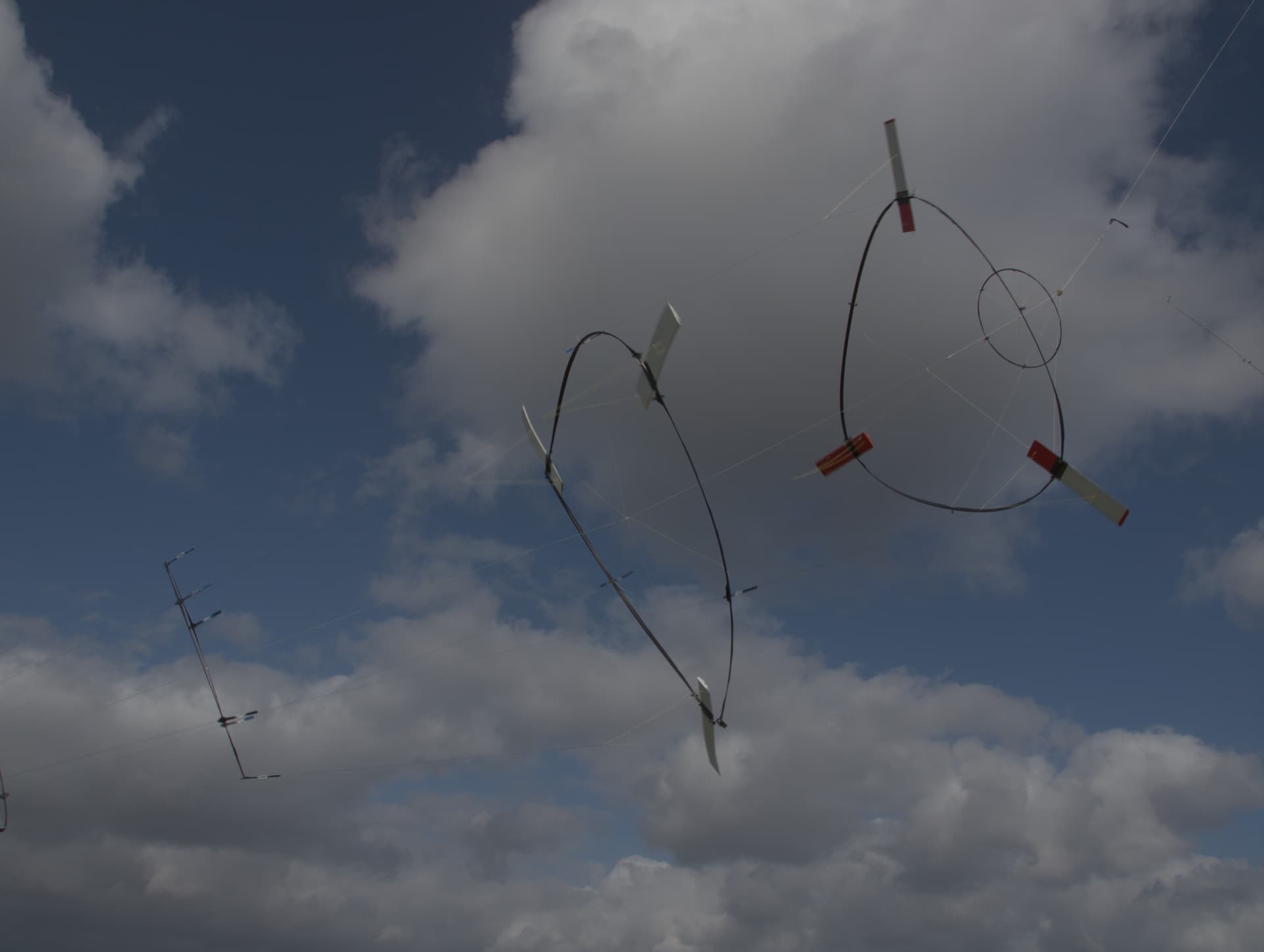
There’s 2 rotors in a TRPT stack here
The top rotor is intact
The lower rotor is disintegrating, The main ring snapping behind the trailing edge of the fuselage.
The main difference between the 2 rotors was where the radial centre lines attached around the ring. On the top rotor 3 of the lines attached to the inner tips of the 3 rotors, the other 3 lines attached to the subsequent midpoints of the ring.
On the lower failing rotor the lateral lines all go to the ring (and ahead of the blade fuselage) … All the centripetal force on the blade fuselage was torquing the blades forward around the lateral line connection, resulting in too much stress on the ring behind the fuselage.
Very interesting, I was actually going to move towards 3 wings at some point for redundancy, and attach them in a triangle instead of a star. What you are saying makes me rethink that triangle connection a little bit. I’ll see what simulations give first I guess, because the wings would not be connected exactly at the same place. The simulation can’t handle a 3 wings system yet so it will take some time.
Sorry for the couple months off the radar. It was super hard but we managed to make our system rotate stably with neither a lifter nor active control surfaces. Funnily enough, the system gets more and more stable the longer the tethers are (up to a point).
You might notice that the base is now powering the rotation. This change was to avoid breaking too many motors, because there were a lot of crashes before we managed to build the wings correctly. We probably will come back to self-propelled wings at some point.
Feel free to comment on the post if you want a quick reply, I don’t always check this forum.
No active control surfaces means that there is a lot of work to do? Or did you figure out how to make it passively stable? I see the tether attachment device is slightly distant from the wing… maybe part of your solution?
Are you looking for actively controlling the wings, or maybe a quasi-controlled design where you change the geometry of the kites once for each operating condition?
We managed to make it passively stable, there will still be a “quasi-control” indeed for different conditions and for takeoff/landing where we need different trims. We are looking into using control surfaces to optimize power output but not sure if needed.