Airborne solar wind energy systems (ASWES)

Hi Pierre: I must have been in an optimistic mood that day. The problems with anything airborne are so repetitive and pervasive, that, overall, at least today, I’ll weigh in against putting solar up in the air, unless it’s to power specialty lightweight aircraft.

Reliability is a major factor for any energy harvesting device. Ground mounting will last decades, always ready to go. Airborne will always have problems and reasons it can;t be used “today” or “right now”. If you don’t have sun at ground level, good luck flying anything with a tether without interference from whatever objects are blocking the sun.

Overall, what’s at play here is a residual urge from AWE to automatically assume being airborne just naturally desirable, but I think that is just a bumper-sticker echo in our minds. I don’t see a compelling reason to make solar airborne. But the sad thing is, that takes us back to musing about the possibilities of AWE, which does not seem to be panning out for anyone yet. :slight_smile:

AWE successes in the broad sense (no or small electricity production) are kite surfing, boating and carting.

As you know, all in ASWES topic is hypothetical or just experimented a little. Maybe by talking about it, it will eventually exist. :joy:

Hi Pierre: In my opinion, citing things like kite-surfing as AWE is a stretch - one more example of the human folly of substituting words for reality. “We” started out talking about replacing wind turbines with kites, based on a fun experience: kitesurfing. What to call the “new” (actually old) idea of the wind not only powering an energy collecting apparatus, but elevating it as well? Well at forst it was "high altitude wind power (HAWP), but when the envisioned heights began to decrease to low altitudes, it was changed to just “airborne”(Airborne Wind Energy) - at any height!

As time rolled on, the “visionaries” were not seeing much success, slowly realizing talk was one thing, doing it was another.

At some point, what had become “AWE” began to retreat from its previous claims of “replacing those dreaded windtowers”. The idea that the towers were such a terrible part of wind energy, easily dispensed with, diminished, as the immense mental acuity of the AWE kitesurfer geniuses started to look less certain, and so as a weaker talking point, the idea that kitesurfing itself WAS “actually” AWE began to gain traction among AWE wannabes. Without ever achieving their original stated goal, they nonetheless attempted to claim victory by merely redefining words, which seems to be the main skill many wannabe AWE people actually have.

Yeah, maybe, maybe, maybe - talk, talk, talk. I think the first thing would be to have a reason for solar to be airborne. The only reason I’m seeing is because AWE isn’t working out, so let’s put some solar on a supposed “AWE” system, and pretend it is a solution. But a solution to what exactly? :slight_smile:

This topic started with a device producing only solar, the author expecting to more duration of sunshine above clouds. Why not to add high altitude wind energy, using a single device?

OK, well, go ahead. I guess we’re back to High Altitude Wind Power (HAWP). Have fun! :slight_smile:

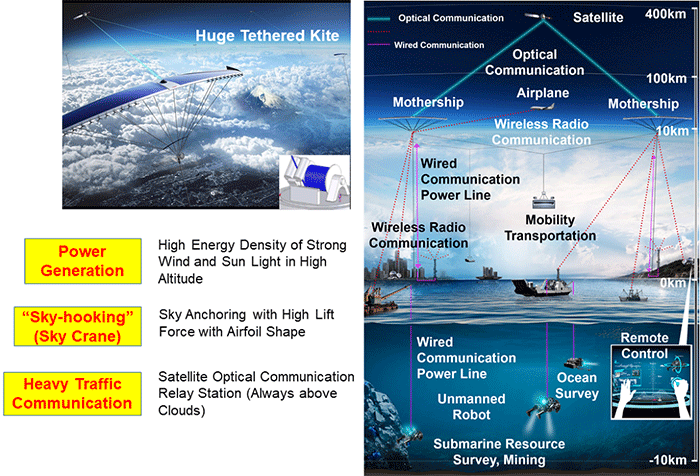
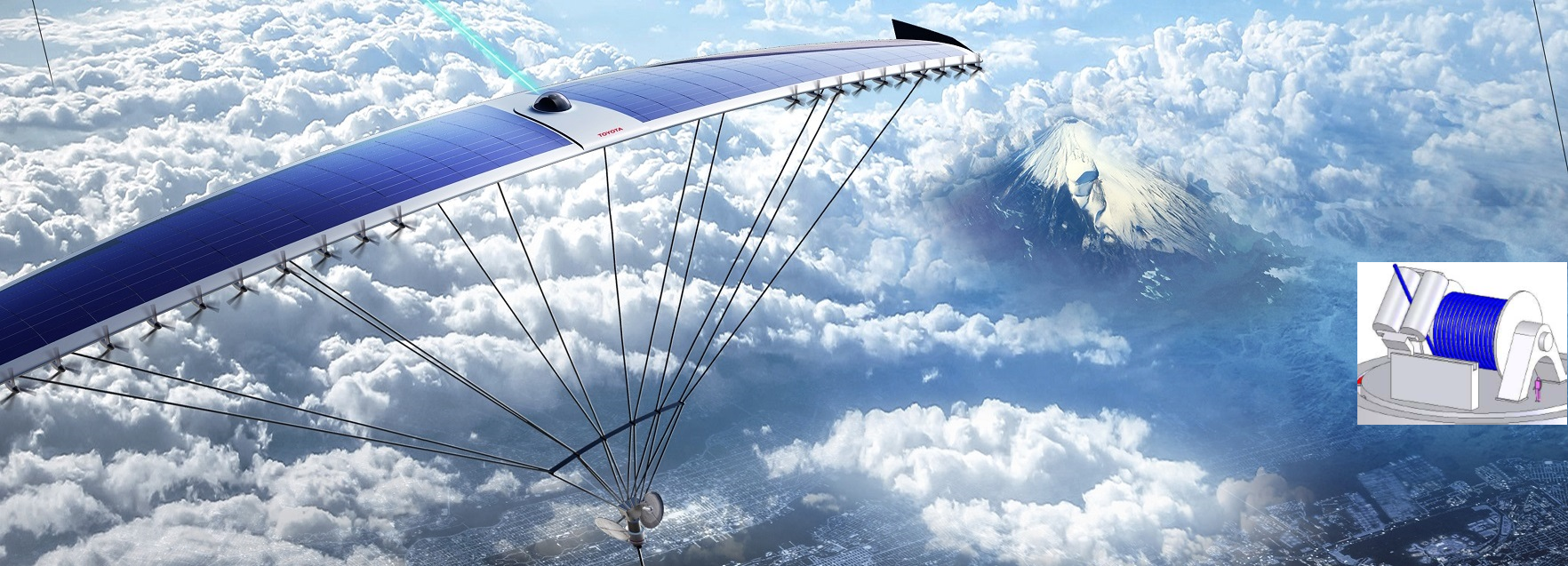
The image (see the turbines on the leading edge and the solar panels on the extrados) and the text (“Strong Wind and Sun Light in High Altitude”) seems confirm the orientation towards an ASWES, although an ambiguity remains in the “Project Overview”: “a land-based electric generator to produce power (left picture, image 2).”, the image 2 showing a winch. Perhaps this is a combination of fly-gen and yo-yo modes. In any case, the use of solar energy does not seem to raise doubt.

The wing and solar could be achieved by using lighter material (solar film integrated in fabric).

OK, as I was saying, the only sensible place for solar on an aircraft would be to keep it aloft, then you might be dealing with adding heavy batteries if it is supposed to remain airborne overnight. So such a scenario might make sense for a kite-reeling or skygen craft that doesn;t need to land, if it could be light enough.

Of course then you get into “tether-weight”, and the whole AWE scenario goes back to day-one from 16 years ago, trying to even figure out basic concepts and where to start!

However, I would be very skeptical of Toyota. Do you know the real story of Toyota? They started out manufacturing oil-engine-powered weaving looms for fabric.
So when people deride Japanese cars “powered by sewing machines”, they are onto something.

The one thing that makes me wonder if anyone at Toyota these days “has both oars in the water” or “is playing with a full deck” (of cards), or might be “a few sandwiches short of a picnic lunch”, is their endless pursuit (or at least talk) of hydrogen as energy storage. Who told them this was a good idea???

As amply-covered in this forum (by me, of course) is the abysmal performance of hydrogen as energy storage. Nothing else even approaches the ultra-low level of efficiency of the entire process of using hydrogen as energy storage! If you charged your phone or car all the way up, then found a 12% charge on the meter, you’d freak out, right? Well, that’s what you get with hydrogen.

The only thing I can think is politicians and maybe even the people in the boardroom running large corporations know nothing of science or even simple 6th-grade math! So, to me, any press-release breakthrough from Toyota should be taken with a grain (ton?) of salt.

They did a good job with hybrid cars such as the Prius, but beyond that, a lot of what they come up with seems like nothing more than symbolic greenwashing, or complete ignorance of basic science and math, again, at a junior-high-school level!

Renderings are nice. Favorable articles are nice. Wow, another article with an impressive rendering promising to “harness the jet stream”, “power 1000 homes” etc. How many of these come true? We all know the answer by now.

How many of these stories ever come true, or lead anywhere whatsoever, beyond buying the company a few temporary brownie-points to get thru the propaganda onslaught from delusional tyrants spreading ignorance as “science” and demanding compliance with their ignorant demands? :slight_smile:

Wow, what a difference a couple of hours can make! Today’s latest (yawn) “press-release breakthrough”: Solar Power from Space! (They don’t mention HOW the energy gets back down to Earth! - Microwaves? What could possibly go wrong? Sounds like a new weapons system to me…)

30 MW space solar plant to send electricity to Earth by 2030

Now, given the odds that any single “press-release breakthrough” comes true, what do you think the odds of this story coming true actually are? Given the previous “sure success” of AWE, should we take bets?

BTW, did you see the costs of manufacturing the system? What is that, about half
a million dollars per house? They don’t include the cost of launch to orbit, the cost of the receiving station(s), let alone operation of this system to power maybe a few hundred (they claim just over a thousand) houses.

And there is NO MENTION of safety - do you want to be caught in a multi-MegaWatt microwave beam? Why not? What if the wrong person gets control of the aim and intentionally re-aims it toward populated areas? What about a quick conversion of a powerplant to an out-of-control adult version of chasing ants around with a magnifying glass in the sun? How would they prevent such an obvious possibility?

Anyway, why bother with flying solar farms, when you can just take them to orbit?
Or why bother with ANY of this, when you can just issue another “press-release breakthrough” and all the idiots will totally believe it, and by the time it’s supposed to be executed, they will never notice, having all forgotten they ever heard about it, too busy reading all about the NEXT “press-release breakthrough”… :slight_smile:

The solar device mentioned in the initial post describes a reversible electrolyzer fuel cell.

I tried to collect some information:

From the pdf available on the website:

Specifications:

  • High performance reversible PEM fuel cell
  • Dimensions (w x h x d): 54mm x 54mm x 17mm
  • Total Weight: 69.7grams
  • Color: Blue or Transparent
    Electrolyzer function:
    When applying an electrical current (solar or D.C power), the
    reversible fuel cell acts as an electrolyzer that produces hydrogen
    and oxygen from water.
  • Input Voltage: 1.8V ~ 3V (D. C.)
  • Input Current: 0.7A
  • Hydrogen production rate: 7ml per minute at 1A
  • Oxygen production rate: 3.5ml per minute at 1A

Fuel Cell Function:
When applying a load, the reversible fuel cell is able to generate electricity from the hydrogen and oxygen gasses.

  • Output Voltage (Parallel/Series): 0.6V(D.C)
  • Output Current (Parallel/Series):360mA
  • Power: 210mW
    Before applying a load you must perform electrolysis and capture sufficient hydrogen and oxygen gasses as in the previous steps.

These figures suggest that a reversible electrolyzer fuel cell would weigh tens of tons at 1 MW range.

Electrolyser alone:

Weight approx. 36 t (operational)

The reversible electrolyser fuel cell would probably be far heavier.

If we add the mass of the water to be carried, we obtain something much too heavy: literally it would be a factory carried by an aerostat.

The factory would have to remain on the ground if this solution was adopted. Thus the balloon would be inflated by the hydrogen station (such as can be found to power the rare hydrogen fuel cell cars). And the electricity supply or complement of supply at night (or when no wind by night for an ASWES) would also be done on the ground using the fuel cell hydrogen function from reversible electrolyzers.

The balloon would produce electricity only by day.

An ASWES would produce electricity by day and when the wind is blowing.

More “evidence” that we may find solar uses in AWES

OK Interesting Engineering website has spouted garbage reports before but
Hey that looks like a solar drone _ Cool

1 Like

My Comment:
***** Round trip efficiency: ~12% *****

Who needs energy storage at 12% efficiency???
As usual, any promotion of hydrogen as energy storage must ignore simple arithmetic. It boggles my mind how a story as full of holes as Swiss cheese can be foisted on politicians, famous for being bad at math, resulting in, as one example, a former bodybuilder, Arnold Schwarzenegger, announcing California’s “Hydrogen Highway”, which was, for anyone who understood elementary-school arithmetic, a nonstarter. Then we get to wait 20 years for it to disprove itself and be dismantled: no customers, all stations closed, even within the unreality of such a misguided and delusional state.

Apparently airborne isn’t enough for solar
There’s a large looking (1km wide) Chinese plan
For space based solar coming along

2 Likes

Very impressive. About space-based solar power:

There are essentially 3 different ways which can be used to send energy down to Earth from space:

  1. Mirrors can reflect sunlight directly to a point on Earth where it can be converted by solar PV or other solar technologies
  2. Lasers could be used to send the energy collected in space in a concentrated high-power beam, but can experience higher losses due to weather and atmospheric scattering
  3. Microwaves represent another option for beaming power down to Earth, but can be operated independent of the weather and experience lower losses (essentially, it’s a more powerful WiFi or your mobile phone connection)

Could the latter (microwaves) also be used for AWES or ASWES?

1 Like

In the following publication, solar and wind are assessed and compared.
Physical limits of wind energy within the atmosphere and its use as renewable energy: From the theoretical basis to practical implications - Meteorologische Zeitschrift Vol. 30 No. 3 — Schweizerbart science publishers

4 Summary and conclusions […] Asharp contrast is photovoltaics, where observations
from the US show conversion efficiencies from solar radiation to renewable energy above 20% (Miller and Keith, 2018). In other words, current solar energy technology is about a factor of 100 more efficient in converting solar radiation into renewable energy than wind or biomass. This high conversion efficiency is achieved because photovoltaics uses the low entropy of sunlight directly without the intermediate conversion into heat as in the case of atmospheric motion, which produces a lot of entropy without yielding free energy (Kleidon etal.,2016). Solar-based renewable energy technology, such as photovoltaics, thus has a much greater potential than other renewable forms of energy including wind energy because it is able to utilize the low entropy contained in solar radiation. […] This should lead to better, more realistic wind resource estimates that show that there is still a lot of renewable energy to be gained, but that detrimental atmospheric effects need to be accounted for.

Would that lead to something like ASWES, aiming to collect more sun (perhaps in addition to wind) at high altitude?

1.9kg/m²

This seems to be the whole weight of a laminated solar film, and not only the solar film which is the inner part of the complete product.

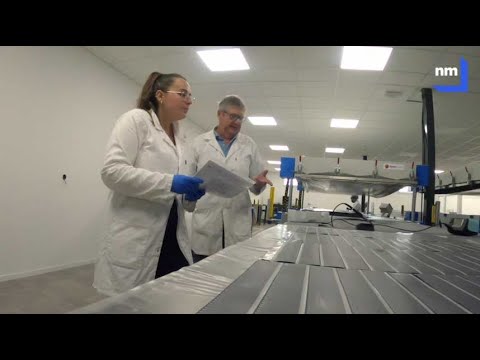
Manufacturing process (in French):

For AWES including parasails, this weight can be still too high. But for balloons, it could be an improvement compared to traditional solar panels which are up to 5 times heavier.

CEA-Liten-Flyer-Stratobus-Module.pdf

Development of lightweight and flexible panels by CEA-Liten
SUCCESSFUL DEVELOPMENT OF A SPECIFIC MODULE DESIGNED FOR THE STRATOBUS ™ AIRSHIP:
• Lightweight <800 g/m²
• High efficiency >220 W/m² (AM0; 40°C)
• Large scale >4m² with 1 by-pass diode per cell.
• Resistance to stratospheric conditions: temperature, UV, Ozone, wind….
• Integrated electrical and mechanical interfaces.
• Terrestrial and low cost fabrication processes.

Website:

CEA-Liten - CEA-Liten website Homepage

800g/m²”: this is becoming interesting for ASWES of type balloon-based, or NPW in lifter static (not crosswind) mode carrying a tiltable wind turbine working in power mode (not tilted) when good or high wind or in lifting (tilted) mode when low wind, and equipped with a pod similar to the pods used for crosswind flight, to ensure an active control of stability in addition to the natural stability, or, to a lesser extent (because of the cyclic deformation and the flight management issue), parasail in yo-yo mode.

I remember Joe Faust’s ‘shade topics’. Here is an article about shades in desert landscapes:

Could shade be created while solar electricity is generated with ASWES?

Moreover, some vegetables can be cultivated in the shade.

About photovoltaic balloons:

Innovative Balloon System Generates Solar Power from Above – Blog

A portable balloon integrated photovoltaic system deployed at low altitude - ScienceDirect

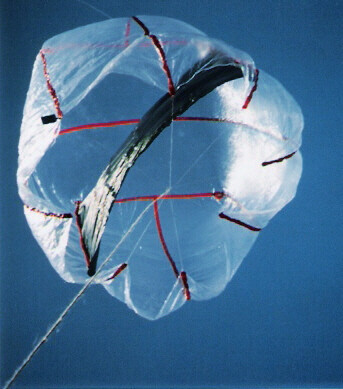
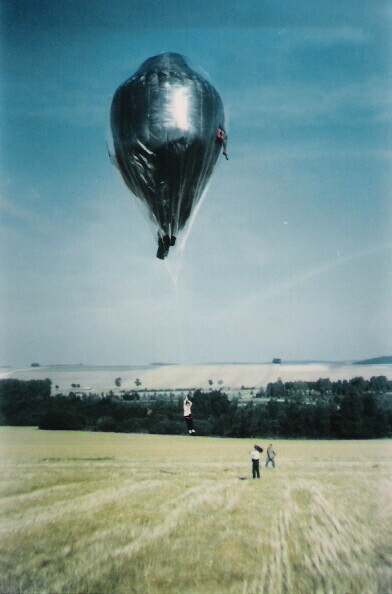
Proposal: a giant photovoltaic balloon oriented towards the sun by motorized belts, and flying during the day with the aerostatic thrust from the air heated by the solar diametrical wall (like on the photo below); and flying at night by utilizing the wind, possibly nocturnal low-level winds (NLLJs), using the Magnus effect through rotation in yo-yo mode, keeping heat enough to compensate for its weight.

That said, a double envelope (like on the photo below, but with also a cylindrical shape) would be a (more expensive) solution to escape to the requirement of orientation to the sun, and flying by Magnus effect night and day, while producing solar energy by day with the internal envelope.

MIT Makes a Super Thin Solar Cell That Can Turn Any Surface into a Power Plant

MIT engineers have achieved a significant advancement in solar technology by creating an ultralight fabric solar cell. These cells, much thinner than a human hair and weighing only one-hundredth the weight of standard solar panels, can transform almost any surface into a power source. Remarkably, they produce 18 times more power-per-kilogram compared to traditional solar panels due to the use of semiconducting inks and scalable printing processes.

The new generation of these solar cells is produced using electronic inks and are entirely printable. They are constructed using a slot-die coater to deposit nanomaterial layers onto a 3-micron thick substrate. The final solar module, after adding an electrode through screen printing, is about 15 microns thick. However, these modules are fragile, leading MIT to use Dyneema, a super-strong fabric, as a substrate. Adhering the solar cells to Dyneema with UV-curable glue results in a durable, lightweight solar structure.

In tests, these cells on Dyneema generated about 370 watts-per-kilogram, 18 times more than conventional solar cells. Their lightweight nature implies a smaller ecological footprint compared to traditional solar panels, reducing solar waste. Moreover, they maintained over 90% of their power generation capability after being rolled and unrolled 500 times. Challenges remain in protecting them from environmental damage, and the team is exploring ultrathin packaging solutions.

Solutions for photovoltaic films are starting to emerge. We can envision airborne solar wind energy systems (ASWES) harnessing solar energy without ground clutter, once locations on other surfaces are saturated.

1 Like