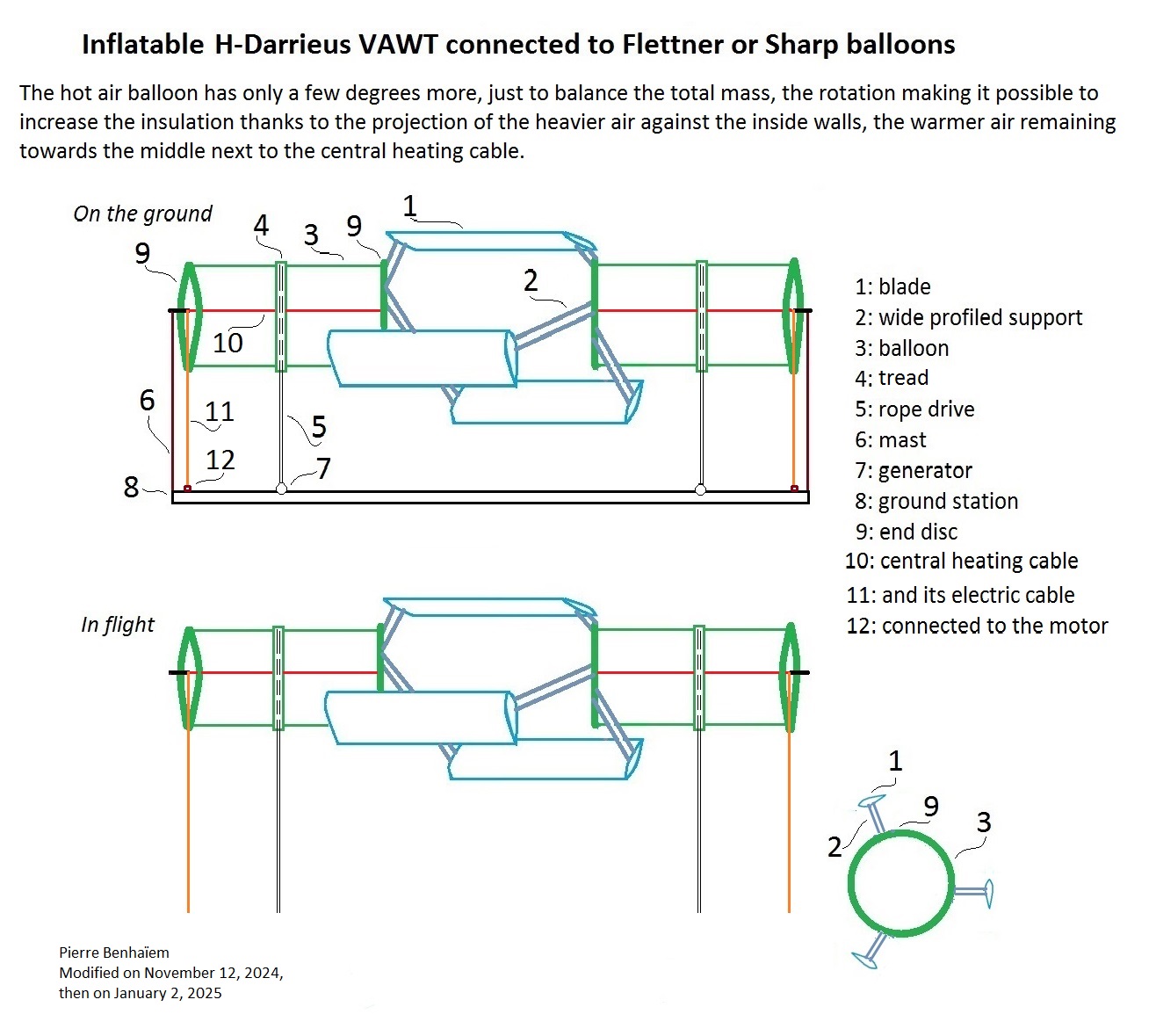
I made a rough comparison between Flettner balloon and VAWT side by side (rope drive transmission, sketch 1 below, preprint) and Preprint: Towards a gigantic Magnus balloon with motorized belts (yo-yo mode, sketch 2 below, preprint).
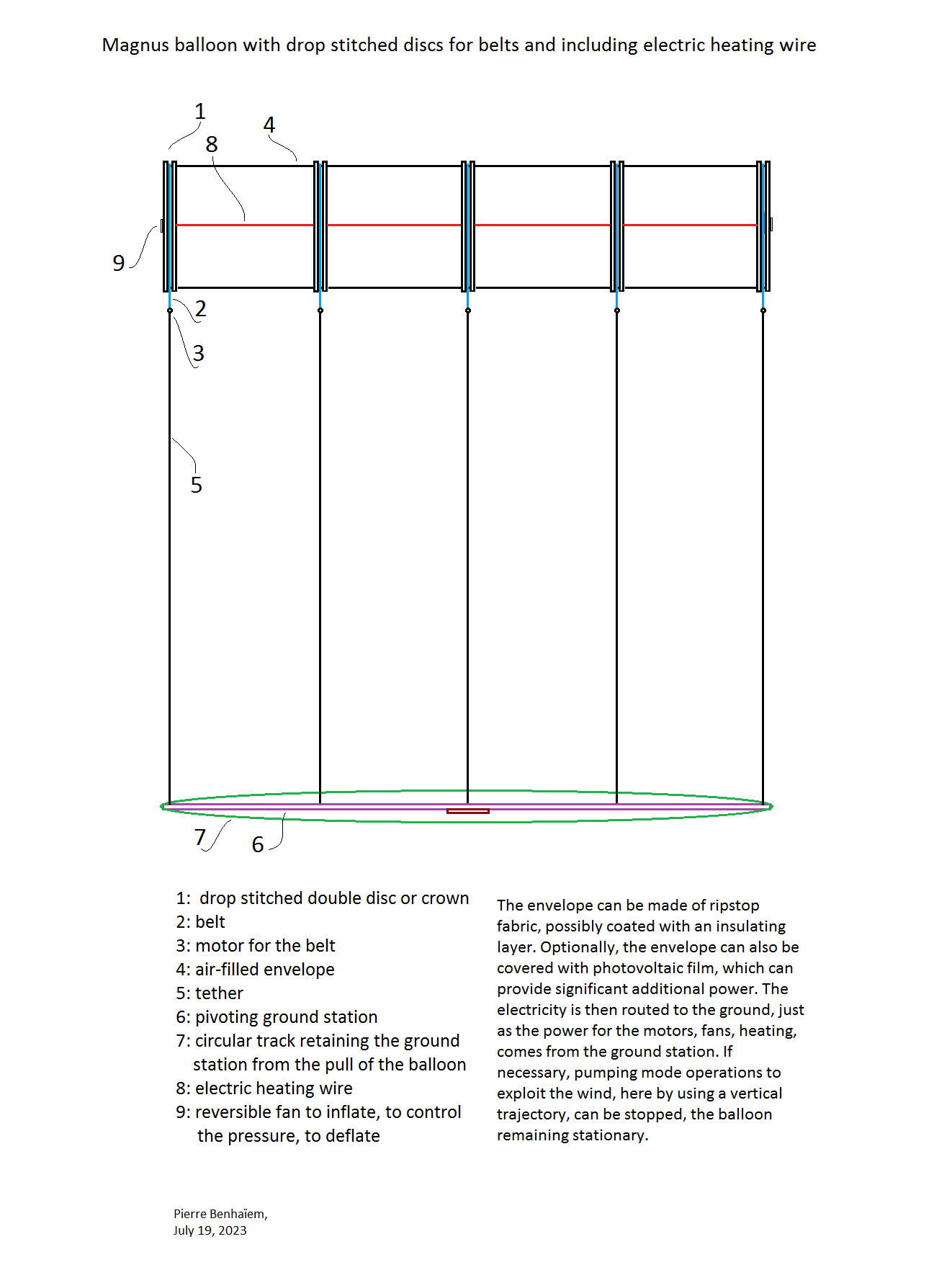
From Chapter 12: balloon 1000 m² (80 m span, 12.5 m diameter), swept area 13940 m², wind speed of 10 m/s, Cp = 0.157.
The power would be 1.313 MW, so 1.313 kW/m².
Giant balloon 1 km span, 0.2 km diameter, 0.4 kW/m², 80 MW, Cp = 0.0478293, swept area 2,788,000 m², 2788 m in height, by keeping the proportions. Wind speed = 10 m/s.
Now 2,788,000 m² of stacked VAWT + Flettner, totaling 1000 m span, with (per unity) 333 m x 333 m for the central VAWT, and 208.125 m diameter and 333 m span for each Flettner balloon. Cp of VAWT being 0.3, but only 0.2 by being optimistic (with not too high wind) due to the loss of lift by deformation of the inflatable profiles, then 0.06666 if we take into account of the Flettner balloons that produce nothing but ensure lift. So we have 13.3 MW with a Cp of 0.2 on the VAWT of 333 m x 333 m. If we don’t take the requirement of spacing between unities, we have 2788 / 333 x 13.3 = 111.13 MW. It would be less with spacing between unities.
The yo-yo mode seems to be more interesting because for an almost equal power for a same swept area, far less material is used. In addition, the VAWT + Flettner balloons combination has unknowns (real Cp of inflatable blades?).
Omnidea tested yo-yo Magnus balloon, but not in vertical trajectory which would be more efficient.
An example of peripheral drive intended for yo-yo giant balloon.
That said this is not enough to compete with HAWT.