Maybe this could interest @Rudo or @dougselsam or @rschmehl.
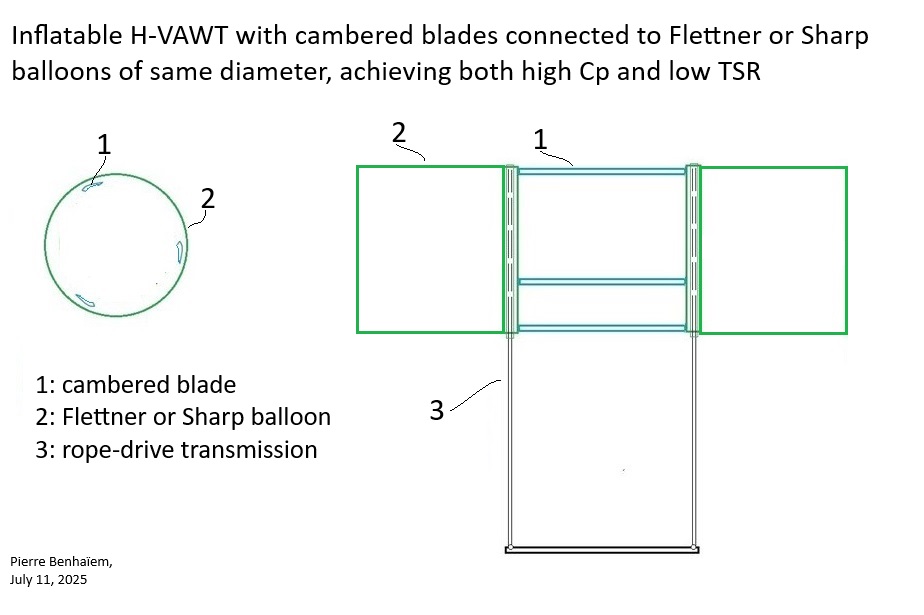
(PDF) Vertical axis wind turbine(s) connected to Flettner or Sharp balloons updated (see just below, with the sketch), following the reading of the publication below on the cambered blades of VAWT, the suitable number of blades (3) and the (high) solidity.
Numerical assumptions of a still more advantageous scenario for H-VAWT using cambered blades
It can be noted that an advantageous aligned layout (same diameter) of the central VAWT and Magnus-effect based balloons cannot be achieved with straight blades due to too high TSR (greater than 1) leading to a too high power consumption or too low aspect ratio of said balloons, as seen in the scenario 2.
A study [29] indicated that high solidity H-VAWT using cambered blades would allow for a high Cp (about 0.3 to 0.5) with a low TSR (below 1).
And for inflatable (Shapewave ® [9 and 10]) blades, the high solidity is not a major drawback since little material is used. Moreover, the low TSR (1 or lesser than 1) allows to diminish the efforts on the blades, leading to better keep their respective shapes [25].
The sketch below takes up certain elements from scenarios 1 and 2, including the assumed diameter of 20 m of the VAWT. However, the TSR is assuming to be 0.8 instead of 1.6, leading to a power consumption eight times lower, allowing each of the Flettner balloons to be extended eight times. The span of each ballon becomes approximately 20 m, and 40 m for both, plus the 20 m span of the central VAWT.
Note that the TSR of a Sharp rotor is also about 0.8 or even 1, which would help avoid energy consumption regardless of the length of the Sharp balloons, which therefore is without limit.
For the reasons stated above, this is by far the most advantageous variant of all the variants described in the preprint.
A kite can suspend the H-VAWT-Magnus or Sharp balloons as outlined below, just like for previously described devices. However, this does not seem advantageous and adds complexity in handling. The buoyancy of the balloons (and perhaps also of the blades) is achieved by inflating with hydrogen or helium, or by hot air using a central heating cable (see above) or by using thermal solar energy. Solar photovoltaic film can be added around the balloons and blades.
A comprehensive analysis of solidity for cambered darrieus VAWTs - ScienceDirect
Also available (full text) on (PDF) A comprehensive analysis of solidity for cambered darrieus VAWTs.