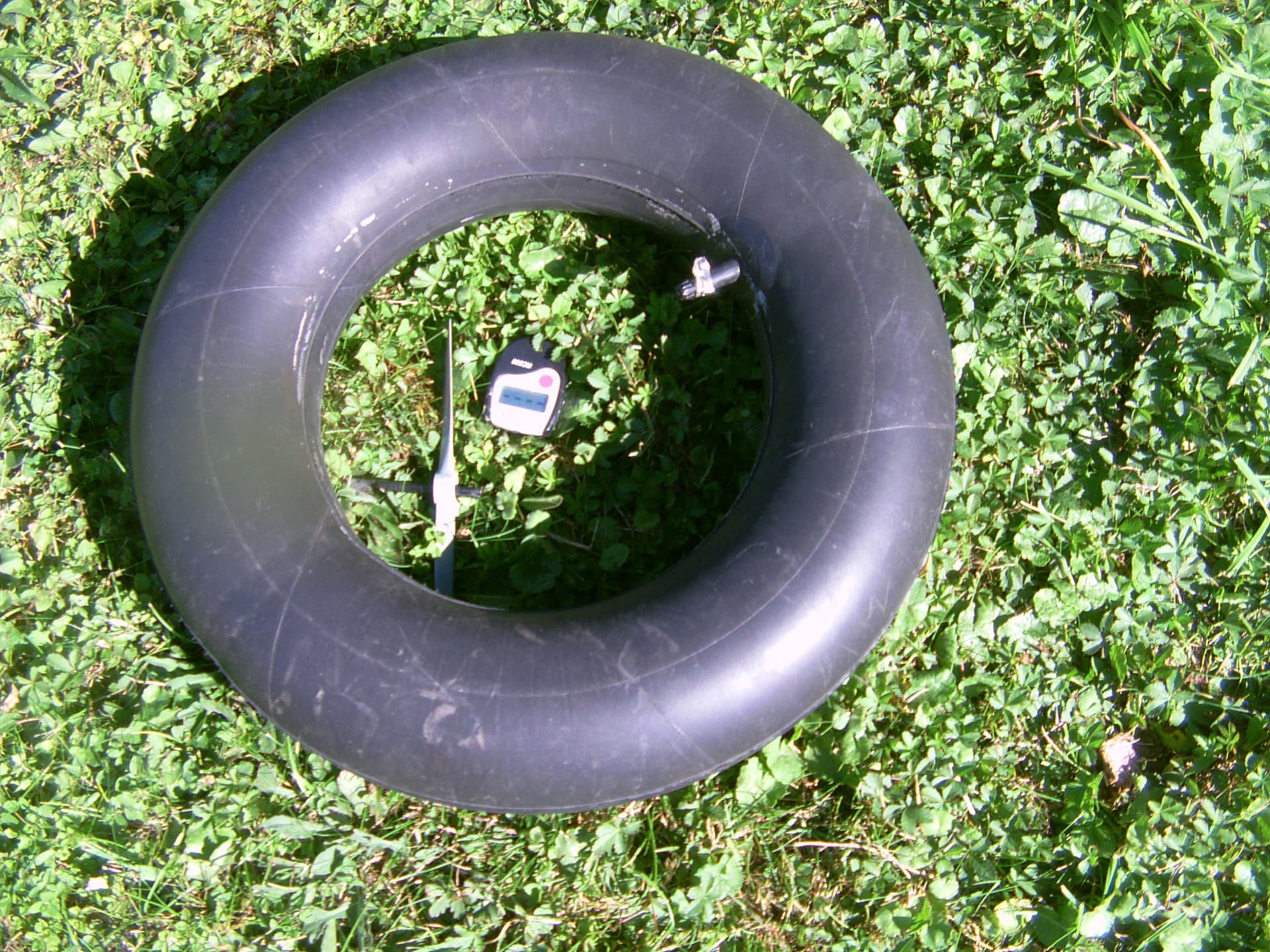
Some update, showing the inefficiency of anemometers (because of too variations), better measures being done by using a rpm-check, indicating a potential of double the power, which confirms some previous approximate evaluations with anemometers.
The rotors of anemometers are small and light, leading to a low inertia, hence too fast variations compared to those of a propeller with a diameter of 20 cm (sometimes 23 cm) which was also used.
While anemometers were finally not useful, the impression of a greater speed of the propeller inside the 42 cm tire (inner tube), the most efficient according to first rough evaluations, was confirmed with measurements using an rpm-check.
Measures with a rpm-check
With the same fan, a rpm-check was used.
Measured rpm (135 x 10) 1350 (sometimes 1400 even more inside) with the 42 cm tire, and rpm oscillating between 1050 and 1100, more often 1050 without tire. The wind speed is directly derived from the rpm.135/105 = 1.2857. So, wind speed is 1.2857 times higher with the tire. 105² = 11025, and135² = 18225. 135²/105² is about 1.65 times. 105³ = 1157625, and 135³ = 2460375.135³/105³ = 2.125, which is more than double the power. And the experiments with the rpm-check all yielded the same result in front of this fan. The difference in speed was obvious, the acceleration much stronger with the tire, and the pain and difficulty of stopping the propeller with fingers was greater. The same was going for outside.
(PDF) Flexible kite carrying a turbine within a torus-shaped balloon. Available from: https://www.researchgate.net/publication/388800040_Flexible_kite_carrying_a_turbine_within_a_torus-shaped_balloon [accessed Sep 10 2025].
42 cm tire (inner tube), propeller, and rpm-check