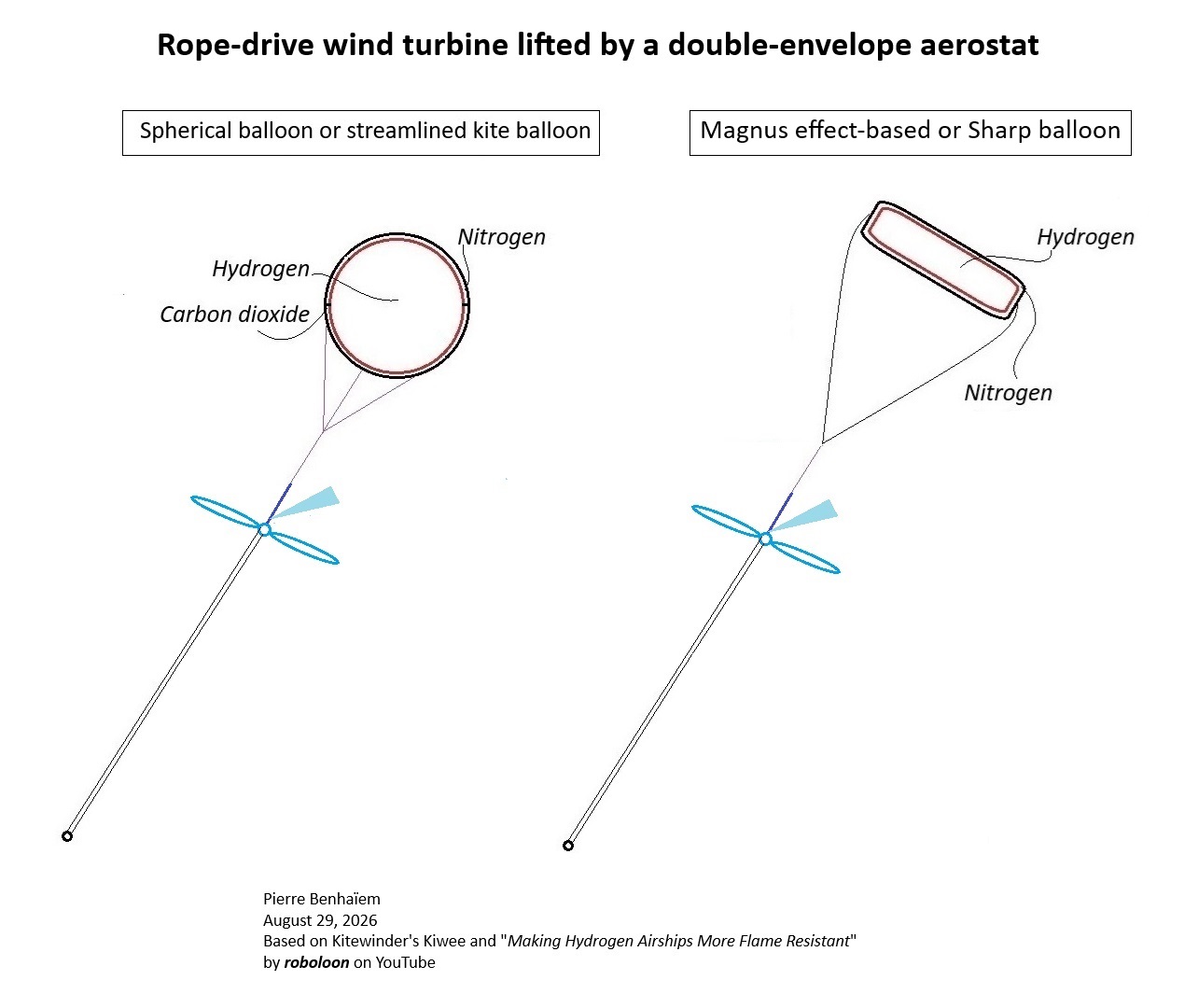
Mixing the rope-drive technology with the shroud effect of a torus.
It is intended to mix both technologies. The torus provides protection for the wind turbine, greater efficiency through the shroud effect, and aerostatic lift.
Looks like it could work, Pierre.
The donut would protect the rotor in crashes - but wait… It’s going to crash? Hmmm, there is a can of worms right out of the box - crashes! Lots of launch/land and other operational issues remain to be experienced, let alone solved. One question is whether the geared rope drive even weighs less than a generator and wire, at prototype scale, then larger. Also, how will it last? Any source of wear is going to cause problems eventually. The donut - what happens when it leaks? Is it filled with helium? for how long and who refills it and how often? What about when it wears out? There’s a big gap between a prototype that can work for an hour or two, and a reliable installation that lasts 20 years. Anyway, nice idea but many details remain…
You can note that the weight of the nacelle (mainly the generator) is far higher than the hub and the blades together. Rope-drive transmission saves this weight.
An equivalent wind turbine (100-200 W range) would weight far more. The mechanism of right angle pulley is perhaps as heavy as a hub (so, heavier than the blades combined).
The donut is flat on the ground, then arises by its helium then the lifter kite.
For your home:
A first example to illustrate an airborne wind energy system for individual use. A torus with an outer diameter of 13.125 m and an inner diameter of 7.5 m, a tube diameter of 2.8126m, a surface area of 286 m² leading to a weight of about 46 kg (0.16 kg/m²) without the fixations, a volume of 201 m³ leading to a lift of 212 kg with helium and 241 kg with hydrogen, could integrate a wind turbine with a rotor diameter of 7.1 m, weighing 0.5 t [8], but being far from being able to lift it. However, a similarly sized wind turbine equipped with a rope-drive transmission of type Kiwee [1 and 2] could be lifted even without the lifter kite.
Yes for the basic version. As you know aerostats lead to a high level of maintenance and costs.
From the preprint:
Cheaper variant using a hydrogen-filled aerostat, which may also include aerodynamic lift
[…] Therefore, it is better to avoid inflating the torus with hydrogen, which will simply be inflated with air. A hydrogen-filled aerostat [4] could replace the kite, to ensure constant lift.
High-density farms in bumper car mode
The turbine-tori can be settled close to each other because collisions do not lead to serious damage. However, collisions between hydrogen-filled balloons should be avoided: they can fly at different altitudes.
I’ve always wondered if the KiWee itself uses more weight in its drive mechanism than just a generator and wire. Sounds like the donut/rope drive could possibly work at some level of output, at some size. But one more factor “weighing” against it is any such rope drive would be trying to climb down the rope, by pulling itself downward with the same force it tries to pull power upward on the rope. Also, as with the ideas targeting jet stream operation, don’t forget the tether weight. Also there is whatever structure mounts the turbine to the donut. and mounts the rope drive to the turbine, and also whatever attaches a lifter kite, if used. And don’t forget how frail the Altaeros donut turned out to be in a stronger wind. One thing is for sure, one could be built and tested at a small scale. A plastic inflatable ring for the beach or swimming pools might be a starting place. Then you might have a few ounces of lift at best to accommodate the entire apparatus, tether, and downward pull. I guess the downward pull would depend on the chosen tether draw speed. Certainly it’s all within the ability of verification by calculations and, if justified, prototype!
Hi Doug,
You often make this remark. I think you confuse the rope-drive motion (transferring power = moment of the torque in Newton-meter, multiplied with rotation velocity in rad/s) down and up, with the traction force wich is produced by the kite and a little by the turbine drag. If you put a giant kite with a huge traction, the rope-drive transmission will work also very easily. And also in a regular wind turbine the rotation creating the torque goes down and up, just like the rope-drive transmission.
Assuming Kiwee produces 200 W at 10 m/s wind speed, the tip speed being 62.8 m/s, with 20 rotations per second, leading to 125.5 rad/s. So, the torque is very low, whatever the pulling force of the kite. The power coefficient (Cp) of Kiwee is very good, being comparable with that of a small regular wind turbine (0.35).
A problem I see with the torus is its useless excess of drag since only the shroud effect inside is used, not the shroud effect outside, which could maybe is used. To use a major part of the shroud effect inside and outside, perhaps concentric tori could be implemented. That said I do not know the result. If rope-drive transmission is used, connect the turbines to each other with belts, then use the central turbine for the general rope-drive transmission. If regular wind turbines are used, connect only the electric wires of the turbines to each other. The mention “suspension lines for each torus” concerns the use of regular wind turbines, since a rope-drive transmission should be connected alone to the ground, otherwise it does not work well.
“Kiwee” [1 and 2] rotor diameter is 1.1 m. Its mass in flight is approximately 0.8 kg, without the lifter kite. A torus with an outer diameter of 2.1 m and an inner diameter of 1.2 m, a tube diameter of 0.45 m, a surface area of 7.328 m² leading to a weight of about 1.1 kg (0.15 kg/m²) without the fixations, a volume of 0.8244 m³ leading to a lift of about 0.9 kg with helium, could integrate it. But the volume is not sufficient. As a result, the initial proportions of the 42 cm outer diameter tire inner tube are changed. A torus with an outer diameter of 2.7 m and an inner diameter of 1.2 m, a tube diameter of 0.75 m, a surface area of 14.434 m² leading to a weight of 2.165 kg without the fixations, a volume of 2.7 m³ leading to a lift of about 2.96 kg with helium, could integrate “Kiwee” while in aerostatic equilibrium, with positive lift being provided by the kite regardless of wind speeds, even in very light winds. On the other hand, the shroud effect should be re-examined, knowing that during preliminary tests [4], the thicker buoy with similar proportions (outer diameter of 85 cm, and inner diameter of 38 cm) had a lesser effect.
Kitewinder [1 and 2] intended to develop a larger version [12) with a rotor diameter of 2.5 m, sweeping an area of 4.9 m². A torus (respecting the initial proportions) with an outer diameter of 4.725 m and an inner diameter of 2.7 m, a tube diameter of 1.0126 m, a surface area of 37.1 m² leading to a weight of 5.565 kg (0.15 kg/ m²) without the fixations, a volume of 9.39 m³ leading to a lift of about 10.3 kg with helium and 11.263 kg with hydrogen, could integrate it, and maybe lift it even without wind. In any case the whole thing would easily fly with a lifter kite even in light winds.
All good points I agree with, Pierre, except not all AWE ground-gen approaches necessitate a pulling-down force on the apparatus to generate power.
Anyway, the added downforce is just something I thought is worth mentioning. I’m trying to understand if you included the weight of the tire tube in your above calculations? I’m guessing that might be the heaviest component of all!
I also had noticed, as you point out, there is no usable funnel effect from the outer part of the torus, however, it does double the volume, increasing buoyancy while retaining the advantage of a shape that can be held by pressure alone, without extra structure added.
Also, I’m sure you remember that from the beginning, I’ve warned about belts and chain drives in wind energy. They are noisy and always fail eventually. The veterans warned me as I warn others and experienced it firsthand myself. I noticed KiWee offers replacement belts and other parts, indicating their product is still at the “not ready for prime-time” stage. One risk is a failed belt or chain may leave the rotor unloaded, and since failures happen in high winds, it’s quite likely in wind energy that one component failure leads to ruining the whole machine.
For example, I had a 10 kW generator burn out when a wire that was never connected properly by the local lame-ass installer came loose from one phase of the generator, which burned out the stator! It’s one thing to have something that works, but, if it’s a known fact that it will quickly experience one or more component failures, it starts to sound like a lot of cars being sold these days: better sell it before the warranty expires! In wind energy, the idea is “set it and forget it” for 20 years or more. Just as when you buy a new furnace for your home, or even just an appliance like a refrigerator or stove, you don’t expect to need a service call for at least 10, 20, or more years.
The torus is relatively heavy on small scales, but the mass of the wind turbine easily outweighs it as the assembly scales up. Torus mass increases squared, with its surface area. Wind turbine increases cubed.
For AWE, regular wind turbines should be far heavier than rope-drive wind turbines since the generator would be aloft.
But it is possible that rope-drive transmission could fail. We not see it in wind energy. How to know?
OK yes, you did include the weight of the empty tire tube. I must have been spacing out to suggest that you had not.
I do think what you’ve presented is a workable idea. Probably the easiest way to get one working would be to add a helium-filled tire tube to a KiWee. I’m guessing you’ve already talked to them about such a possibility.
Anyway, as I always say, there are unlimited ways to make SOME power at SOME cost, from the wind. The question in any case is whether any new way is reliable and more economical than what exists. Of course we like to pretend the rules for AWE are different. For AWE, if it even works at all, for even a few minutes, in light-to-average winds, it’s “a major breakthrough’ - no wait, a “Gamechanger!”.
Other than that, not trying to shoot down the idea, just help out by examining it for whatever flaws or failure points it may have, rather than them turn out to be a surprise, just as I do with my own ideas. Don’t worry, there are always the surprises we didn’t think of. to deal with eventually.
I would say, though, that the one with the concentric rings is not impressing me as a good idea, since these larger rings do not surround each turbine closely so as to accelerate the wind through the rotors very much. Plus you would have trouble finding off-the-shelf tire tubes for those larger rings!
If not Kiwee alone. The helium-inflated tire tube adds protection, lift, and shroud effect, which increases flight time and reliability, but also increases cost and drag.
It’s just a backup idea, and more for conventional wind turbines, like the S1500 for which I would like to know the shroud effect.
So, the only way is using a rope-drive wind turbine of Kiwee type, right? Otherwise, harnessing very fast winds in jet-streams, using the “air cooled” version of:
One could go on all day citing components with characteristics stated by the marketing figures from the would-be sellers. Nice to find such promising numbers, so now the trick is to actually match up a set of components that could hopefully work together, and see if it indeed works, or then what adjustments or modifications are needed. Diagrams are easy, working examples a bit more challenging.
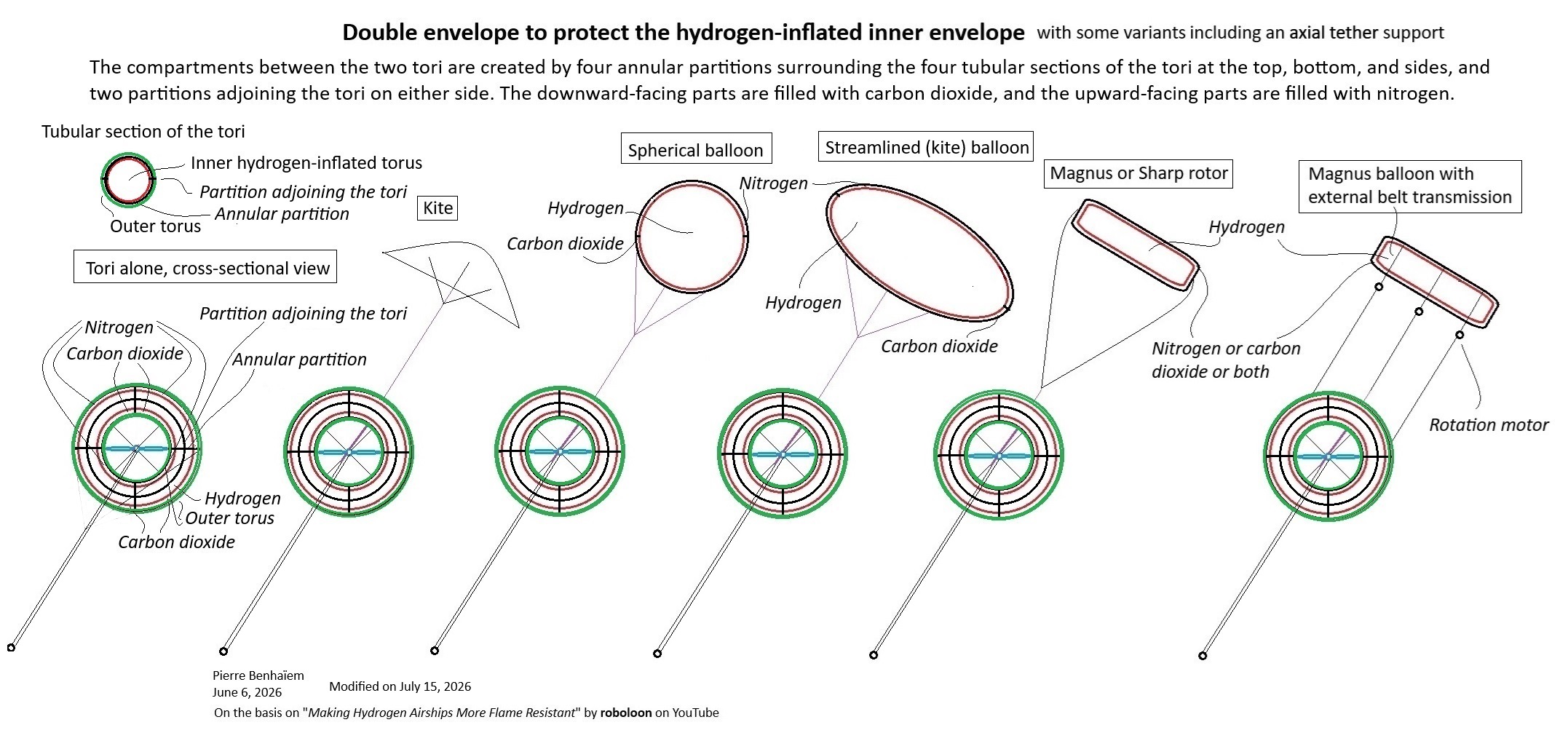
If the wind turbine with rope-drive transmission actually turns out to be lighter than a conventional wind turbine, then the first two variants (torus alone or with a lifting kite (sketch below) might be enough if the described process proves safe for hydrogen use.
It turns out that the axial tether and support may be insufficient for the stability of the torus relative to the wind turbine, the rope-drive transmission preventing a bridling of said torus, which is therefore not retained.
Hydrogen Type Production Method Estimated Price Per Kg
Grey Hydrogen Steam Methane Reforming (SMR) from natural gas with CO₂ released. $1.00 – $2.00
Blue Hydrogen SMR from natural gas with CO₂ captured and stored (CCS). $1.80 – $4.70
Green Hydrogen Electrolysis of water using renewable electricity (e.g., solar, wind). $4.50 – $12.00
1 kg of hydrogen leads to 11.1 m³. Its density is 0.08988 kg/m³.
1 kg of helium leads to 6.06 m³. Its density is approximately 0.1785 kg/m³. The density of nitrogen is approximately 1.25 kg / m³ (a little less than air density).
The density of carbon dioxide is approximately 2 kg / m³.
Per volume unit [m³), the price of hydrogen, which varies, is easily dozens of times lower than that of helium, as is the price of nitrogen. However, the price of carbon dioxide is between 5 and, let’s say, 8 times cheaper than that of helium. So, the average price of the three gases would remain slightly higher than the price of hydrogen alone.
Hydrogen would occupy most of the volume—perhaps 90%, perhaps only 80% if a greater safety margin is desired, or even less to increase the safety margin, for an overall cost that keeps rising when the part of hydrogen decreases, while still being extremely low compared to the cost of helium, which is also a rare gas and prioritized for certain applications.
Tests and theoretical studies could reveal possibilities or impossibilities depending on the configurations of the aerostat (rotating or not), the proportions between the volumes of hydrogen and of protective layers, knowing that we remain in the field of unmanned flying devices.