I tested three torus (see in the preprint): a thin 36 cm tire, a 42 cm tire (internal diameter 24 cm), and a 85 cm buoy.
The 42 cm diameter tire was better due to its proportions, neither too thin nor too fat. The rpm of the propeller was 1.1 to 1.3 higher in the tire (measurements by rpm-check after those by anemometers). If the cube of wind velocity applies as expected, the power would be between 1.3 and 2.2 times higher, which is not too bad for a simple thing which is primarily a protection for the turbine, and which would allow easier stacking of the turbines.
Note: where the torus (tire) was tilted, even little, its efficiency dropped drastically. Thus, I don’t see how a longer tilted tube could be efficient in regard to the wind turbine inside.
They apply formulas, only seeing the problems afterwards, realizing then that the formulas were not complete.
You will soon see that what is called a crosswind kite (including FlygenKite) is not so advantageous. If you add the weight, that becomes impossible.
Although this device was initially designed to be lifted by a balloon or a lifter kite, it can also fly on its own, inflated with helium or hydrogen.
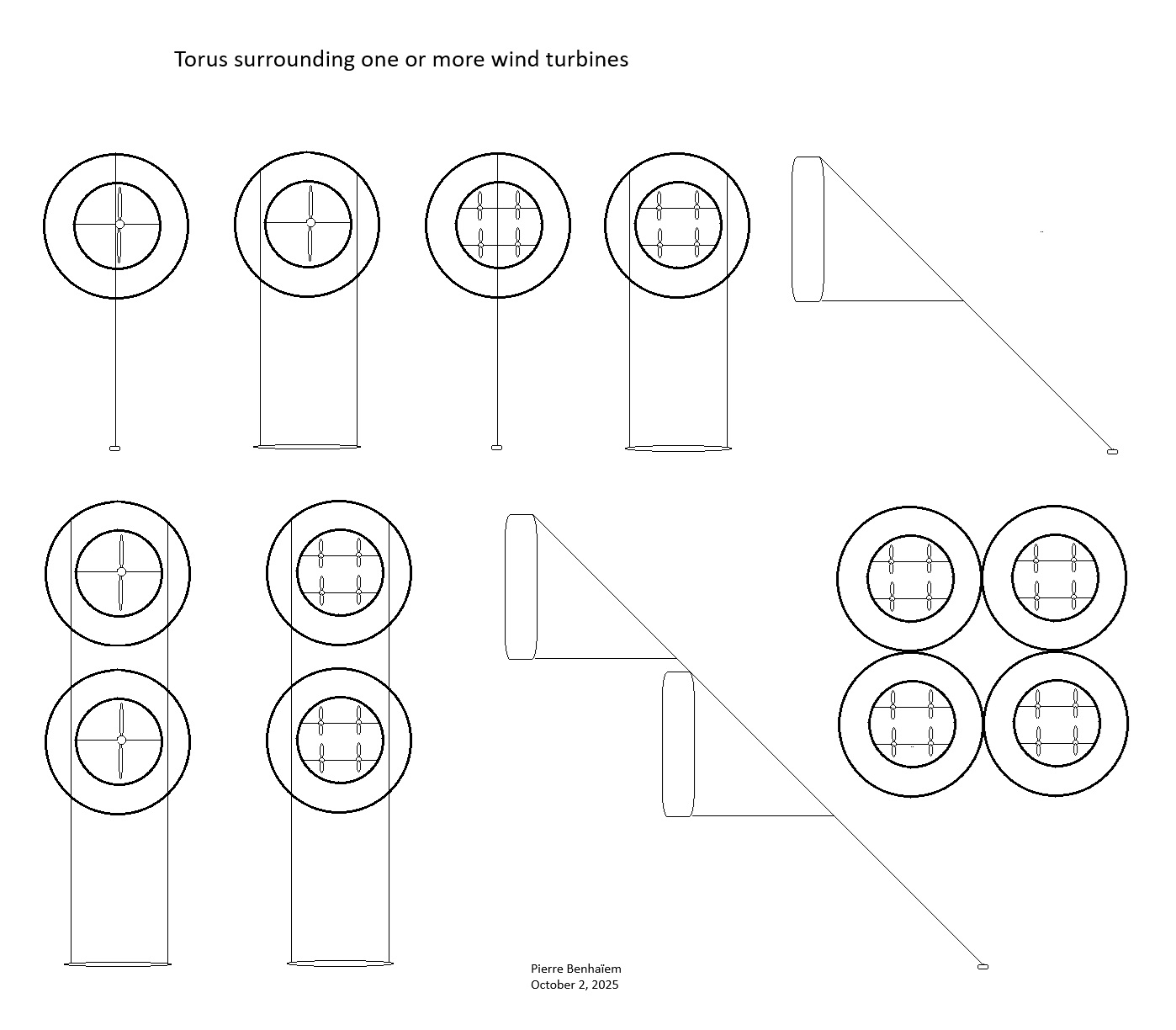
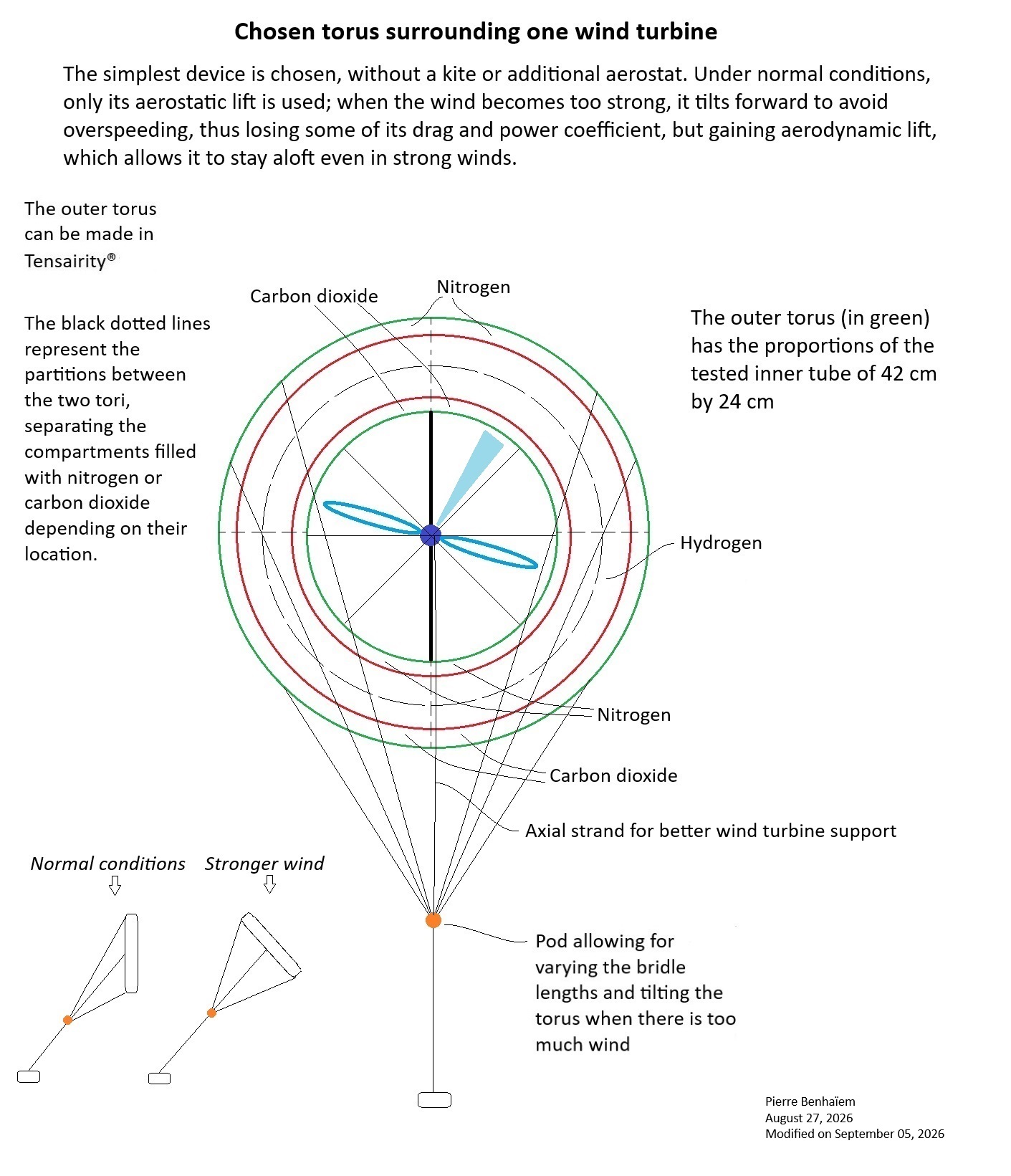
The sketch below depicts a torus with the same proportions as the 42 cm diameter tube that proved to be the most efficient. A torus can include a single wind turbine or several smaller turbines to lighten the overall structure.
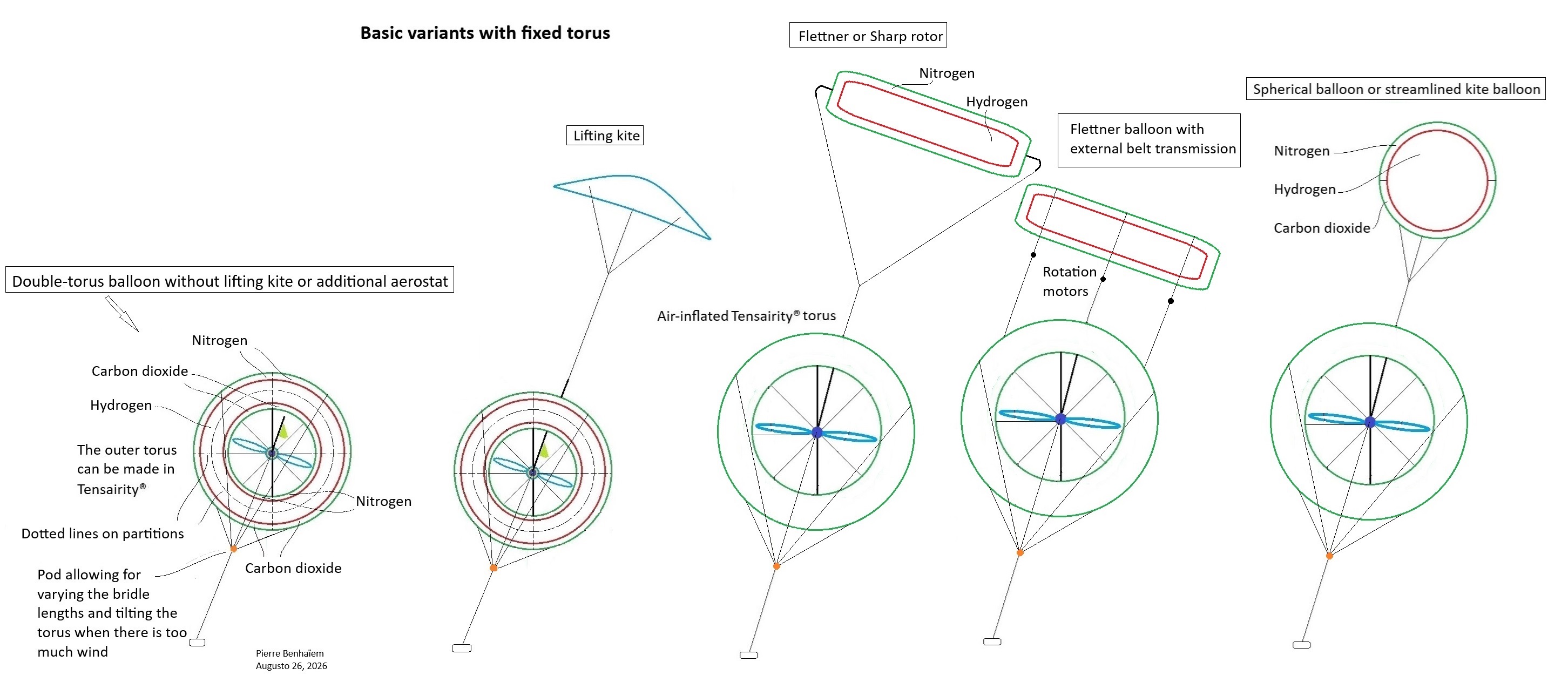
Trains of torus with wind turbine(s) are also shown, as well as torus connected to each other. All variants can be combined with the devices with kites or aerostats described below.
For a first calculation, we will assume an outer diameter of 22 m, and an inner diameter of 12.57 m, tube diameter of 4.715 m, volume 948 m³ leading to a lift of 999 kg with helium and 1137 kg with hydrogen, would weigh (0.16 kg/m²) about 130 kg without the fixations. A wind turbine of 12 m diameter (113 m²) would weigh 1.3 T [14], but four smaller windturbines [15] installed on an inner frame could weigh about 40% less, due to an approximation of the square-cube law penalizing the mass by the cube when the dimensions increase. Thus, four wind turbines totalizing 800 kg could be lifted narrowly, and more largely if the generators (more powerful due to both stronger winds and shroud effect) are studied to be lighter.
Now a giant torus of inner diameter of 100 m and outer diameter of 175 m, tube diameter of 37.5 m, weighing (0.25 kg/m² plus rigid structure) about 13 T and more since this large torus should be rigidified (like the beams supporting the turbine), volume 477,095 m³ leading to a lift of 502 T with helium and 571 T with hydrogen, could largely lift this 2 MW wind turbine [16], even by taking account of heavier blades and more powerful generator to reach about 27.5 MW with 20 m/s wind speed and the torus shroud doubling the power, allowing a good elevation angle even with strong winds. The device would be lighter with smaller wind turbines, as indicated above, but the advantage of a lesser mass could be destroyed by the requirement of many elements.
An example of a torus with an inner diameter of 5.5 m and an outer diameter of 9.625 m, a tube diameter of 2.0626 m, a surface aera of about 154 m² leading to a weight of 23.1 kg (0.15 kg/m²) without the fixations, a volume of about 79 m³ leading to a lift of 86.66 kg with helium and 94.24 kg with hydrogen, could be in aerostatic equilibrium by carrying a wind turbine with a rotor diameter of 5 m, including a generator weighing 43.1 kg and producing a continuous power of 82 kW [21] in air cooled version, at a much lower rpm than the 1400 rpm at the 145 kW peak power, the tip speed of the blade being a little over 200 m/s. The swept area is 19.625 m², the wind power could match the 82 kW of the generator [21] with a wind speed of 21 m/s (in LLJs), an air density of 1.2, and the shroud effect of the torus increasing the power by 2 times the initial power of the wind turbine. The lifter kite adds aerodynamic lift.
All these examples sound promising, however, as the saying goes, “the devil is in the details”. I see so many versions described it’s enough to make my head spin. One thing i think I noticed was the claimed power output of a generator was at a much higher rpm than a wind turbine could spin it. Other aspects include whether the stated output levels are for real, and/or could be maintained for hours or days on end without overheating. Also, it’s been found that shrouded turbines need higher-solidity rotors to reduce the Mach number in high winds. This adds weight while reducing efficiency. Then there is the mass of the supporting structure for the turbine. Some of these and other considerations would become evident if a prototype were built and run. Maybe a lighter turbine could be used for low winds and the torus tilted in higher winds to spill the extra power. This might at least get something running. Anyway, it would all start with a model of high enough quality to be taken seriously, that could actually be flown and run and produce steady-state power, for hours, on a nice, windy day. The scale need not be huge, but the quality would have to go beyond the level of experimental toy components. Still, such high-quality components are easily available, and I see nothing stopping one from being constructed. As to whether the stated numbers could be met, and still make it lighter than air, remains to be seen, but certainly, a light-duty turbine at some level of output could be lifted by a torus of some size!
I experimented a tilted torus: the efficiency dropped drastically, even with small tilt. And an AWES should be able to exploit very strong winds, otherwise what is its use (unless you rely on the average load factor all the time)?
That said tilting the torus-turbine can be a way to avoid overspeed.
Yes, probably. Happily the torus is an efficent shroud, but not too much!
I think Makani used 5-bladed secondary turbines to avoid a too large TSR.
200 m/s is still below the Mach number. But it is a high speed which can be bad because of noise and stress on the blades.
Just checking … and for the sake of writing it down explicitly somewhere.
With tilting to avoid overspeed
you tilt the top windward edge down
the trailing lower edge up
giving the overall form some lift
but lowering the exposed frontal area of the rotor
Yes, and only by a few degrees, because the torus is thick, and produces a wind shadow even when tilted slightly. In addition there is “lowering the exposed frontal area of the rotor” by cosine (without taking into account the torus itself).
Lift (with the assembly tilted) was not noticeable with the small propellers I was using. And the torus produces no lift, even when tilted.
Experiments today, wind speed 7 to 13 m/s in the weather station, and 5 to 10 m/s locally.
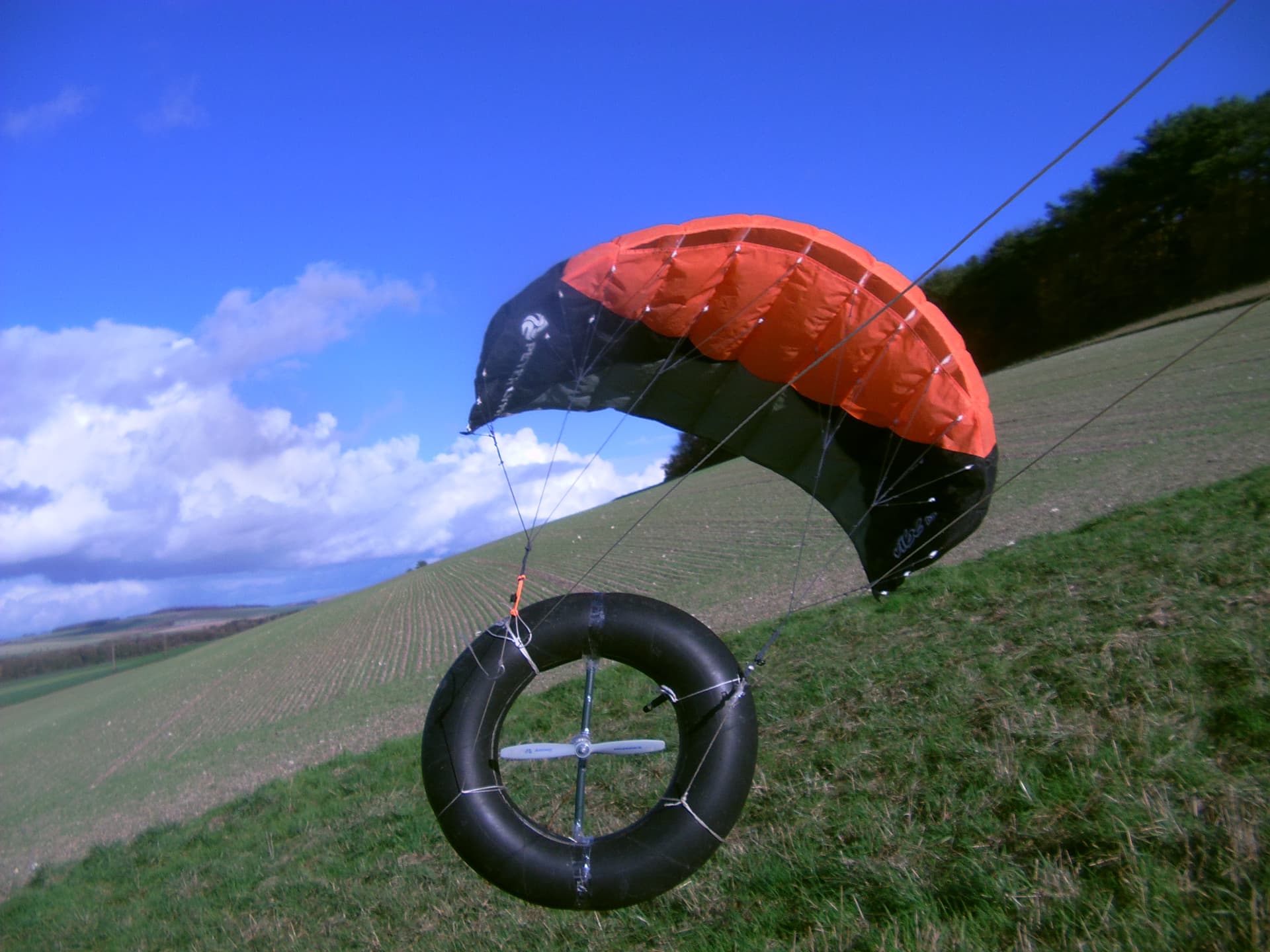
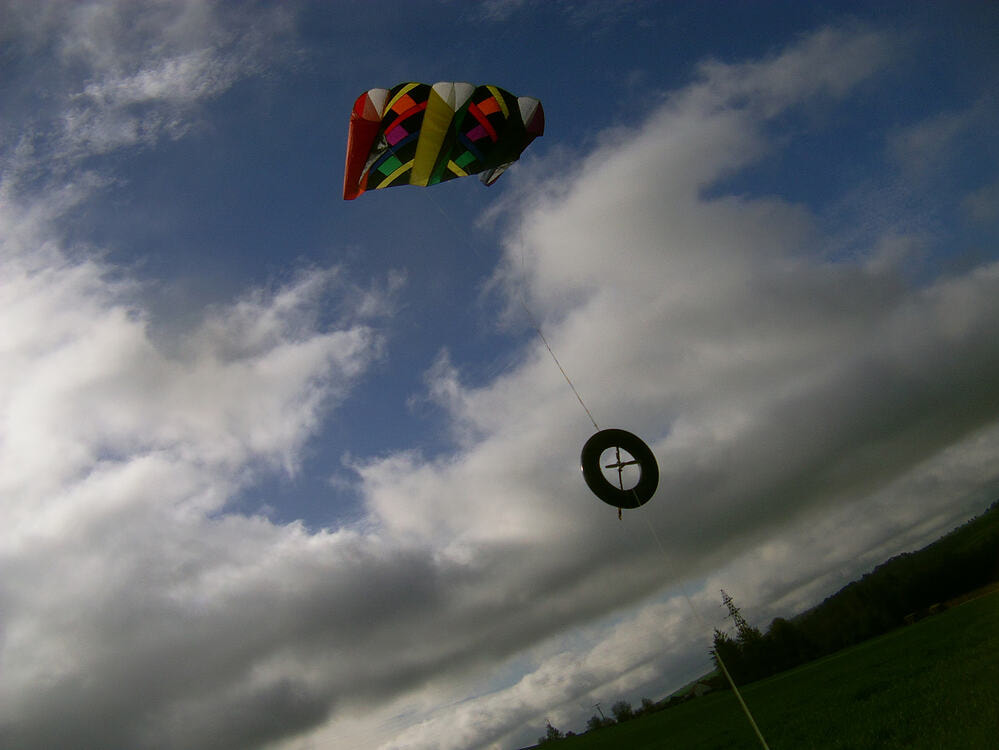
Experiments of “FlygenKitire” (kite + tire inner tube + turbine), wind speed of 5 to 10 m/s
The two-line kite is 0.5 m² in projected surface area. The weight of the 42 cm diameter torus is 0.45 kg. The experiments revealed significant instability due to the mass of the torus relative to the projected surface area of the kite, but especially to the drag exerted by the torus. After one or two seconds, the torus would flip over and destabilize the entire assembly, which would immediately fall.
You need to be patient during recharging, perhaps overnight after setting up the tent.
This might be useful for getting from one camp to another during expeditions to high mountain peaks.
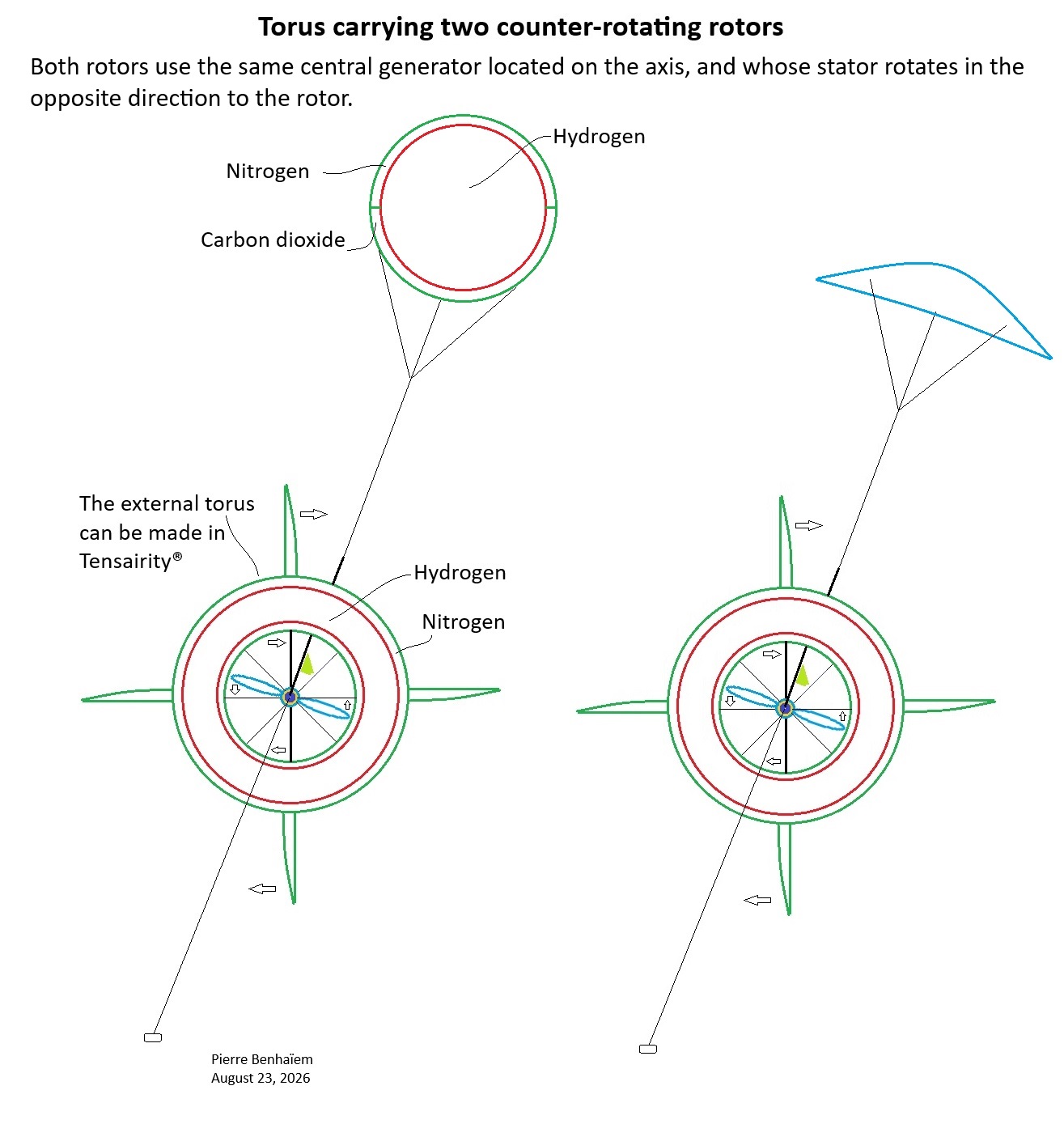
The numerous possibilities should, however, lead to research aimed at optimizing the entire system, potentially resulting in a torus supporting two counter-rotating rotors. The inner rotor would likely develop twice the power thanks to the ducting effect of the torus (measured and presented in this article), thus compensating for the force of the larger outer rotor attached to the torus. Both inner and outer rotors would drive the same central generator whose stator rotates in the opposite direction to the rotor, each rotor driving either the stator or the rotor. A sketch is presented below.
Just found this great video in an old. open window, from KQED, on AWE, featuring Ken Caldiera, including a “FLYgEnKiTe” (plane) and others. Fun to watch! Airborne Wind Energy | KQED
However, simpler versions with a fixed torus or double torus may be preferable. The axial tether and support are supplemented with a bridle for improved stability, by avoiding collisions between the wind turbine and its transverse mast, due to the significant drag of the torus, and to allow for progressive tilting in strong winds, generating and increasing turbine and torus lift [34] while reducing their respective drags. Hence, a still simpler system without an additional kite or aerostat (when the volume is high enough) is still more advantageous. The variants below have been partially presented above, including the simpler system first.
As a result, the simplest torus surrounding one wind turbine is represented alone below. It is now chosen as the best option for this temporary conclusion. In addition, this device can be adapted to existing wind turbines, provided that the double-torus balloon exceeds a certain volume.