As an external layer to protect the inner hydrogen-inflated balloon (see below).
To complete the initial preprint.
The video (again), just on a sketch:

As the Magnus effect-based balloon is rotating, only nitrogen would be used to protect the internal hydrogen-inflated envelope.
Since, in pumping mode but not as a lifter, high aerostatic thrust is not required, and must be almost neutral, two less expensive inflation configurations are presented, including the one with a mix of air and helium, and the other with an internal hydrogen-inflated envelope [4], the layer between the external and the internal envelope being inflated with nitrogen.
Aside from that, I think that crosswind operations (from right to left and vice versa), while theoretically more efficient, require a higher spin ratio (tangential speed x wind speed) due to the greater apparent wind speed, which leads to potentially excessive energy consumption, judging by the results published by Omnidea for a low spin ratio and low wind speed.
That’s why I’m sticking with a vertical trajectory, at least for the time being, and insofar as I believe there’s a possibility for Magnus-effect based balloons.
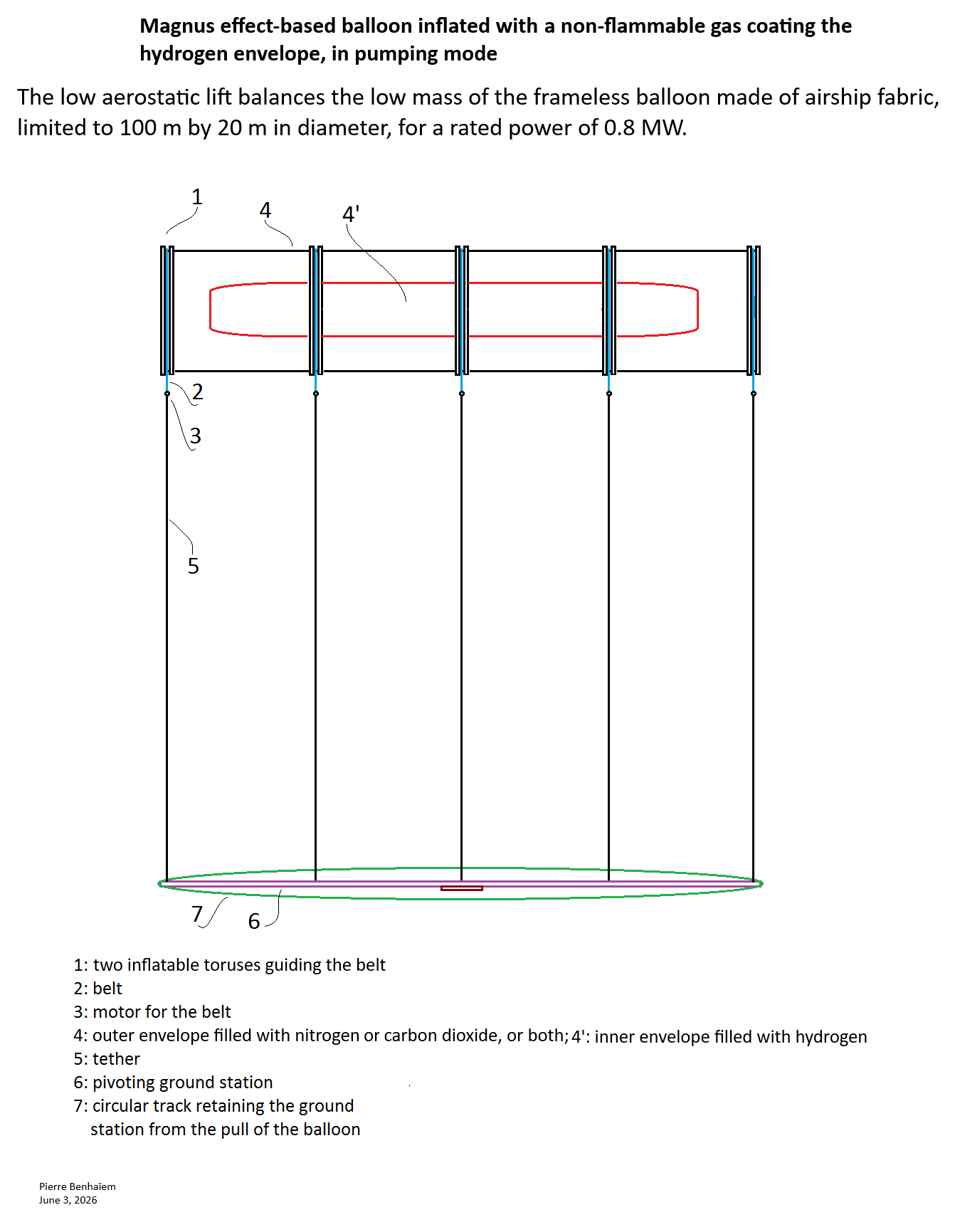
Thus, in pumping mode, and provided the equipment is sufficiently lightweight, a very thick layer of nitrogen could separate the inner hydrogen-filled balloon from the rest of the balloon.
This demonstrates (?) that, regarding AWE, hasty conclusions are not necessarily the most accurate. Therefore, although this is only a hypothesis, the expected low efficiency of pumping mode and of Magnus effect could be mitigated by the possibility of using hydrogen with lower risks.