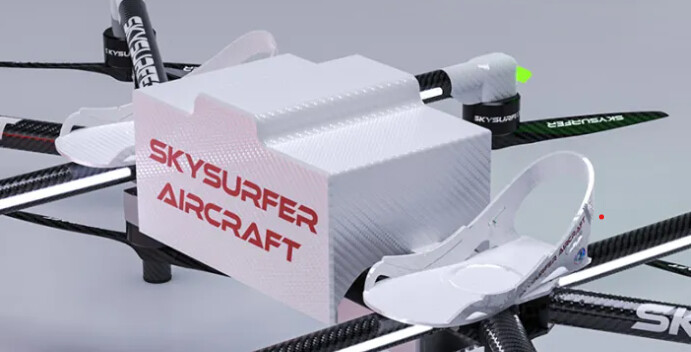
A little one - looks pretty good.
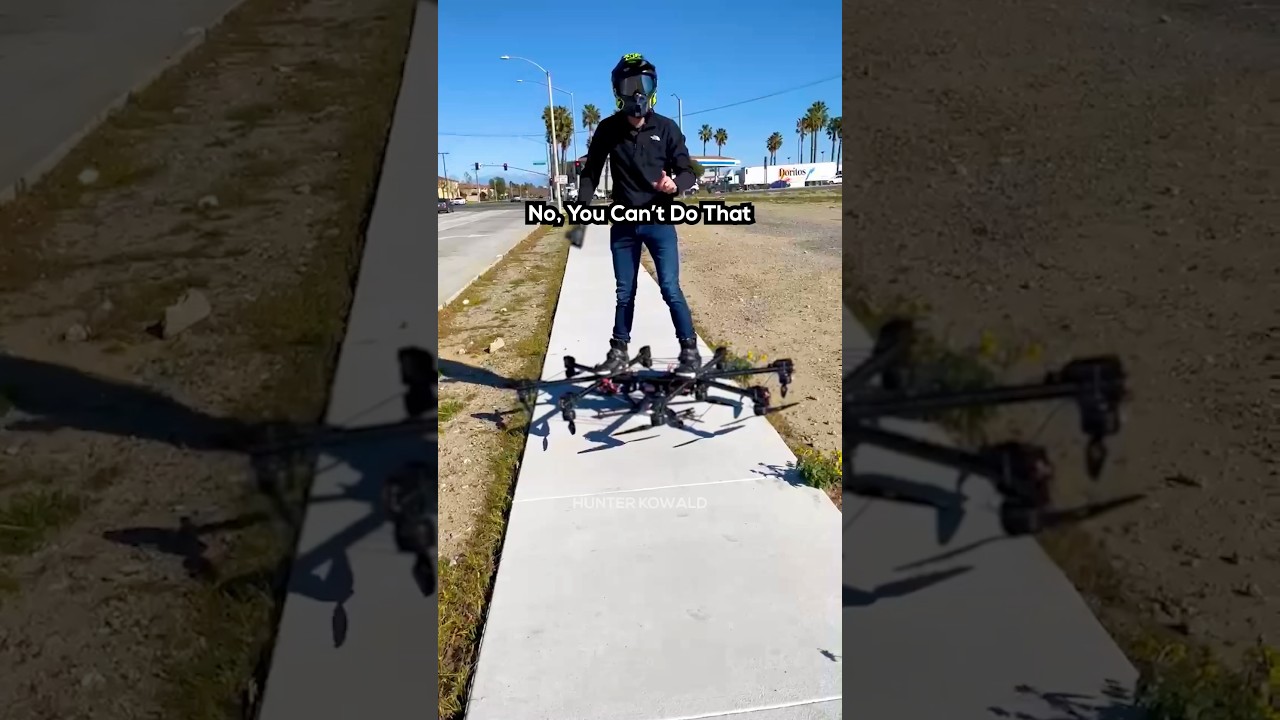
A little one - looks pretty good.
Hi Doug, very impressive. Some information and photos on:
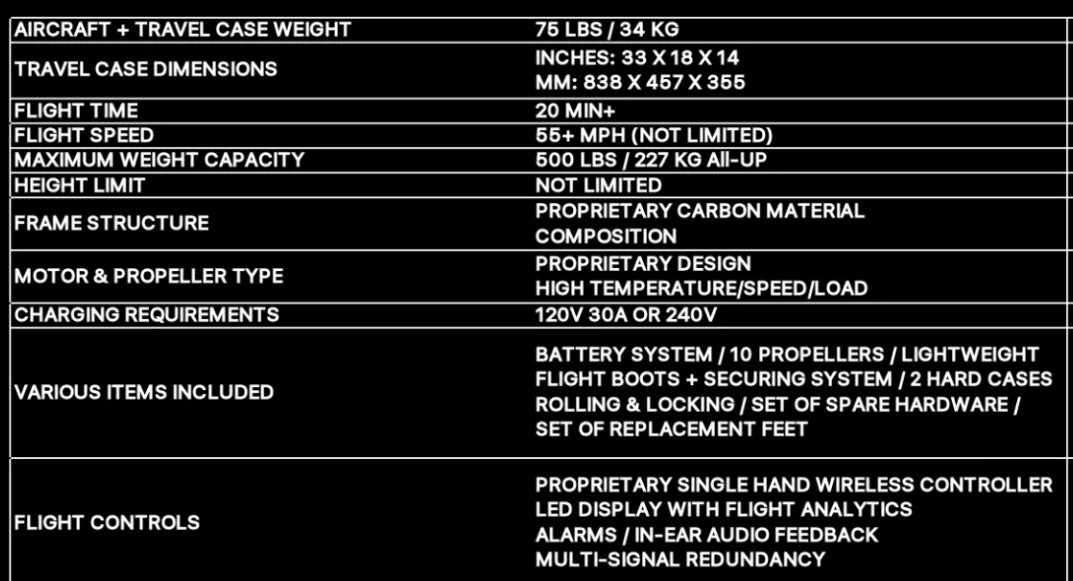
Technical specifications (“aircraft + travel case weight 75 LBS / 34 kg” and other specifications) on:
The speed of 65 MPH (29 meters per second) and the video you linked, indicate that perhaps a crosswind tethered EVTOL AWES version would be a possibility.
Ohhhh nope
Not for me
reminds me of those Kangaroo boots I used to have
Scary
Definitely best to use it for airborne wind energy instead
By the scale of the pack between the foot pads
Looks dangerous to me. There’s a reason these little single-human-carrying drones always fly over water, or stay low enough over land to hopefully survive if anything goes wrong. I’m thinking like broken arms, legs, neck, back, pelvis, or being chopped up by the exposed blades - who knows?
But the performance is impressive, at least from a quick video.
Hey, wait - maybe they could be used to “get one person to the airport quicker”! yes, I think we’ve found the main use case - getting people to the airport - a place where there is access to actual reliable and safe fuel-powered aviation, capable of taking you somewhere over a long distance, hopefully without killing you… 
OK thanks for identifying it Pierre: I went to the website and found, yes, the main “use case” is indeed getting to the airport! Kind of like the main “use case” for “AWE” has become “disaster relief”.
It’s small and light enough to qualify as “luggage”, so what else do you need? Obviously, probably by later this year, people will be flying in to major airports on these, and folding them up as “luggage” to “lug” through the terminal. Unless, wait a minute - will they allow the batteries onboard the airplane?
Will they allow you to fly anywhere near an actual airport in the first place???
Hmmm… maybe time to find a new “use case”. How about getting kids to school? What could possibly go wrong there? How about just going over to your friend’s house? Delivering newspapers? Going to the store? What about “inspecting power lines”? What about using to hike while camping? You could charge it up with that Danish camping windmill!
Of course, being near Los Angeles, it’s found a publicity niche in a Spiderman movie. So funny - living here I look at such movies as nothing but one more “product”, for idiots to waste their time watching - would never watch such repetitive drivel - oh well, call me jaded, and you would be right.
So their website is still talking about how many they have in stock in 2024 (3). Maybe time for an update. But don’t worry - you can put down a $100 deposit! Why is it always “a deposit”? I guess you can’t actually just buy one. I signed up for being sent actual PRICING! They don’t want to put pricing on their website - maybe too scary.
I could see a military use - imagine 100 of them carrying soldiers with machine guns! Look out below! Only thing is, they might make easy targets themselves… :0…
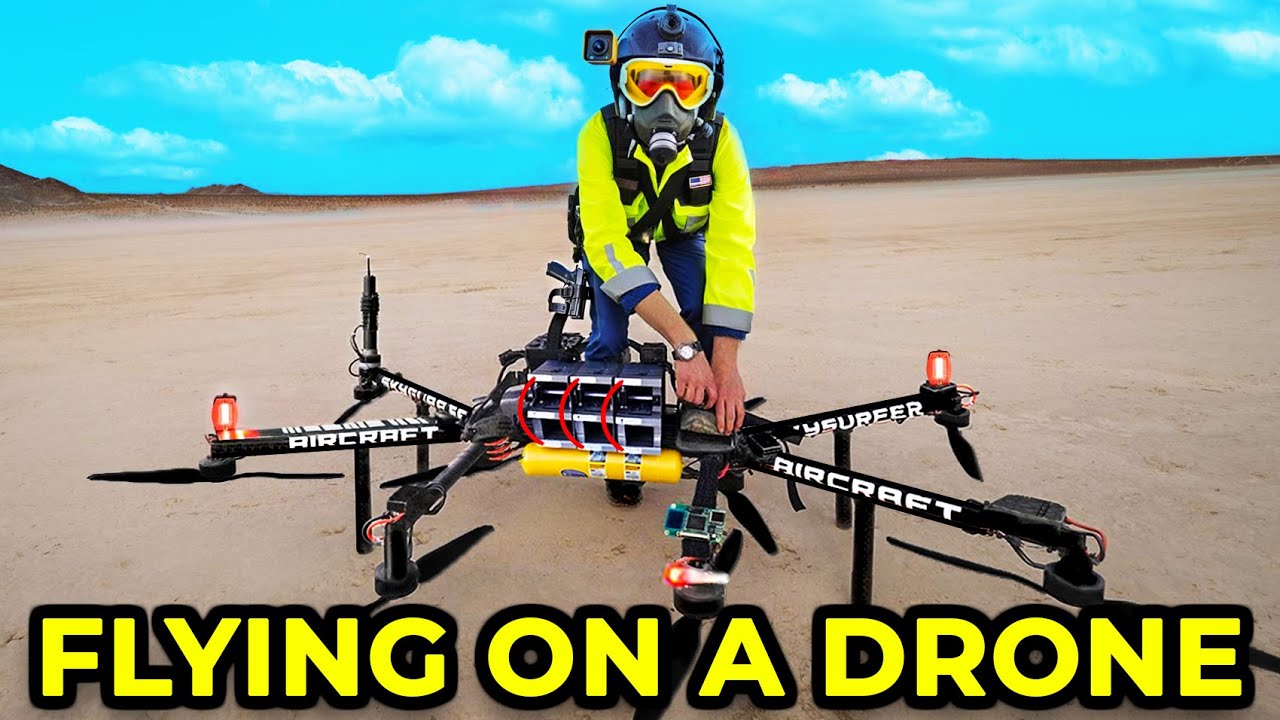
Flying a $78,000 Human Drone Flight Vehicle | SkySurfer Manned Drone / Flying Hoverboard Aircraft
The author of the video is Hunter Kowald and is mentioned, as the founder of SkySurfer Aircraft Inc., on
Not a so good possibility, because reaching relatively high speed (29 m/s) as a kite would lead to a low angle of attack, resulting in a low efficiency of the wind turbines.
Hi Pierre: As you can see in the video, which looks like it was taken near here, our biggest problem is dust!
This is a great entertaining video. The pilot found the answer to dust - fly it in the snow!
Special Operations vet commutes by Flying Car from rural off-grid home
Bloomberg Interview with JoeBen Bevirt of Joby:
This link should take you to the part of the video where they interview him:
Markets Prepare for Nvidia GTC, New FTC Chair on Trump | Bloomberg Technology
They are of course asking when someone will be able to take one of these EVTOL-icopters to the airport,
Remember, it was gonna be 2025?
OK now it looks like the new talking-point year is “2026”…
Well I mean, now that it IS 2025, they kind of HAVE to say that, right?
Still hilarious if you’re Scottish to hear they’re going to be filling the seats in their flying joby


OK I had to look that one up. Yeah, funny.
To me, a big red flag on the EVTOL landscape is the fixation of “4 passengers and a pilot” taking a “trip to airport”, as though that is some huge multi-billion-dollar market that could possibly get them out of the financial holes they are already in - the ones who haven’t yet gone bankrupt like Lillian…
Meanwhile, even before the plane hitting the helicopter in DC, large, busy airports have been trying to get rid of helicopters and even small planes (general aviation) because they are dangerous traffic hazards in such an already crowded and chaotic operational airspace. The LAST thing they need is a whole lot of small flying aircraft, coming in late for the connecting flights, causing more confusion and mid-air collisions!
Once again, it’s part of the delusional derangement syndrome - they are “electric” so they will “save the world”. Except the main thing in aircraft design is low weight (not heavy batteries), and also helicopters have a large rotor for a reason - its more efficient. You may notice all these airport-hopping efforts always mention targeting very short flights - then they have to rest and charge up again. I guess meanwhile they are stranded at the charging station, not makeing any money. So all these companies have a product which, if ever certified, would have limited use, and they are all competing for the same market - going to the airport. Sounds really lame to me.
Like this drone with just two larger rotors being more efficient - comments mention how it will lead back to a helicopter.:
[Falcon Mini bicopter drone: a nimble alternative to quadcopters](Falcon Mini bicopter drone: a nimble alternative to quadcopters
Imagine, supposed aero people, not only targeting heavy batteries to yield a low-range, limited-use aircraft, but using a known less-efficient lifting concept! There’s where the derangement syndrome has taken over their feeble brains.
Then there’s this one, a bit too reminiscent of a vertical-axis wind turbine to be taken too seriously, but hey, who knows, right?
[Falcon Mini bicopter drone: a nimble alternative to quadcopters](Falcon Mini bicopter drone: a nimble alternative to quadcopters
BTW, all the URL info identifying these links as having come from me have been removed!
Lots of eVTOLs and flying cars from China in this video in French.
The market does not seem to be just “going to the airport”, but concerns all urban activities.
It is interesting to see that all the projects or achievements seem to make it possible to occupy the entire urban space, and not just the ground, thus reducing traffic jams.

Hmm. Kitemill currently deploy both prop rpm control and tiltable motor pods in the current actuator system for VTOL. My though is that the tiltable part of the system is slow and hard to implement, compared to having additional thrusters that are permanently fixed.
Coming from this thinking, the Falcon drone doesnt look that great to me
Here’s an article from CleanTechnica, spelling out the EVTOL disaster:
Dwindling List Of EVTOL Firms Shrinks Further - CleanTechnica
Last Updated on: 28th January 2025, 02:27 pm
The inevitable is occurring in the dead end space of Jetsons urban air mobility fantasies. Two more origami rotorcraft have left the vertiport for the great airplane graveyard in the sky as Volocopter disappears and Airbus drops its program.
Volocopter was founded in 2011 in Bruchsal, Germany. Initially named e-Volo, the company gained attention in 2011 with its maiden flight of the Volocopter VC1, the world’s first manned multicopter. Over the years, Volocopter expanded its vision to the fanciful notion of disrupting urban transportation. The company developed several models, including the VoloCity for passenger transport and the VoloDrone for cargo delivery. With significant backing from investors such as Daimler and Intel, Volocopter achieved some milestones, but not many.
Volocopter aimed to showcase its eVTOL technology on a global stage by launching passenger air taxi services during the Paris 2024 Olympics. The company planned to operate its flagship aircraft, the VoloCity, to transport one passenger at a time with perhaps a carry on bag from a barge in the Seine to the Charles de Gaulle airport. Never mind that the RER B train connects Paris Charles de Gaulle Airport (CDG) to central Paris, providing a fast and efficient transit option for travelers. Departing every 10–15 minutes from Terminals 2 and 3, the RER B runs to major Paris stations like Gare du Nord and Châtelet-Les Halles in about 30–40 minutes. It carries an estimated 40,000 passengers and all of their luggage per hour during peak times, serving both airport travelers and local commuters.
That plan failed due to delays in obtaining necessary engine certifications. The company cited issues with a U.S. supplier failing to deliver components on time, which hindered the certification process. Additionally, the project faced criticism from Paris city officials over concerns about noise pollution and the perception that the service would cater exclusively to the wealthy, a completely reasonable observation.
This was, of course, before the FAA released its downdraft testing results on similar multi-rotor eVTOLs and found category 2 hurricane force winds and changed its vertiport requirements to require much larger setbacks and much more restrictive flightpaths. That wouldn’t have made anyone happy if the planned flights in Paris had occurred.
Being unable to get to certification is par for the course for eVTOLs. As I noted late last year when Lilium failed, getting through certification in Europe or North America will cost about $1.5 billion per aircraft model due to all of the novelties inherent in the space. Volocopter was likely among the cheaper ones because it didn’t try to be anything except a helicopter, albeit a multirotor one, foregoing the substantial complexities and risks associated with transitioning to horizontal flight, typically with tilting rotors, wings or other components.
When I first looked at the space a few years ago it was clear that it was a safety nightmare. There’s a reason why the only aircraft in service that transition from vertical to horizontal flight are military. The mission profiles of military aircraft and military acceptance of risk are radically different than any civilian equivalent. The one I pointed at was the Bell Boeing V-22 Osprey, the tilt wing aircraft that kept falling out of the sky. It’s still doing it.
In August 2023, an MV-22B Osprey crashed on Melville Island, Australia, during a training exercise, killing three U.S. Marines. Later, in November 2023, a CV-22B Osprey crashed into the East China Sea near Japan, killing eight airmen after a catastrophic failure in the left-hand proprotor gearbox led to an unrecoverable loss of control. Most recently, in December 2024, the Pentagon grounded the entire Osprey fleet after a near-crash in New Mexico revealed widespread metal fatigue in critical components.
Meanwhile, the flagship jet VTOL, the F-35B Lightning II, keeps crashing, with ground personnel not removing engine covers being a leading cause. In November 2021, an F-35B launched from the HMS Queen Elizabeth crashed into the Mediterranean Sea due to a failure to remove an engine intake cover, with the pilot ejecting safely. Shortly after, in the same month, another F-35B from the USS Carl Vinson fell into the South China Sea following a mishap during landing, prompting a complex recovery operation to secure the sensitive technology. Most recently, in December 2022, an F-35B crashed during a test flight in Texas after losing stability during a hover, reportedly linked to a pre-flight inspection lapse.
Thankfully no one has been killed due to the F35B, unlike the Osprey. It’s worth noting that none of these crashes were because the planes were shot down and they weren’t even in war zones. VTOL is just hard.
As I noted a couple of months ago, Rolls Royce had already left the vertiport, shuttering their Advanced Air Mobility division because no one was buying their products. That left three big manufacturers with eVTOL initiatives, Airbus with its CityAirbus NextGen, Boeing with its Wisk Aero joint venture with Google founder Larry Page’s Kitty Hawk, and Embraer with its Eve Air Mobility subsidiary. But now there are only two as Airbus has abandoned its CityBus program.
The first CityAirbus demonstrator, featuring four ducted fans and designed to carry four passengers, conducted its maiden unmanned flight in May 2019. Drawing on lessons from both this project and the earlier single-passenger Vahana prototype, Airbus unveiled the CityAirbus NextGen in September 2021. This updated version introduced a fixed-wing design with eight propellers, a range of 80 kilometers, and a cruising speed of 120 km/h. In March 2024, Airbus showcased the NextGen prototype at its facility in Donauwörth, Germany, ahead of its maiden flight, reaffirming its commitment to advancing urban air mobility solutions.
So much for commitment. Airbus has announced a pause in the development of its CityAirbus, citing concerns over the current maturity of battery technology. According to Airbus Helicopters CEO Bruno Even, the decision follows a strategic review concluding that existing battery performance does not meet the requirements for the aircraft’s intended missions. The company plans to complete the ongoing flight-test campaign before halting further development at the end of 2025.
The lack of sufficient battery energy density, even with CATL’s new 500 Wh/kg batteries targeted at aviation, is exactly zero surprise to anyone paying attention. While battery energy density is increasing rapidly, it’s been obviously insufficient for the extreme requirements of passenger carrying rotorcraft over cities requiring 1000 foot above tallest building flights leading to extended high power climbing and descending drains. This was something that was clear years ago, and while I’m very battery optimistic, it was clear it wasn’t going to be resolved in under a decade.
This is especially problematic for eVTOLs as the descent phase would be when the battery would be in the lower half of charge and hence have both less power to deal with emergency situations and significantly reduced divert capabilities. This isn’t particularly a concern for fixed wing electric aircraft, by the way, because they aren’t trying to beat the air into submission, but to seduce it with very aerodynamic and typically high aspect ratio wings.
On that note, in late December 2024, China’s Civil Aviation Administration (CAAC) granted type certification to the RX4E under General Aviation Aircraft standards, marking the world’s first fully electric general aviation aircraft to receive such approval. Developed by the Liaoning General Aviation Academy, the RX4E is a four-seat, light propeller aircraft powered by a lithium battery system. The aircraft features a wingspan of 13.5 meters, a length of 8.4 meters, and a maximum takeoff weight of 1,260 kilograms. It is capable of a maximum flight time of 1.5 hours. By contrast, the two-seater Pipistrel is certified under Light Sport Aircraft standards.
This leaves the eHang customer Cuisinart as the sole certified electric rotorcraft. Like the Volocopter, it doesn’t twist, bend or fold, simplifying things considerably. It also has no pilot, being operated somewhat autonomously with ground oversight. It’s now commencing sightseeing flights in Shanghai along the river it seems, so has managed to get out of rural fairground ride certification into urban fairground ride territory. No price point has been disclosed for the flights, but one assumes that they are catering exclusively to the wealthy, something Shanghai officials have less concerns about than Parisian ones.
There aren’t many players left. Boeing and Embraer still have their marketing programs, but with Rolls Royce and Airbus leaving the vertiport, I expect these two will fly their programs into the graveyard of airplanes soon.
Joby will limp along for a while longer. It’s managed to get through the first three of five phases of certification, but it’s about to get tougher. The fourth and fifth stages of the FAA’s type certification process are the most time-consuming and expensive for aircraft manufacturers. The fourth stage involves extensive testing and compliance demonstrations, including flight tests and system evaluations under FAA oversight, to ensure the aircraft meets stringent safety and performance standards. The fifth stage finalizes operational approvals, requiring production processes, training programs, and operational manuals to align with regulatory requirements. These phases demand significant resources, specialized facilities, and close collaboration with regulators, with delays or modifications potentially adding substantial costs. Despite their complexity, these stages are critical to achieving certification and enabling commercial operations.
Meanwhile, in January 2025, industry experts indicated that the FAA is unlikely to issue type certifications for eVTOL aircraft before 2027 after a big meeting where FAA laid out its priorities. This projection stems from ongoing testing and data collection efforts, with critical evaluations expected to extend into 2026. Consequently, the results necessary for establishing comprehensive standards and regulations may not be available until mid-2027.
That means Joby has years more before it gets to the point where it might be in operation, assuming it actually gets through the certification process and any vertiports get built to meet the new FAA requirements for much bigger setbacks and much more restrictive flight paths. It’s well enough funded that it will probably last through 2025 at least, but it’s burning money for a non-existent business case, so it will join the rest of the firms eventually.

It is a very long article about the advantages of EVTOL, particularly in difficult geographical areas, such as mountainous and densely populated regions of China. “Joby Aviation’s S4 eVTOL” is also mentioned.
My opinion is that if China is so interested in EVTOL, it is likely that there is a large market.
A publication about Centrifugally Stiffened Rotor (CSR) is available on:
Indeed this publication is interesting. For example, see, page 14:
Figure 1.5: Lift load distribution on CSR concept versus conventional wing configuration.
Hi Doug,
The author is Michael Barnard. He is also the author of some AWE articles (Airborne Wind Energy: It's All Platypuses Instead Of Cheetahs - CleanTechnica) discussed on Barnard’s predictions - Analysis / Industry and Market Analysis - AWESystems Forum.
And as you know, Mike Barnard does not favor hydrogen:
Concerning EVTOL (since this topic is dedicated to it), see also other sources, for exemple on EVTOL drones to carry people - Lounge - AWESystems Forum.
An excerpt:
Electric aviation is still advancing, but in a different direction. Conventional electric CTOL aircraft are moving toward certification and can fit into existing airport infrastructure, with a four passenger CTOL fully certified in China and the Pipistrel trainer leading. They avoid the peak power problem of vertical lift and can serve short haul routes with real payloads.
Hi Guys!
Just saw this article about Wisk Aero, supported by Boeing, having their first flight, lasting 30 seconds.
Of course the article has to use the term “game-changing”, right? I’m dumbfounded. How many years have we heard about “Wisk”, and they just now flew a full-size version? OMG what have they been doing???
Before that, Joby, an early AWE “player”, actually made a flight between two airports, after 17 years of “development”.
Joby’s Flying Taxi Makes Its First Test Flight Between US Airports - Business Insider
Mind you that anyone could build a kitplane, light-sport, ultralight, powered hang glider, or even just put on a powered parachute, and fly between two airports right away.
I remain completely amazed at this lack of progress in the EVTOL space. It is like an AWE deja vu, in that even skeptical me didn’t think it would be this bad!
One big clue is the general lack of efforts toward simply electrifying a helicopter, a design that superseded the multirotor approach 100 years ago due to higher efficiency and better safety, including fewer failure points, and the ability to glide down in autorotation in the event of a power failure.
I think the reason for few attempts at electrifying helicopters is it entails a direct comparison between gas and battery power, with too glaring of an advantage for gas, as opposed to a multi-ton flying battery forced into existence by the spectre of saving the world.
So Joby buys “blade”, the leading “fly us to the airport” helicopter chartering company.
Electric air taxi company Joby to acquire helicopter passenger business Blade - YouTube
This looks like a strategic move preparing for future dominance, but smells more like a “plan B” face-saving maneuver, only possible because fools have supplied too many billions for Joby to spend on its own aircraft, which may never emerge as a commercial success, at this rate.
Anyway, 2025 WAS supposed to have been the year when we would find ourselves flying to the airport to catch our jet flights in EVTOL’s.
Question, as 2025 ends, has anyone taken an EVTOL to the airport? Does this sound familiar at all?