An earlier topic: Teaching a glider to soar using reinforcement learning in the field
Links to more info and related topics here.
An earlier topic: Teaching a glider to soar using reinforcement learning in the field
Links to more info and related topics here.
…
Original topic: Swiss researchers invent drone-flying AI that tops champions

Autonomous Drone Racing with Deep Reinforcement Learning - YouTube
Off-topic here, but still on kite control:
A few thoughts on this use for Reinforcement Learning(RL):
An alternative to reinforcement learning is transfer learning, or supervised learning, by which both a human’s “correct” control actions and the physical state of the controlled system (= kite’s speed, acceleration, position, orientation, etc..) are measured for an amount of time to collect sufficient data to feed a learning algorithm that directly learns from real-world data.
The advantages here are
Some disadvantages still persist, e.g. not having recorded data on unexpected circumstances and possibly a long amount of human work spent on handling a real kite. But IMO it might be easier to handle a kite for days or weeks to collect sufficient data instead of attempting to develop a simulation of same kite.
If only because it is more fun and a more available domain of expertise.
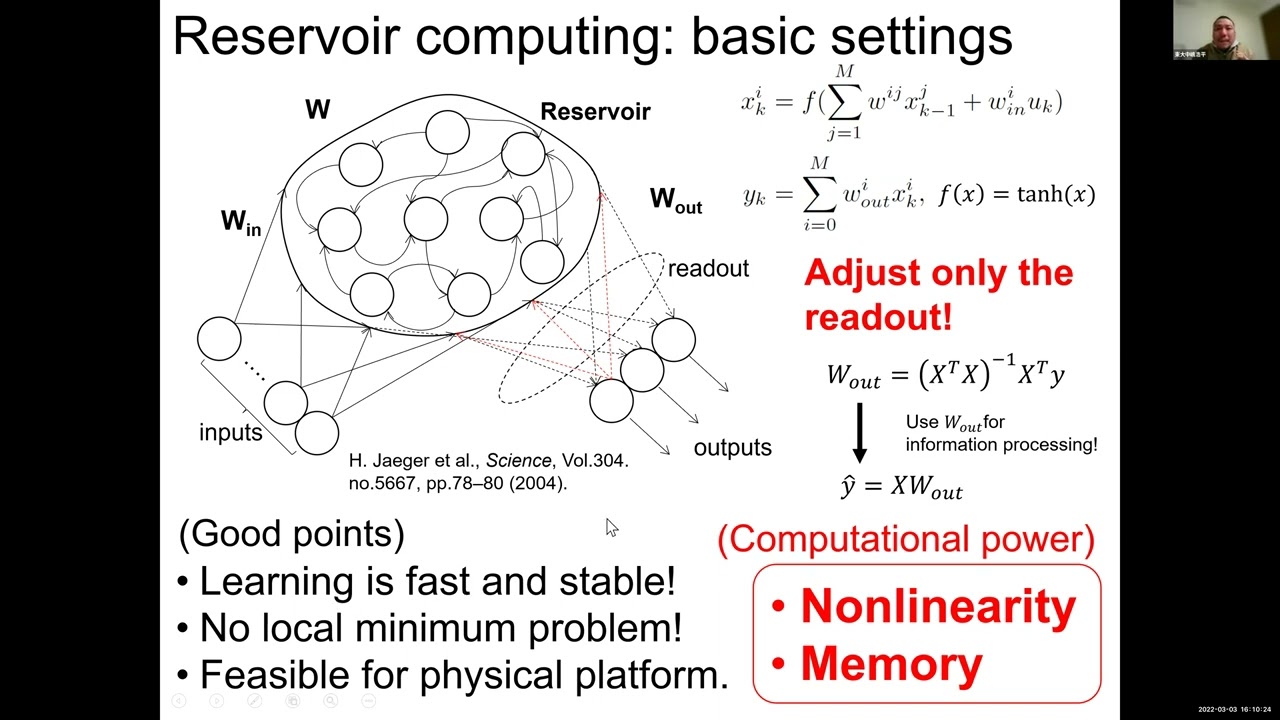
What do you want to show about reservoir computing?
I hadn’t heard of it before. It seems like another way to do flight control, but more efficient; thousands to millions of times less data and computer time needed for training compared to deep learning, Daniel Gauthier: https://youtu.be/wbH4En-k5Gs?t=848
The time-stamped link in my previous comment showed a practical application.
Ah, ok here it is in a different topic. I’m quite fond of reservoirs, they make sense for dynamic awareness and control in robots and drones. And likely kites too.
Just a couple notes
Gauthier’s “next generation” reservoirs are just one unorthodox approach to this kind of computation. They may be better on certain problems. What I got from other papers is it tends to be more expensive computationally, but I don’t know what exactly that means.
I mentioned above collecting human-controlled flight data for transfer learning - Compared to classical deep-learning, reservoirs tend to be very sample efficient that means comparatively they need very little data to learn a dynamic pattern.
The same real-kite collected data might also be useful to imitate the dynamic response of the kite, that means a trained reservoir might replace a simulation using a physics engine. A most challenging part in robotic development via reinforcement learning is transferring the trained behavior from simulation to the real system.